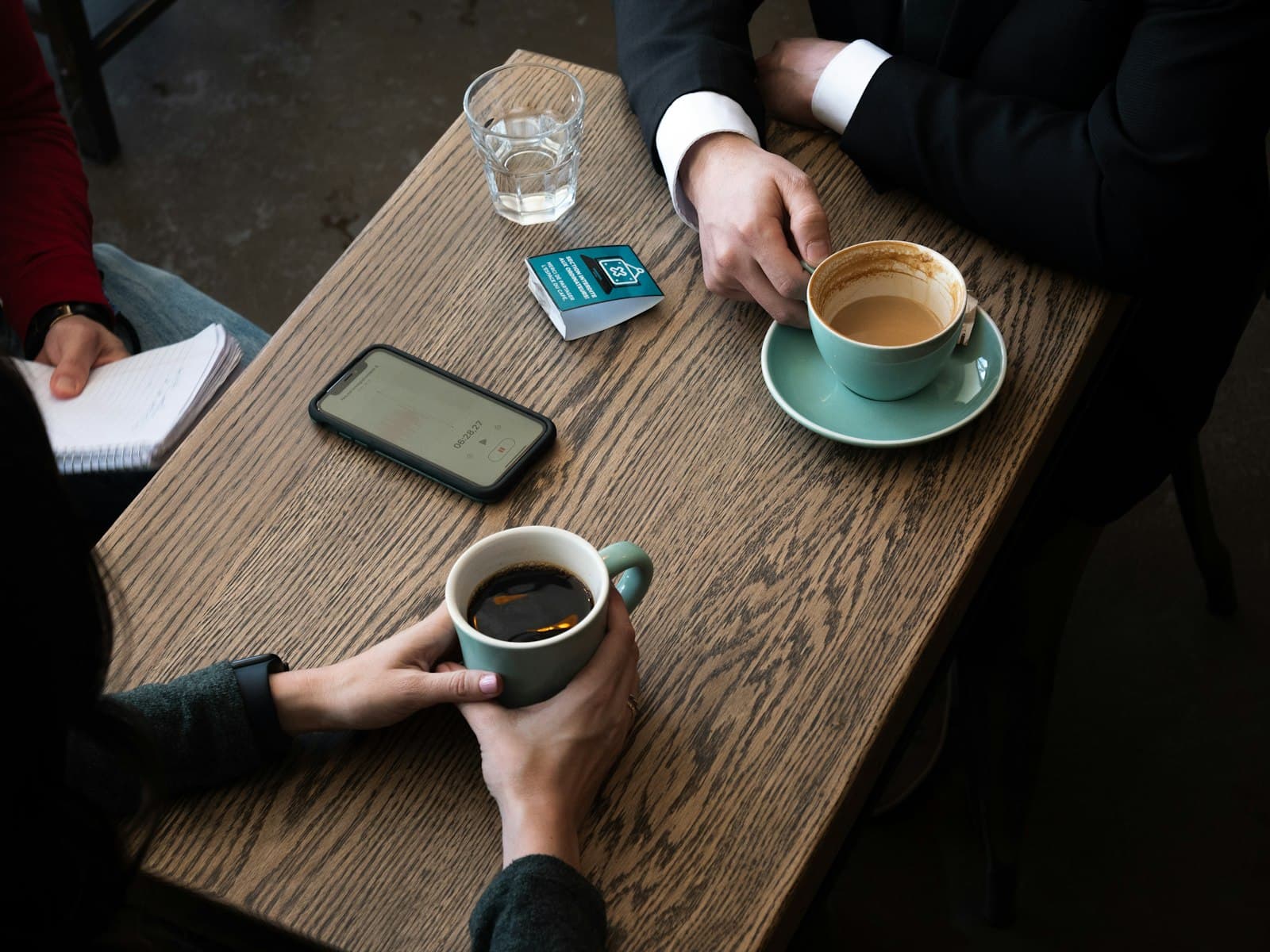
The hardest part of dating with IBS is usually not the symptoms. It is the decision you have to make over and over about who gets told, when, and in how much detail, with almost no information about how the person in front of you is going to take it.
Every article that ranks for this keyword tells you the same three things: be open, plan a non-food date, and manage your stress. That advice is not wrong, but none of the pages currently ranking for "dating with IBS" cites a single study, and the biggest one is built from testimonials collected on Instagram sitting next to a link to the author's paid programme. Meanwhile there is a small but real body of research on exactly the thing that makes this hard: how people actually react to IBS compared with other conditions, what restricting food around social events does over time, and what happens to intimacy. This guide is built on that, plus what people in the IBS community describe in their own threads.
The short answer: this is a disclosure problem wearing a symptom costume
You can control most of the symptom variables on a date. You can pick the place, the time, the food and the length. What you cannot control is the other person's reaction to the sentence "I have IBS", and that is the part almost every guide skates over with the reassurance that most people are understanding.
The one study that has tested this directly suggests the reassurance is shakier than it sounds. Researchers recruited an online cohort, randomly assigned each participant one of six clinical vignettes describing a man or a woman with IBS, with IBD, or with adult-onset asthma, and then measured enacted stigma, meaning the discriminatory attitudes people were willing to express toward that person. Participants reported higher levels of enacted stigma toward IBS than toward either IBD or asthma. There was no difference between IBD and asthma (Taft 2017).
That is a vignette study in a self-selected online sample, so it measures expressed attitudes rather than what someone does on a third date. But it is the closest thing we have to an answer, and it points the opposite way to the standard advice. A condition with no visible marker, no blood test and a name that still gets used as a punchline is treated worse than a condition people have heard of. This also explains something the threads are full of: the difference between a partner who says "that sounds hard" and a partner who says "have you tried not stressing about it" is not really about you.
The same research group found that familiarity with the condition tracked with lower stigma, most strongly for IBD (Taft 2017). Practically, that means the first reaction is not always the final one. Someone who has never heard of IBS beyond an advert has nothing to work with. Someone who has spent twenty minutes understanding what a bad day involves often behaves differently.
Why a date is a harder test than a normal meal out
A date stacks several independent problems on top of each other, which is why "it is just nerves" undersells it.
Anticipatory gut-specific anxiety. The Visceral Sensitivity Index measures gastrointestinal-specific anxiety, meaning fear of gut symptoms and of the situations where they might happen, as distinct from general anxiety. In two undergraduate student samples of more than 500 people each, GI-specific anxiety mediated the relationship between broader emotional distress and IBS symptoms, rather than general anxiety doing the work (Labus 2007). A later comparison of 222 matched participants found mean VSI scores of 38.8 in IBS, 26.6 in IBD and 3.4 in healthy controls (Trieschmann 2022). The fear of the symptom is measurably its own thing, and dates are built to provoke exactly it.
An unfamiliar, usually larger meal. Food-related symptoms are near-universal in IBS. Among 197 patients asked about 56 food items, 84% reported symptoms related to at least one, and reporting food-related symptoms was associated with more severe symptoms and lower quality of life (Bohn 2013). That is self-report, not a challenge test, but a restaurant portion you did not cook is a poor place to find out.
Alcohol, usually more of it than normal. Covered properly in does alcohol make IBS worse, so one line here: a drink is doing several things at once and a first date is when people drink more than they meant to.
Timing you did not choose. Evening dinners land the meal in the window where a lot of people are already worse, and they sit on top of a day of anticipation. If your symptoms follow a predictable clock, why does my IBS flare up in the morning and how long after eating does IBS flare up are the two posts to read before you pick a time.
Four variables, all moving, all at once. Any one of them alone would be manageable. The reason dating feels disproportionately hard is that a conventional date is designed to move all four in the wrong direction on the same evening.
When to tell someone: what the evidence can and cannot settle
There is no trial of disclosure timing in IBS. Anyone who tells you "tell them on date three" invented that number. What we can say is what the two failure modes look like and how to avoid both.
Failure mode one: disclosing under duress. The worst version of this conversation is the one you have while in pain, mid-date, after twenty minutes in a bathroom, when you are distressed and the other person is confused. You end up explaining a chronic condition in the least flattering possible frame, and often over-explaining because you are rattled.
Failure mode two: concealment for so long that the disclosure becomes an event. Qualitative work on long-term IBS describes people organising daily life around control: disciplined self-care, control over routines, self-centredness in the sense of having to keep attention on their own body, alongside a search for social support (Jakobsson Ung 2013). A qualitative systematic review of 17 studies and 299 adults found social consequences as one of four dominant themes across the literature (Shorey 2021). The longer the management is invisible, the bigger the reveal feels, even though nothing about the condition changed.
A staged approach avoids both. It is not clever, but it is what people who date successfully with this seem to converge on:
| Stage | What you say | What it is for |
|---|---|---|
| Before the first date | "I am fussy about food, can we do coffee instead of dinner?" | Gets you the format you need with no diagnosis attached |
| On the date, if it comes up | "I have a gut condition, so I am careful about where I eat. Nothing dramatic." | A reason, flatly delivered, that does not invite interrogation |
| Once you like them | "It is called IBS. Mostly it means X. Sometimes I have to bail on things." | The real version, given while calm, with a concrete example |
| Before overnight stays | Practicalities: bathroom, food that evening, your own way home | Removes the specific things people actually panic about |
| If it gets serious | What a bad week looks like, and what helps and does not | Lets them get it right instead of guessing |
The point of staging is not secrecy. It is that you get to choose the conditions of the conversation, and you collect evidence about the person before handing over something they can be unkind about.
A thread in r/ibs from someone in their early twenties asked exactly this: every guy suggests lunch or dinner, and they eat only a handful of ingredients, so how do you explain that (r/ibs thread). The highest-voted replies split into two camps that map onto this table. One camp suggested a small placeholder such as "food allergy" early, opening up as things get serious. The other argued for being upfront on principle, on the grounds that it filters out people who would be a problem later. One reply described being upfront before a first date, having the person decide on the date that they could not be with someone that careful about eating out, and coming away with a friend and no hard feelings. Both approaches are defensible. What the thread does not contain is any version where waiting until it went badly worked well.
First dates: fix the format, not the menu
Dinner is the default first date in a lot of places, and it is the worst available format for almost everyone with IBS. It is long, it is food-centred, it is hard to leave early without an explanation, it usually happens in the evening, and it involves a menu you did not write.
What makes a format work is not whether food is present. It is four things:
- Short by design. Forty-five minutes to an hour, with a natural end. A coffee has one. A three-course meal does not.
- Easy to exit. You can leave without it being a story. Separate transport matters more than people expect.
- Bathroom access you have confirmed. Not hoped for. Confirmed, because you have been there, or because it is the sort of venue that obviously has one.
- Not built around eating something new. If food is involved, it should be something you have eaten before, at a place you have been.
Formats that satisfy all four: coffee or tea somewhere you have been; a gallery or museum; a walk in a park with facilities; a market; a bookshop; a daytime drink. Formats that fail at least two: a tasting menu; a long hike; a festival; a drive somewhere remote; anything where you are a passenger in someone else's car for more than half an hour; a cinema, if urgency is your main problem, although a cinema is fine if bloating and pain are.
A post that drew around 290 upvotes in r/ibs was titled simply as a plea for luck before an all-day date with someone the poster really liked (r/ibs thread). The title alone is the lesson. The all-day format is the one that produces dread, because it removes every exit.
If proposing the plan is itself the sticking point, note that suggesting the date is usually welcomed rather than resented. You are doing work the other person would otherwise have to do.
Eating before, during and after a date
There is no meal plan here, because there should not be one. What there is: a few patterns that come up repeatedly and what the evidence says about them.
The pre-date fast. Eating nothing all day so that there is nothing to go wrong is extremely common and it backfires in two ways. It usually means you arrive very hungry and then eat a large unfamiliar meal, which is the exact scenario you were trying to avoid. And over time it narrows what you eat.
That narrowing is the risk worth naming. In a retrospective chart review of 495 consecutive referrals to adult and paediatric neurogastroenterology clinics, 39% had a history of exclusion diets and 24% had symptoms of avoidant restrictive food intake disorder, a non-body-image eating disorder driven by fear of aversive consequences. Where documented, the exclusion diets were self-initiated by the patient in 66% of cases (Atkins 2023). A scoping review of 18 studies found ARFID symptom prevalence in neurogastroenterology patients ranging from 10% to 80% depending on the setting and the tool used (Mikhael-Moussa 2025), and a small tertiary-clinic analysis of 33 refractory patients found 82% met some form of the core ARFID criterion, dropping to 33% when strict severity thresholds were applied (Martin 2025). Those are specialist clinic populations, not everyone with IBS, and the wide range reflects how unsettled the measurement is. The direction is still clear enough to take seriously. We cover this at length in can the low FODMAP diet cause an eating disorder.
The safe-meal-beforehand approach. Eating a familiar, moderate meal a couple of hours before, then having something small on the date, avoids both the fast and the large unfamiliar plate. It is not risk-free and it does not work for everyone, but it fails less often than the alternatives.
Portion and stacking, not ingredient bans. Several small amounts of moderately fermentable foods across one evening can add up to more than one obvious trigger would, which is why the "I avoided my trigger foods and still reacted" post is so common. FODMAP stacking examples walks through the arithmetic. If you are in the middle of a structured low FODMAP trial, that is a short, supervised elimination with a planned reintroduction phase, ideally run with a dietitian, and a run of dates is a genuinely awkward time to be in the restriction phase. It is worth timing around if you can.
Afterwards. If something did go wrong, log what actually happened rather than reconstructing it a week later. This is where a tracker earns its place: Clairop records meals by voice or barcode and looks for patterns with a delay window, which matters because the reaction to a Friday dinner may not show up until Saturday. Guessing at one-off events is how people end up avoiding foods that were never the problem, which how to keep a food diary for IBS covers in detail.
Clairop logs meals, symptoms and stool in seconds, then looks for the foods your gut reacts to, including reactions that land days later.
Cancelling, and what repeated cancelling actually costs
Cancelling is the part people apologise for hardest and handle worst. Two things help.
Be specific rather than vague. "Something came up" is the least credible sentence in dating, and using it repeatedly for a real reason trains the other person to doubt you. "My gut has gone badly wrong today, I would be terrible company" is more believable precisely because it is more awkward.
Reschedule in the same message. The signal people read from a cancellation is not "they are unwell", it is "they are losing interest". Naming a specific alternative day removes that reading entirely.
There is a subtler cost to watch. If every plan that involves leaving the house gets cancelled, the world quietly shrinks, and then the anticipation before the next plan is worse than it was before. That loop, and what actually breaks it, is the subject of IBS anxiety about leaving the house. It is worth reading if you notice that you are now cancelling plans you would have kept a year ago, because the evidence-based response to that pattern is structured and graded rather than white-knuckled.
Sex and intimacy: the section nobody writes
This is the part people are actually anxious about and it is missing from essentially every page ranking for this keyword. The research is imperfect, but it exists.
The clinical silence is measured. In a multimethod study of 480 adults with inflammatory bowel disease, 39.2% wanted sexual health information from a healthcare provider, but only 5.7% both wanted and received it (Fretz 2024). That is an IBD sample, not IBS, so read it as evidence about how gastroenterology handles the topic rather than about IBS specifically. The gap between wanting the conversation and getting it is enormous.
What people describe. A phenomenological study of 43 people with IBD framed the experience as grieving multiple losses: body image, control, choice of partners and future opportunities (Fourie 2024). A separate study of 19 adults with Crohn's disease or ulcerative colitis in southern Italy found that stigmatisation of symptoms such as incontinence and bloating led people to withdraw from physical intimacy (Mercuri 2026). Qualitative work on body image in IBD found that participants evaluated their bodies primarily by function rather than appearance, and described the unpredictability and invisibility of the condition as central to how they felt seen (Pellizzer 2026). Again, all IBD samples. They are the best-studied proxy and the mechanisms they describe, unpredictability, invisibility, bloating, fear of an accident, are not IBD-specific.
The IBS-specific numbers, with caveats attached. A cross-sectional study of 504 Jordanian women, 279 of them with IBS, found that 88.2% of the IBS group scored below the Female Sexual Function Index cutoff of 26.55, compared with 76% of the group without IBS, an odds ratio of 2.35, with lower mean scores across desire, arousal, lubrication, orgasm and satisfaction (Dwairi 2026). Two things to note honestly: the rate in the comparison group was also very high, which suggests the questionnaire cutoff is flagging a great many people in this population, and a cross-sectional design cannot tell you which came first. A smaller Iranian study comparing three groups of 49 (IBS, depression without IBS, and healthy controls) found sexual function differed significantly across all three groups, and that depression alone did not account for the difference in the IBS group (Keshavarzi 2025). Small, single-centre, and not necessarily generalisable, but it points at the same thing: this is not purely a mood effect.
What helps, practically. Bloating that changes through the day is a real factor and not vanity; IBS bloating that makes you look pregnant explains why distension often peaks in the evening, which is also when most people have sex. Timing around your own pattern, rather than around what a date is supposed to look like, is legitimate. And if pain during sex is part of this for you, that is a specific symptom to raise with a doctor rather than something to absorb, because several causes of it are treatable and some have nothing to do with IBS.
Staying over: the first nights
The recurring fear in the threads is not sex. It is bathroom noise, needing the bathroom at 3am in an unfamiliar flat, and having nothing of your own with you.
What reduces it, in roughly the order people find useful:
- Host first if you can. Your bathroom, your food, your timing. Most of the fear disappears at home.
- Bring your own kit rather than improvising from their cupboard. What that contains is personal, but not having to ask is the point.
- Have your own way home. Knowing you can leave at 6am without a conversation removes a surprising amount of the dread.
- Decide about the evening meal in advance, because the "we will just get something" plan is how people end up eating a takeaway they have never had before at 10pm.
- Say the practical line out loud beforehand. Something like "I might be up in the night, it is a gut thing, ignore me" takes ten seconds and pre-empts the whole 3am problem.
One genuine caveat on the emergency-kit habit: in cognitive behavioural terms, some preparations reduce risk and some are safety behaviours that quietly maintain the fear by making it feel necessary. The line between them is whether the item actually gets used. That distinction is worked through in IBS anxiety about leaving the house.
And one clinical note. If your symptoms genuinely wake you from sleep, rather than keeping you from falling asleep, that is not a dating logistics issue. Nocturnal waking with gut symptoms is one of the features that prompts a closer look for something other than IBS, and it deserves a doctor's assessment promptly. Is IBS waking me up at night explains why.
"I want to date someone who also has IBS": the honest answer
This is one of the most consistently upvoted sentiments in r/ibs. A post simply saying the community needs a dating app for people with IBS drew hundreds of upvotes and ninety comments (r/ibs thread). Another, framed as a gentle rant, explained the appeal precisely: not a partner who finds you attractive despite the symptoms, but one for whom the symptoms are simply unremarkable (r/ibs thread).
Here is the honest position. No study has ever tested whether a partner who shares your diagnosis produces better outcomes, in symptoms, relationship satisfaction or anything else. There is no published evaluation of any IBS-specific dating app, because there is no established IBS-specific dating app. The repeated threads asking for one are asking precisely because it does not exist.
What the threads do contain is both sides of the argument, and it is worth seeing both:
- People with a partner who also has IBS describing instant, wordless understanding, no negotiation about cancelled plans, and no embarrassment.
- People with a partner who has no GI problems at all describing exactly the same support: a partner who went dairy-free with them, who treats a cancelled evening as a night in rather than a disappointment, who did not need to share the condition to take it seriously.
- People saying plainly that they are too unwell to take on a partner with significant health needs as well as their own, and that what they need is empathy, not a matching diagnosis.
Read together, the variable that does the work is responsiveness, not diagnosis. Two people with IBS can still have an unkind relationship, and one of the more practical risks nobody mentions is mutual accommodation: two people who both find leaving the house hard can very easily stop leaving the house, and that is the loop that makes avoidance worse rather than better.
There is one thing the shared-diagnosis wish gets exactly right. It is the wish to stop being the person who has to explain. That is a reasonable thing to want, and it is also achievable with a partner who does not have IBS, through information rather than shared experience, which is what the familiarity finding in the stigma research points at (Taft 2017).
On apps: if you do find a chronic-illness dating app, treat it as an unregulated consumer product. You would be putting a medical diagnosis into a commercial profile. Read what the app says it does with that before you do.
What a genuinely supportive partner does
Very little research addresses this directly in IBS, so this section is deliberately short and clearly labelled.
An old and small study, 53 people with IBS or recurrent headache, found that IBS patients, whose symptoms the authors described as embarrassing, reported fewer instances of tangible assistance than people with headache, while rating the main types of support as equally helpful (Martin 1994). It is from 1994 and the sample is tiny, so treat it as a hypothesis rather than a fact. But the hypothesis is interesting: people may want practical help and not get offered it, because the symptom is embarrassing rather than because the support is unavailable.
Analysis of an online IBS support community found that its dominant function was informational support: symptom interpretation, illness management and navigating healthcare (Coulson 2005). That is what people go looking for when it is not available closer to home.
Stigma research consistently finds that internalised stigma, the version you turn on yourself, predicts worse outcomes. In 191 people with IBD, 36% reported internalised stigma, and it related strongly to poorer quality of life, more psychological distress, lower self-esteem and lower self-efficacy (Taft 2013); a systematic review across IBD found stigma linked to quality of life, psychological functioning and treatment adherence (Taft 2016); and a study of 149 people with eosinophilic gastrointestinal disorders found greater internalised stigma associated with poorer disease-specific quality of life and higher anxiety and depression (Guadagnoli 2020). None of these are IBS dating studies. Together they make a modest and defensible point: how you are treated about this, including by a partner, is not cosmetic.
So in plain terms, the behaviours worth looking for are the unremarkable ones. Adjusting a plan without making it a discussion. Asking what helps rather than suggesting a remedy they read about. Not commenting on what you order. Treating a cancelled evening as a changed evening. Those are observable within a few weeks, which is useful, because they are better evidence than anything the person says about how understanding they are.
Does treating the IBS make dating easier?
Partly, and the trials that show it measured social functioning, not just bowel habit, which is unusual and useful here.
CBT tailored to IBS. The ACTIB trial randomised 558 adults with refractory IBS to therapist-delivered telephone CBT, web-based CBT with minimal therapist support, or treatment as usual. At the 24-month follow-up, with outcomes available for 58% of participants, mean IBS Symptom Severity Score was 40.5 points lower in the telephone-CBT group than usual care (95% CI 15.0 to 66.0, p=0.002), while the web-CBT difference of 12.9 points was not statistically significant. On the Work and Social Adjustment Scale, which is the outcome that matters most for this article, both CBT groups did better than usual care: 3.1 points for telephone CBT and 1.9 points for web CBT (Everitt 2019). The authors note that some gains had faded relative to the 12-month results, and the follow-up was not prespecified. It was funded by the UK National Institute for Health Research.
Gut-directed hypnotherapy. The IMAGINE trial randomised 354 patients in the Netherlands to individual hypnotherapy, group hypnotherapy, or group educational supportive therapy. In the intention-to-treat analysis, adequate relief at 12 months was reported by 40.8% of the individual hypnotherapy group, 49.5% of the group hypnotherapy group and 22.6% of controls, with hypnotherapy more effective than control at both 3 and 12 months (Flik 2019). Group delivery was non-inferior to individual. The trial reports no funding.
But read the meta-analysis honestly. A 2025 systematic review and meta-analysis of 12 studies in 11 papers, covering 1,158 patients, found that all 12 studies favoured gut-directed hypnotherapy over the comparator and nine reached statistical significance. On pooling, however, the effect on global IBS symptoms was a standardised mean difference of 0.73 with a confidence interval running from -0.09 to 1.55, and heterogeneity of 93% (Adler 2025). In other words the pooled estimate did not reach statistical significance and the studies disagreed with each other enormously. That is a weaker result than the individual trials suggest, and it should be said plainly.
The American College of Gastroenterology suggests gut-directed psychotherapy to treat global IBS symptoms, alongside a positive diagnostic strategy rather than diagnosis by exclusion, and a limited trial of a low FODMAP diet (Lacy 2021). NICE recommends considering referral for CBT, hypnotherapy or psychological therapy for people whose symptoms have not responded to pharmacological treatment over 12 months (NICE CG61).
None of that is a dating intervention. But if the anticipatory fear is the thing wrecking your evenings, the treatments with the best evidence target exactly that, and they are worth asking about. If you are not sure whether your current care is the right level, should I see a gastroenterologist for IBS covers the referral question.
Not everyone carries this equally
Two findings are worth stating because they tend to go unsaid.
Disorders of gut-brain interaction are more common in women. Across 73,076 adults in 33 countries, the Rome Foundation Global Study found at least one such disorder in 40.3% of internet respondents and 20.7% of household respondents, with higher prevalence in women in both survey modes (Sperber 2021). Most of the qualitative and survey work quoted above is therefore heavily female, and the male experience of dating with IBS is comparatively under-researched rather than absent.
A 2025 cross-sectional survey of 718 people, median age 22, found that participants from sexual and gender minority communities with IBS reported significantly higher IBS symptom severity scores and higher anxiety than cisgender heterosexual participants with IBS (Reyes-Diaz 2025). It is a single-country online survey and cross-sectional, so it cannot explain why. It is still the only study we found that looks at this population specifically, and it suggests the disclosure burden is not evenly distributed.
Myths about dating with IBS
"If you are honest straight away, most people will understand." This is the universal advice and it is unsupported. The one experimental study of how people respond to IBS found more enacted stigma toward it than toward IBD or asthma (Taft 2017). Honesty is still often the right call. It is not risk-free, and pretending it is leaves people blaming themselves for a cold reaction.
"It will be easier with someone who has IBS too." Untested, in either direction. The community threads contain enthusiastic accounts on both sides, including people who say they specifically could not manage a partner with health needs of their own.
"If you are stressed on a date, that is the whole explanation." Stress is genuinely part of the mechanism rather than an optional extra, but a date also changes food, alcohol, timing and sleep at the same time. Can stress cause an IBS flare up separates the strands.
"Just do not eat and you will be fine." In the short term this often works, which is exactly why it becomes a habit. The chart-review evidence on exclusion diets and restrictive eating in gut clinics is the reason to watch it (Atkins 2023).
"Everyone poops, so there is nothing to be embarrassed about." True and useless. Embarrassment is not a logic error, and telling someone their feeling is irrational rarely shifts it. What does shift it, in the stigma literature, is other people's familiarity and your own internalised stigma, which are both workable.
"IBS is ruining my relationship." Sometimes a relationship is genuinely strained by illness. Often what is straining it is the secrecy around the illness, the cancelled plans with no explanation attached, or a partner's dismissiveness. Those are different problems with different solutions, and it is worth working out which one you have before concluding it is the IBS.
A worked example: one month of dating, tracked
Someone with IBS-D matching on an app, three dates with the same person over four weeks. Not a prescription, just what it looks like to run this deliberately.
Week 1, date one. Coffee, 11am on a Saturday, at a place she has been to twice. Sixty-five minutes. No disclosure beyond "I am fussy about food". Logged afterwards: symptoms mild, anticipatory anxiety high in the two hours beforehand, none during. The useful data point is the gap between the dread and the event.
Week 2, date two. A gallery, then a drink at 4pm. She eats a familiar lunch at home at 1pm rather than arriving empty. Mid-afternoon, he suggests dinner; she says she has a gut thing and would rather do food another time when she can pick the place. His reaction, immediate and unremarkable, is the first piece of real evidence.
Week 3, date three. Dinner, at a restaurant she chose, from a menu she has eaten before. She has one drink rather than three. Symptoms: mild bloating in the evening, no urgency. Over dessert she gives the fuller version: it is called IBS, here is what a bad day looks like, sometimes I will cancel and it will not be about you.
Week 4. She cancels a Thursday, specifically and with Saturday offered instead. He says fine and asks if she wants company or quiet. That answer tells her more than the previous three dates combined.
What made this work was not luck. It was four decisions: choose the format, eat beforehand, disclose while calm, and treat his response as information. What she logged afterwards, symptom load, anticipatory anxiety and what she ate, turned three anecdotes into a pattern she could see, which is the whole argument for tracking anything at all.
When to see a doctor
Dating logistics assume you already have a confirmed IBS diagnosis and that it is the right one. Book an appointment, and say clearly what has changed, if:
- There is blood in your stool, or black tarry stools. See a doctor promptly.
- You are losing weight without trying, or have a fever, or feel persistently unwell. See a doctor promptly.
- Symptoms wake you from sleep rather than just interrupting your evening. See a doctor promptly.
- Your bowel habit changed and stayed changed, especially if you are over 50. See a doctor promptly.
- You have a family history of bowel cancer, coeliac disease or IBD, or you have never had basic blood tests and coeliac serology done. See a doctor promptly.
- Your eating has narrowed to a short list of foods, or you are skipping meals routinely to control symptoms.
- Sex is painful, or symptoms are stopping you having the relationships you want. Both are legitimate things to raise, and a clinician who brushes them off is worth a second opinion.
NICE notes that about 20% of people experiencing faecal incontinence disclose it only if they are asked directly, which is exactly why it suggests clinicians ask open questions about how symptoms affect daily life, including leaving the house (NICE CG61). If your clinician does not ask, say it anyway.
The honest bottom line
Dating with IBS is a logistics problem you can largely solve and a disclosure problem you cannot fully control. Solve the part you can: pick short, daytime, exitable formats; eat something familiar beforehand instead of nothing; choose the restaurant and the timing; decide your two sentences in advance.
For the part you cannot control, the research offers one genuinely useful correction to the standard advice. People do react worse to IBS than to better-known conditions, so a cool reception is not evidence that you handled it badly. Familiarity is what moves that, which means information given calmly, at a time you chose, does more than either heroic early honesty or indefinite concealment.
And the thing the threads keep asking for, a partner for whom this is simply not a big deal, does not require a matching diagnosis. It requires someone who adjusts the plan without making it a conversation. That is observable within a month, which makes it one of the few things in dating you can actually test.