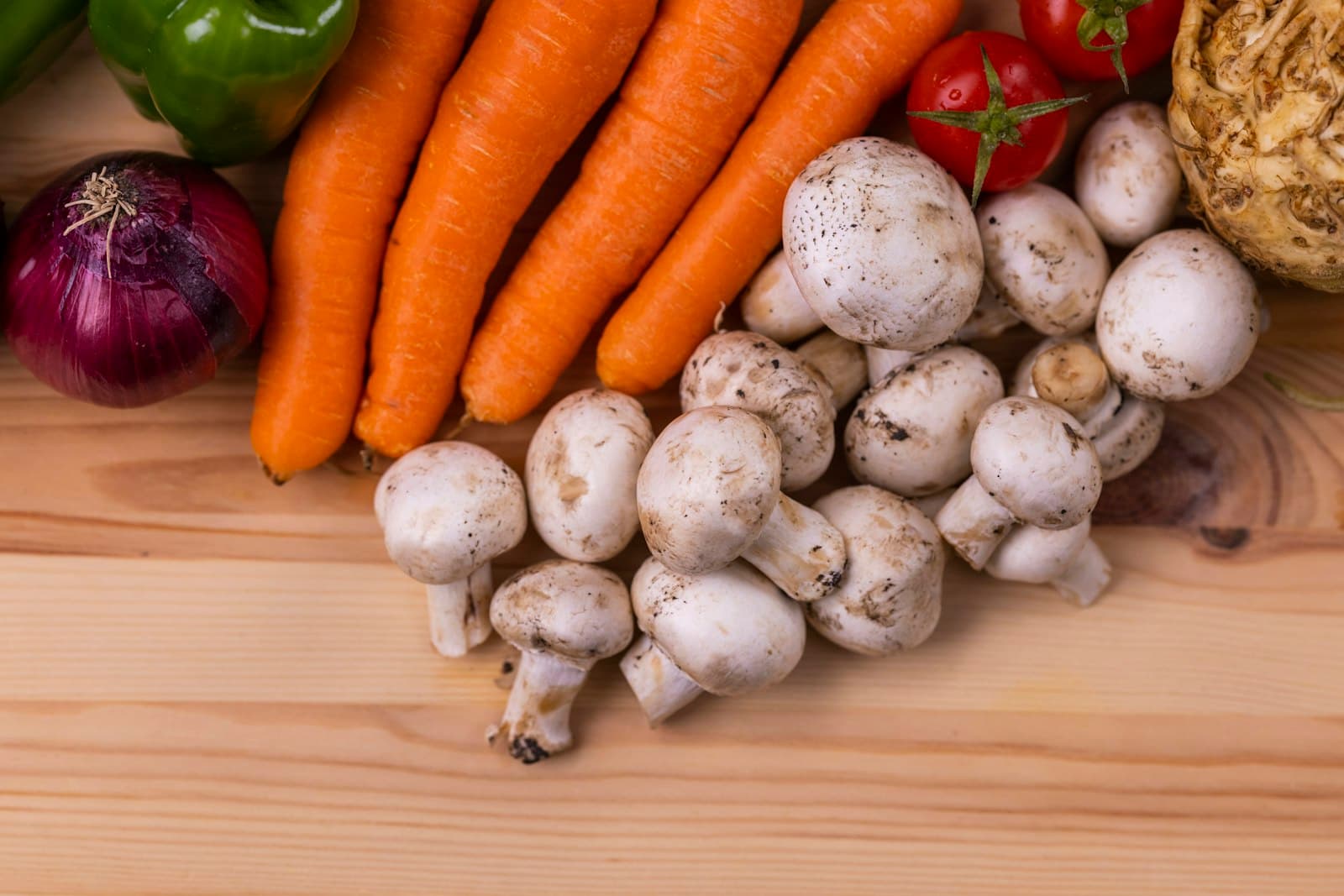
Yes, you can eat vegetables with ulcerative colitis, and outside a flare most people with UC should be eating more of them than they are. No major guideline tells people with UC in remission to avoid vegetables. The American Gastroenterological Association advises people with inflammatory bowel disease to follow a Mediterranean diet "rich in a variety of fresh fruits and vegetables" unless there is a contraindication (Hashash 2024), and the 2025 European consensus says targeted fibre restriction is indicated only for people with stricturing Crohn's disease (Svolos 2025).
That is the answer to "can you". The more useful questions are the ones people actually ask once they are out of a flare: which vegetables, in what form, how fast, and whether the old rules about skins, seeds, salad and popcorn were ever real. This article is about that second phase, getting plants back. If you are in a flare right now, our guide to what to eat during a UC flare is the one you want; it covers the flare-diet evidence and we will not repeat it here.
One thing to say up front, because it runs through everything below: the research on vegetables in ulcerative colitis is small. The best trials have fewer than 30 people each. Where a finding is weak, mixed, or contradicted by another source, we say so and show the numbers.
The short answer: vegetables are allowed; the real question is form and timing
For most people with UC in remission, the practical answer is: eat vegetables, start with the gentlest forms, and widen the range at your own pace.
A flare and remission are different situations. During active inflammation, many people tolerate coarse, high-residue food badly, and changing the texture of vegetables is a reasonable short-term strategy. The problem is what happens afterwards. The texture rules that got you through a flare tend to harden into a permanent list, and most of that list was never meant to be permanent.
You can see both halves of this in the community. In an r/UlcerativeColitis thread titled "i miss eating veggies", a person mid-flare described tolerating courgette only when "cooked to mush". Replies included people who could eat broccoli florets but not the stalks, people for whom broccoli soup worked when broccoli did not, and people who said that once they reached remission they could eat vegetables again. In another thread, someone asked how long you have to be in remission before trying trigger foods again, and described being able to eat uncooked vegetables in moderation a few months after their medication brought the disease under control.
Those are individual experiences, not evidence, but they describe the pattern the guidelines assume: tolerance tracks inflammation, and it tends to come back.
Why vegetables feel so dangerous once you have UC
Vegetables feel risky because, during a flare, they really do make symptoms worse for many people, and that memory is vivid.
When patients in the large US CCFA Partners internet cohort were asked which foods worsen their IBD symptoms, the list was dominated by plants and plant textures: non-leafy vegetables, fruit, nuts, leafy vegetables, popcorn, high-fibre foods, corn, seeds and beans all appeared, alongside spicy and fried food, dairy, alcohol and coffee. Yogurt, rice and bananas were the foods most often said to help (Cohen 2013). The authors concluded that patients identified foods they believed worsened symptoms and restricted their diets accordingly, and that prospective studies were needed to tell whether diet actually influences disease course. (One small arithmetic slip is worth noting for anyone who reads that abstract: it reports an odds ratio of 2.14 with a 95% confidence interval of 1.02 to 1.03, which cannot be right, since an interval must contain its point estimate. It concerns sweetened drinks in people with ostomies, not vegetables, and does not change anything here.)
Self-report tells you what people experience. It does not tell you what is happening in the colon. A food can cause gas, cramping and urgency without adding a single ulcer. Our piece on whether food can trigger a UC flare covers the difference between a flare and a bad symptom day in detail; the short version is that "this vegetable gives me symptoms" and "this vegetable makes my colitis worse" are different claims, and only the first is usually supported by what you notice.
The Reddit vocabulary is telling. In a thread called "I tried putting vegetables back in my diet..... I regret that very very much", the poster described severe pain after broccoli and then spinach. The replies split three ways: people who said thoroughly cooked root vegetables were fine, people who found broccoli, cabbage, kale and spinach the hardest, and people who said they could only manage vegetables steamed or cooked soft. In a separate thread on which foods still cause problems in remission, cabbage, sprouts, raw vegetables, onions, legumes and popcorn came up repeatedly, and so did the opposite report: "When I'm in remission, nothing bothers me."
Both are true for the people saying them. The job is to work out which one is true for you, without either forcing foods that hurt or avoiding foods that would have been fine.
What the guidelines actually say about vegetables in UC remission
The three main sources of dietary guidance for IBD all point the same way: in remission, eat a varied plant-rich diet, and reserve texture restrictions for specific situations.
The AGA (2024). Its first best-practice statement advises that, unless there is a contraindication, all people with IBD should follow a Mediterranean diet rich in a variety of fresh fruits and vegetables, monounsaturated fats, complex carbohydrates and lean proteins, and low in ultraprocessed foods, added sugar and salt. In the same statement it says plainly that no diet has consistently been found to decrease the rate of flares in adults with IBD. Its second statement is the one that gets misapplied: people with symptomatic intestinal strictures may not tolerate fibrous, plant-based foods such as raw fruits and vegetables, and careful chewing, cooking and processing to a soft consistency may help them include a wider variety of plants (Hashash 2024). The texture advice is framed as a way to keep plants in the diet, not a reason to remove them. The AGA also notes this document was not a systematic review and did not formally grade the evidence.
ECCO (2025). We read the accepted manuscript of the European consensus in full. The relevant statements:
- Statement 11.2: neither low- nor high-fibre diets are recommended for maintenance therapy for Crohn's disease or ulcerative colitis.
- Statement 38: assessment of dietary fibre intake is recommended in people with IBD, because intake is often below recommendations. The text says targeted fibre restriction is indicated only for people with stricturing Crohn's disease, and that referral for dietary assessment should be considered for people who restrict fibre or plant-based foods, naming fruit, vegetables, whole grains, legumes, nuts and seeds.
- Statement 7.2: the Mediterranean diet could be considered for maintenance of remission in UC as an adjunct to medical therapy, rated at a low evidence level (Svolos 2025).
So the European position is not "eat lots of fibre to stay in remission". It is "there is no good reason to cut fibre in UC, people with IBD tend to eat too little of it, and restricting plant foods is itself something a dietitian should look at."
The Crohn's and Colitis Foundation, in its patient guidance, lists squashes, fork-tender cooked carrots and green beans among vegetables to increase, suggests cooking, chopping or blending leafy greens, and says that if you adjusted the texture of food during a flare, you can start reintroducing tougher-to-digest foods in remission (Crohn's & Colitis Foundation). It also warns specifically against self-imposed restrictive diets, noting their potential for nutrient deficiencies, unplanned weight loss and disordered eating.
Does eating more fibre keep ulcerative colitis in remission?
Probably not by itself, as far as anyone can currently show. The honest summary is that fibre and plant-rich eating look safe in UC remission and may have benefits, but the evidence that they prevent flares is weak.
The Crohn's finding that gets quoted at UC readers
The study most often cited for "fibre prevents flares" followed 1,619 people with IBD in remission for six months. People with Crohn's disease in the highest quartile of fibre intake were less likely to flare than those in the lowest (adjusted odds ratio 0.58, 95% CI 0.37 to 0.90), and those who did not avoid high-fibre foods were about 40% less likely to flare than those who did. But in the 489 people with ulcerative colitis or indeterminate colitis, there was no association between fibre intake and flares (adjusted OR 1.82, 95% CI 0.92 to 3.60) (Brotherton 2016). The authors' own conclusion says fibre was associated with fewer flares in Crohn's disease "but not UC".
It is worth reading that UC number carefully rather than just noting "not significant". The point estimate of 1.82 actually leans the other way, toward more flares with more fibre, but the confidence interval runs from slightly below 1 to 3.6, so the study cannot distinguish a modest harm from no effect at all. The fair reading is "no evidence of benefit or harm in UC from this study", not "fibre prevents UC flares", which is how it often gets summarised.
The older trial evidence, briefly
A systematic review of 23 randomised trials of fibre in IBD found that 3 of the 10 UC trials reported a benefit on disease outcomes, rated the evidence limited and weak, and concluded that outside overt obstruction there was no evidence fibre intake should be restricted (Wedlake 2014). Our UC flare diet guide walks through that review and the Plantago seed versus mesalamine trial, so we will not rebuild them here. ECCO's own reading of that seed trial is that no difference in maintaining remission was found at 12 months (Svolos 2025).
One smaller trial is directly relevant to the question of symptoms in remission. In a four-month placebo-controlled trial in people with UC in remission who still had gut symptoms, ispaghula husk (psyllium) was rated superior to placebo, with improvement in 69% versus 24%. Twenty-nine participants, 81% of those who started, completed the trial; four withdrew after a relapse, three of them while taking placebo (Hallert 1991). Two limits: it is from 1991 and small, and its outcome was symptoms, not inflammation. It supports the idea that the right kind of fibre can make UC-in-remission bowels feel better. It does not show it keeps the disease quiet. ECCO rates the evidence for psyllium in maintaining remission as insufficient. This is not a prompt to start a supplement; that is a conversation for your IBD team or dietitian.
The two plant-rich diet trials in UC remission
These are the closest thing to a direct test of "eat more vegetables with UC", and both are worth reading in more detail than the headlines give them.
The Miami crossover trial. Seventeen people with UC in remission or mild disease ate two catered diets for four weeks each, in random order: a low-fat, high-fibre diet with 10% of calories from fat, and an "improved standard American diet" with 35% to 40% of calories from fat but more fruit, vegetables and fibre than a typical American diet. Both improved quality of life compared with baseline, and everyone stayed in remission. Serum amyloid A, an inflammation marker, fell significantly from baseline on the low-fat diet (7.99 to 4.50 mg/L, p = 0.02), and C-reactive protein fell numerically (p = 0.07) (Fritsch 2021).
Here is where two sources describe the same trial differently. The paper's title says the diet "reduces markers of inflammation". ECCO's summary says it improved quality of life "but did not demonstrate improved biochemical outcomes" (Svolos 2025). Both are defensible, and the abstract shows why: serum amyloid A fell compared with baseline, but the difference between the two study diets was not significant (p = 0.07). A before-and-after drop in a four-week trial with no untreated comparison is weaker evidence than a between-diet difference. So the trial shows that a much healthier diet than people were eating was well tolerated and associated with feeling better, and hints at lower inflammation. It does not isolate vegetables, since both diets increased them, and its main contrast was fat. We could not find a funding statement for it in PubMed and did not read the full paper.
The Canadian Mediterranean diet trial. Twenty-eight adults with quiescent UC were randomised to a Mediterranean diet pattern (15 people) or their habitual Canadian diet (13 people) for 12 weeks. The abstract's headline: at week 12, 75% (9 of 12) of the habitual-diet group had faecal calprotectin above 100 μg/g, against 20% (3 of 15) of the Mediterranean group (Haskey 2023).
Put together: plant-rich eating in UC remission looks well tolerated and may lower inflammation markers in some people, and there is no sign in these trials that it provokes flares. Whether it keeps UC in remission is not yet shown. That is roughly where ECCO lands when it says the Mediterranean diet "could be considered" as an adjunct, at a low evidence level.
Why the "vegetables prevent colitis" studies do not answer your question
You will see claims that eating more vegetables lowers the risk of ulcerative colitis. Those studies are about developing UC, in people who did not have it yet. They say little about what someone who already has UC should eat.
Even on their own question, they disagree. A 2011 systematic review of 19 studies found high vegetable intake associated with a lower risk of developing UC (Hou 2011). The Nurses' Health Study, which followed 170,776 women for 26 years, found fibre (especially from fruit) associated with lower risk of Crohn's disease, but no significant association between total fibre or any specific fibre source and UC (HR 0.82, 95% CI 0.58 to 1.17) (Ananthakrishnan 2013). ECCO's reading of the prevention cohorts is that fibre from high-fibre cereals, not vegetables, was the source linked to lower UC risk, and that even this was inconsistent across studies (Svolos 2025). Three sources, three different answers about which plant food matters for UC prevention. We cannot reconcile them, and for a reader who already has UC it matters less than it looks.
The same caution applies to the one study we found that tried to link specific foods to how inflamed the colon looked in people who already had UC. It compared seven-day food diaries with sigmoidoscopy findings in 81 people and found lettuce, tomatoes, apples and pears, citrus, potatoes and legumes among the foods eaten more by people with less active disease (Magee 2005). That is encouraging for salad lovers, but it is a single snapshot. People whose colitis is active tend to stop eating salad, so the association could run entirely in reverse: less inflammation leading to more lettuce, rather than the other way round.
Three kinds of fibre, three different effects
The single most useful idea for getting vegetables back is that "fibre" is not one thing. The older soluble/insoluble split explains less than people think. Researchers who study fibre in the gut now sort it by what it does: whether it is fermented by bacteria, whether it forms a gel, and whether it passes through as bulk (So 2021). ECCO uses the same three-way categorisation, fermentable, viscous and bulking, in its guidance (Svolos 2025).
| Fibre behaviour | What it does in the colon | What you tend to notice | Common vegetable examples |
|---|---|---|---|
| Fermentable | Rapidly broken down by gut bacteria, producing gas and short-chain fatty acids | Gas, bloating, cramping, sometimes urgency, often a few hours after eating | Onion, garlic, leek, legumes, cabbage family, some of the carbohydrate in broccoli and cauliflower |
| Viscous (gel-forming) | Holds water as a gel, resists drying out | Softer, more formed stool; can steady loose stools | Oats, psyllium, the flesh of some fruit; present in smaller amounts in cooked vegetables |
| Bulking (coarse, poorly fermented) | Passes through largely intact, adds bulk, speeds transit | More frequent stools, visible pieces in stool, a sense of "going straight through" | Skins, stalks, corn and popcorn hulls, raw kale, tough leaves, seeds |
Real vegetables contain a mix, which is why the table is a guide rather than a sorting rule. But the categories map neatly onto the complaints in the threads. The people who get painful gas from onion and cabbage are describing fermentation. The people who see corn come out unchanged a few hours later are describing bulking fibre. And the people who find psyllium or oats steadies them are describing a viscous fibre.
A widely cited review of fibre physics explains the bulking effect this way: in the large bowel, large or coarse insoluble particles mechanically irritate the lining, stimulating water and mucus secretion, which is part of why coarse bran is laxative (McRorie 2017). That review focuses on isolated fibre supplements rather than whole vegetables, and PubMed carries no conflict of interest statement for it, which we could not check further without the full text.
There is also newer laboratory evidence that fermentation matters in a way specific to IBD. In a study using colon biopsies and immune cells, unfermented beta-fructan fibre (the inulin-type fibre found in onion, garlic, leek and chicory root, and added to many "high-fibre" processed products) triggered inflammatory signalling in a subset of samples from people with IBD. When gut bacteria fermented the fibre first, the response dropped, but only when those bacteria came from people without IBD or with inactive IBD. The authors concluded that fibres are typically beneficial where fermentation is normal but some may be harmful in select patients with active IBD who lack fibre-fermenting microbes (Armstrong 2023). This is mostly laboratory work, and it does not show that eating onions inflames anyone's colon. What it does suggest is a plausible reason why the same fibre can behave differently during a flare and in remission, and a reason to be more cautious with concentrated inulin-type fibre additives than with ordinary vegetables while inflammation is active.
If fermentable carbohydrate is your main problem in remission, that is a FODMAP question, and our article on whether low FODMAP is good for ulcerative colitis covers when a short, structured FODMAP trial with a dietitian makes sense and why it should be followed by reintroduction rather than kept as a permanent diet.
Cooked, peeled, chopped or blended: what actually changes
Changing the form of a vegetable changes how its bulking fibre behaves, and that part has reasonable physiological evidence. The evidence was gathered in people without UC, so treat it as a mechanism, not a UC trial.
Particle size is the variable with the most evidence. In a 1974 study in people with constipation and diverticular disease, coarse bran lowered colonic pressure and sped transit at the dose used, while finely milled bran did not (Kirwan 1974). Twenty-five years later, researchers tested the idea more directly by giving 18 healthy volunteers inert plastic, either as bran-like flakes or as small granules. The flakes cut whole-gut transit time by 24%; the small granules did not change it significantly (Lewis 1999). Plastic cannot be fermented and has no nutrients, so this isolates the physical effect: coarse, sharp-edged particles speed things up; fine ones much less so.
That is the best available explanation for why chopping finely, blending into soup, grating, mashing and cooking until soft make the same vegetable easier for many people. It also explains why skins, stalks and hulls tend to be the problem parts: they are the coarsest material on the plate.
One common claim goes further than the evidence. The Crohn's and Colitis Foundation's diet page says raw kale and blended kale contain the same amount of insoluble fibre, but blended kale "acts more like soluble fiber in the intestines". It gives no source for that, and we could not find one. Blending does not turn insoluble fibre into soluble fibre. What it does, according to the particle-size studies above, is reduce the size of the pieces, which reduces their bulking and transit-speeding effect. The practical advice (try blended greens before raw) is sensible; the mechanism offered for it is not quite right.
Cooking softens plant cell walls, which makes vegetables easier to chew into small pieces and less coarse by the time they reach the colon. Peeling removes the toughest layer of many vegetables and fruit. Deseeding tomatoes and cucumbers removes the part people most often blame. Chewing thoroughly is the one intervention every guideline mentions and nobody needs a prescription for. We could find no trial comparing cooked with raw vegetables, or peeled with unpeeled, in people with UC. These are reasonable adjustments based on mechanism and experience, and that is how they should be described.
The morning and breakfast posts on this site cover the timing side of the same idea, since the colon is most reactive in the hours after waking: see why mornings are the worst with ulcerative colitis if your worst reactions cluster early in the day.
Skins, seeds, corn and popcorn: where the rule came from
The "no skins, seeds, nuts, corn or popcorn" rule has two origins, and neither of them is ulcerative colitis in remission.
Origin one: diverticular disease. For decades, people with diverticular disease were told to avoid nuts, corn, popcorn and seeds in case they lodged in a diverticulum and caused diverticulitis. A prospective study of 47,228 US men followed for 18 years tested it and found the opposite: men who ate popcorn at least twice a week had a lower risk of diverticulitis than those who ate it less than once a month (hazard ratio 0.72, 95% CI 0.56 to 0.92), nut eaters showed a similar trend, and corn showed no association. The authors concluded the recommendation to avoid these foods should be reconsidered (Strate 2008). That study was in men and specifically excluded people with inflammatory bowel disease, so it says nothing directly about UC. What it does show is that the most famous version of the seeds-and-popcorn rule did not survive testing in the population it was written for.
Origin two: stricturing Crohn's disease. A narrowed section of bowel can be blocked by a bolus of coarse, undigested food, so people with Crohn's strictures are often advised to limit bulky fibre. Even here, ECCO's Statement 21.1 is candid: there are no data supporting a modified or low-fibre diet in stricturing Crohn's disease, and the advice rests on "mechanism-based reasoning" at the lowest evidence level (Svolos 2025). Our Crohn's piece on why junk food can feel better than healthy food covers strictures in that context.
Why that matters for UC. UC affects the lining of the colon rather than the full thickness of the bowel wall, and strictures are not a routine part of it. In a large US hospital series from 1959 to 1983, 59 of 1,156 people admitted with UC (5%) developed colorectal strictures, and 17 of those 70 strictures (24%) turned out to be cancers. Strictures appearing after 20 years of disease, strictures above the splenic flexure, and strictures causing obstruction were far more likely to be malignant (Gumaste 1992). That was a specialist hospital's admitted patients over decades, so the 5% is probably higher than in UC generally. The lesson is not "avoid seeds in case you have a stricture". It is that a stricture in UC is something to investigate, not something to manage with diet, and symptoms of obstruction are a reason to see a doctor promptly.
And the low-residue diet itself is on shakier ground than most people realise. A 2015 review noted that low-residue diets had been removed from the Academy of Nutrition and Dietetics' Nutrition Care Manual because there was no scientifically accepted definition of "residue" and no way to measure it, and proposed replacing the term with a low-fibre diet defined as no more than 10 g of fibre a day (Vanhauwaert 2015). The review describes these diets as used for bowel preparation and as part of treatment during acute relapses, not as long-term eating.
So what about popcorn?
Popcorn deserves its own section because it generates some of the most emotional threads. In one, titled "Goodbye forever, Popcorn", someone doing well for two months ate half a bag of popcorn on an empty stomach and then had bloody mucus for two days. The replies are a fair cross-section of what people with UC report: some say popcorn reliably wrecks them, some say they got it back after a long remission, some can eat the fluffy part but not the hulls, and several say food has never triggered a flare for them at all. One reply pointed out that the only way to know is to repeat the popcorn with everything else unchanged.
Here is what can honestly be said. Popcorn hulls are a textbook bulking fibre: tough, poorly digested, and often visible in stool afterwards. Seeing them does not mean they injured anything. They can plausibly cause cramping, urgency and more frequent stools for a day or two. We could find no study showing that popcorn causes ulcerative colitis to relapse. But bleeding is a different category of symptom from urgency, and new blood after any food is a reason to contact your IBD team rather than assume the food caused it. A flare that happened to start the same week is at least as likely as a popcorn-induced one, and it needs the same response either way. Our guide to telling whether your UC is flaring explains how to check.
If popcorn is not worth it to you, not eating it is a perfectly reasonable choice. Popcorn is not a nutritional necessity. Several people in that thread found hull-less puffed corn snacks gave them the taste without the problem.
When the flare list outlives the flare
The biggest risk with vegetables in UC is not eating them. It is never going back to them.
In a cross-sectional study of 161 people with IBD, just over half of whom had UC, 92% avoided at least one food during active symptoms and 74% were still avoiding at least one food when they had no symptoms. Seventeen percent screened positive for avoidant restrictive food intake disorder, and those who did were far more likely to be at risk of malnutrition (Yelencich 2022). Separately, a systematic review of 26 studies found people with IBD generally eat less fibre than healthy comparison groups, with total intakes ranging from roughly 10 to 21 g a day, and in four studies only 10% to 21% of participants met national fibre recommendations (Day 2021). ECCO puts typical guideline targets at 25 to 30 g a day for comparison (Svolos 2025).
What long-term vegetable avoidance costs is not dramatic, which is why it gets missed: less variety, fewer vitamins and minerals from food, fewer of the plant compounds gut bacteria feed on, and meals that become a source of anxiety. If restriction has started to feel less like a choice and more like a rule you cannot break, our piece on when restrictive eating tips into disordered eating covers the warning signs.
There is also a UC-specific irony. Some people with left-sided colitis or proctitis get constipation in the colon above the inflamed section, a pattern called proximal constipation. In one series it affected 46% of 125 people with UC, and it was more common with active and left-sided disease (James 2018). For someone in that situation, cutting vegetables to reduce bowel movements can work against them. Our article on UC symptoms while in remission covers proximal constipation and the other causes of gut symptoms when the colitis is quiet.
Clairop logs meals, symptoms and stool in seconds, then looks for the foods your gut reacts to, including reactions that land days later.
How to bring vegetables back without kidding yourself
The most reliable approach is slow and boring: confirm remission, set a baseline, then add one vegetable in one form at a time, and judge it over more than one try.
The community is ahead of the research here. In a thread from someone newly diagnosed and asking what people eat in remission, the most consistent advice was to start slowly, and one person said it took about a year to bring everything back. In the 12-years-with-UC diet thread, the poster described going carefully with anything new. What follows turns that instinct into something that gives you a usable answer.
Step 1: make sure you are actually in remission
"I feel better" and "the inflammation has gone" are not always the same thing. Before you start judging vegetables, ask your IBD team whether your remission has been confirmed objectively, usually with a faecal calprotectin test or a scope. Our guide to what calprotectin levels mean for UC explains the numbers. If you reintroduce foods while low-grade inflammation is still there, you will blame the vegetables for symptoms the colitis is causing, and you will end up with a longer avoid list than you need.
Step 2: record a baseline for a week or two
Before adding anything, note your usual daily pattern: stool frequency, stool form (the Bristol scale is fine), urgency, blood, pain and gas. Without that, a normal off day after a new food looks like a reaction. Our IBS food diary guide explains why informal trigger hunting throws up so many false alarms, and the arithmetic applies to UC too.
Step 3: one vegetable, one form, a small portion
Pick a vegetable you miss and choose its gentlest form. Eat a small portion alongside meals you already tolerate. Do not add two new things on the same day, and do not test during a week that is already unusual (illness, travel, a big change in stress, for many people their period).
Step 4: watch for 48 to 72 hours, and sort what you see
Some reactions to vegetables, especially fermentable ones, show up hours later or the next day. Sort what you notice into two groups:
- Expected, food-type symptoms: more gas, bloating, softer or more frequent stools, visible pieces of vegetable. These are information about tolerance, not damage.
- Colitis-type symptoms: blood, mucus with blood, a rise in stool frequency that persists after the food is gone, urgency that keeps building over days, night-time bowel movements. These are a reason to stop the experiment and contact your team.
Step 5: repeat before you decide
One bad reaction is weak evidence. Give a vegetable two or three tries on different days before you put it on a "no" list. If it causes the same mild symptoms each time, try a smaller portion or a gentler form rather than dropping it altogether. Our guide to finding what triggers your IBS covers challenge and rechallenge design properly, and most of it transfers.
Step 6: move up the texture ladder
Once a gentle form works reliably, try the next one for that same vegetable.
| Rung | Form | Examples | Main fibre effect |
|---|---|---|---|
| 1 | Blended or puréed | Vegetable soups, puréed squash, blended greens in a sauce | Smallest particles, least bulking |
| 2 | Well cooked, peeled, soft | Carrots, courgette, peeled potato, green beans, squash | Low bulking, modest fermentation |
| 3 | Cooked with skins or florets | Roast vegetables with skins, broccoli florets, cooked spinach | More bulking material |
| 4 | Soft raw | Peeled cucumber, deseeded tomato, soft lettuces, avocado | Some intact fibre, low fermentation |
| 5 | Coarse raw and highly fermentable | Raw kale, raw cabbage, raw onion, sweetcorn, mixed salad with seeds | Most bulking and fermentation |
This ladder is a practical framework based on the fibre categories above, not a clinical protocol from a trial. Plenty of people skip rungs, and some never want rung 5, which is fine. The point is to have a next step to try rather than a single yes-or-no verdict on "vegetables".
If keeping all of this in your head sounds like a lot, Clairop is built for this kind of record: it logs what you ate and your symptoms and looks for patterns across a delay window, which helps with reactions that show up the next day. It does not diagnose anything, and a paper diary works too.
A worked example: six weeks, four vegetables
This is a hypothetical example to show how the steps fit together, not a real case.
Sam has left-sided UC, diagnosed two years ago. After a flare last spring she was eating almost no vegetables apart from mashed potato. Her team has confirmed remission with a normal calprotectin. She misses broccoli, salad and roast vegetables.
Weeks 1 and 2: baseline. Sam notes one or two formed bowel movements most days, occasional softer stools, no blood, mild gas in the evenings.
Week 3: carrots, courgette, squash (rung 2). Well cooked and peeled, a few spoonfuls with dinner, one vegetable every two days. No change from baseline. These go on the "yes" list.
Week 4: broccoli soup (rung 1), then cooked florets (rung 3). The soup causes nothing noticeable. The florets, tried on Tuesday, bring more gas that evening and a softer stool the next morning, then nothing further. Friday: the same portion, the same mild gas. Sam keeps florets in small portions and leaves the stalks out for now.
Week 5: salad (rung 4). A small side of soft lettuce, peeled cucumber and deseeded tomato. Fine twice. A shop-bought mixed salad with raw red onion and seeds leads to cramping and three bowel movements the next morning. Rather than writing off "salad", Sam retries the gentle version (fine) and puts raw onion on a separate "test later" list, suspecting fermentation.
Week 6: roast vegetables with skins (rung 3). Tolerated well.
After six weeks Sam has gone from one vegetable to eight, with two items on a "later" list rather than a "never" list. She has not proved that vegetables keep her UC in remission, and nothing in the evidence says she should expect them to. She has a varied diet back, and she knows which specific form of which food gives her symptoms.
If you have had surgery, the rules change
Everything above assumes you still have your colon. After a colectomy, vegetables behave differently.
With an ileostomy, the concern is blockage at the stoma from bulky, poorly chewed food, and output volume. ECCO's Statement 24 says fibre intake could increase ileostomy output, but likely not above what is considered a normal volume (Svolos 2025). Our guide to foods that cause ileostomy blockage covers the specific foods and what to do.
With an ileal pouch (j-pouch), ECCO's Statement 25.1 says fermentable fibre might improve pouch function, though the evidence is limited. If you have a pouch or a stoma, follow the advice from your surgical and stoma team over anything in this article.
Myths about vegetables and ulcerative colitis
"People with UC should avoid vegetables." No guideline says this for remission. The AGA recommends a diet rich in them for people with IBD unless there is a specific contraindication, and ECCO recommends looking at your diet if you are restricting plant foods.
"Fibre causes UC flares." In the main prospective cohort that looked, fibre intake had no association with UC flares in either direction that the study could detect (Brotherton 2016).
"Fibre prevents UC flares." Not shown either. The widely quoted 40% reduction was in Crohn's disease. The UC trials of plant-rich diets are small; the Mediterranean trial's primary clinical endpoint looked similar in both arms, and the crossover trial improved both diets it tested.
"Raw vegetables scratch or tear the inflamed colon." We could find no evidence that vegetable fibre physically injures the colon lining. Coarse particles do speed transit and may irritate the lining enough to stimulate secretion, which can mean more symptoms when it is already inflamed. That is a reason to adjust texture during a flare, not proof of injury.
"Blending turns insoluble fibre into soluble fibre." It does not. Blending makes the particles smaller, which is the change the evidence says matters.
"If you can see vegetable pieces in your stool, you are not digesting them and they are doing harm." Coarse plant material, especially corn and skins, often passes largely intact in everyone. Seeing it is not a sign of a problem.
"Once a food has triggered symptoms, it is off the list for good." Many people get foods back as inflammation settles. One reaction during or just after a flare is weak evidence about a food.
"Diet can put UC into remission, so you can come off medication." Nothing in the evidence here supports that. Some case stories online, and some comments in community threads, describe cutting back medication while changing diet. The trials above were run in people who stayed on their usual treatment, and ECCO frames the Mediterranean diet as an adjunct to medical therapy. Never change medication without talking to your IBD team.
When to see a doctor promptly
A vegetable causing gas or softer stools is not an emergency. Some symptoms are not food problems at all, and need prompt medical attention whatever you ate:
- Blood in your stool, especially new bleeding after a period of remission.
- Stool frequency that stays raised for days, night-time bowel movements, or urgency that keeps worsening.
- Fever, feeling generally unwell, or a racing heart alongside bowel symptoms.
- Unexplained weight loss, or signs of anaemia such as unusual tiredness, breathlessness or pale skin.
- Symptoms of obstruction: cramping pain with a swollen abdomen, vomiting, and not passing stool or wind. In UC this is uncommon and needs urgent assessment.
- A change in bowel habit after many years of colitis, since long-standing UC carries an increased risk of bowel cancer, and your surveillance plan matters more than your diet.
If you have severe bleeding, many bowel movements a day with blood, or are feeling very unwell, our guide on when to go to hospital with a UC flare sets out the thresholds.
A registered dietitian with IBD experience is worth asking for if your diet has shrunk and you cannot get it back on your own. The AGA calls registered dietitians an essential part of the team caring for people with IBD (Hashash 2024), and ECCO's Statement 2 says everyone with IBD should have access to one.
The honest bottom line
You can eat vegetables with ulcerative colitis. In remission, the guidelines want you to, and the main risk in the evidence is not vegetables but a restricted diet that outlasts the flare that caused it.
What the research does not yet show is that eating more vegetables will keep UC in remission. The two diet trials in UC remission are small, and their inflammation signals come from before-and-after comparisons or secondary outcomes, while the one primary clinical endpoint we could check looked similar in both arms. The famous fibre-prevents-flares figure is a Crohn's result. The rules about skins, seeds and popcorn come from diverticular disease and Crohn's strictures, and the first did not hold up when tested in its own population while the second rests on reasoning rather than trials.
So treat vegetables as something to bring back rather than something to prove. Confirm your remission, start with soft and blended forms, add one at a time, give each more than one chance, and keep the foods that work. If a vegetable only ever gives you gas, you can eat less of it, cook it longer, or skip it without guilt. If you ever see blood, that is a question for your IBD team, not your plate.