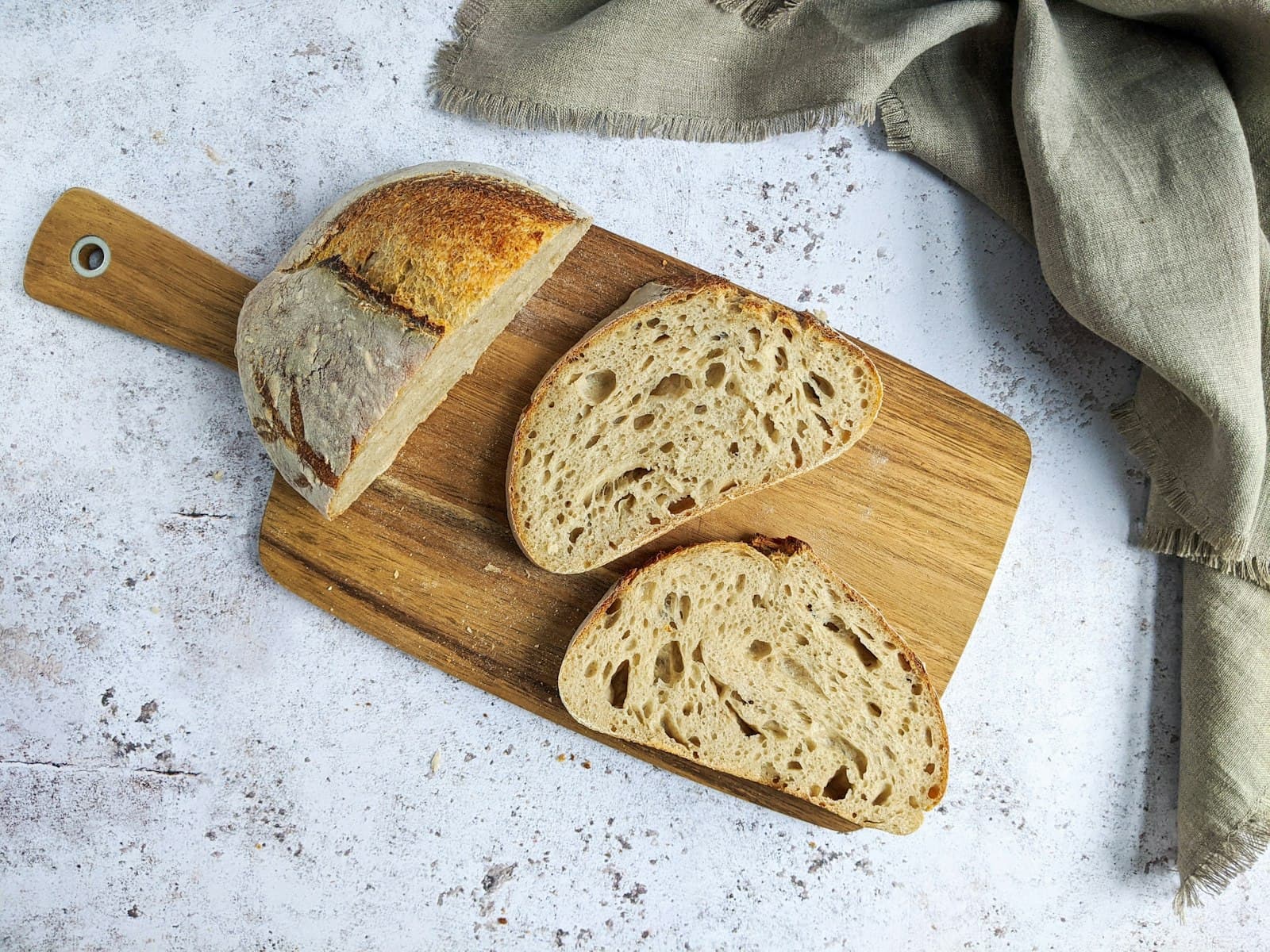
Bread is not one food, and that is why it behaves so inconsistently. A loaf has at least five separate dials on it: the grain it was milled from, how much of the bran and germ stayed in, how long the dough was fermented before baking, what fibre was added back in the factory, and how much of it you eat in one sitting. Move any one of those and the same "bread" can go from fine to ruinous.
For most people with IBS, the thing actually causing trouble is fructans, a fermentable carbohydrate the human small intestine has no enzyme for, plus the bran in wholemeal flour and the size of the portion. Gluten is the usual suspect and it is mostly the wrong one. That matters, because "I think I'm gluten intolerant" sends people down an expensive and often unnecessary path, while the dial that would have actually helped them, fermentation time, is never printed on the packet.
The short answer: fructans, bran and portion size
Three mechanisms explain almost every "bread makes me worse" story, and none of them is gluten.
Fructans. Wheat, rye and barley store carbohydrate as fructans, short chains of fructose units. Humans produce no enzyme that can break those chains, so they pass the small intestine intact and arrive in the colon, where gut bacteria ferment them and release gas. Bread is a major dietary source simply because people eat a lot of it, not because any single slice is especially concentrated (Whelan 2011).
Bran. Wholemeal flour keeps the outer layers of the grain. That adds coarse insoluble fibre, which behaves very differently in an IBS gut from the soluble fibre in something like psyllium, and it also tends to bring more fructans with it.
Portion. Fructan reactions are dose-related. Two slices at breakfast and two more at lunch is a different exposure from two slices in a day, and the second lot lands on top of whatever else you have eaten. Our guide to FODMAP stacking covers the arithmetic of how separate "safe" portions add up within a window.
This is also why the community experience is so contradictory. In an r/ibs thread from someone living in Italy, the poster could manage two slices for a sandwich or two small slices of pizza and no more, while a reply in the same thread said bread was their only safe food (r/ibs thread). Both are plausible. They are eating different loaves in different amounts with different thresholds.
Is it the gluten or the fructans?
For most people, the evidence points hard at fructans. It is not unanimous, and the exception is worth knowing about.
The trial everyone cites was run in Oslo. Fifty-nine people who had already put themselves on a gluten-free diet, and in whom coeliac disease had been excluded, were given muesli bars containing either gluten (5.7 g a day), fructans (2.1 g a day) or placebo for seven days each, in random order, double-blind, with washout periods between. Average symptom scores were highest after fructans, and fructan scores were significantly higher than gluten scores, especially for bloating. Gluten was no different from placebo (Skodje 2018).
There is a detail in that paper that rarely gets quoted and deserves to be. Of the 59 participants, 24 had their worst week on fructans, 13 on gluten, and 22 on placebo. More than a third of people who were certain gluten was their problem felt worst during a week when they were eating neither gluten nor fructans. That is the size of the noise you are competing with when you try to identify a trigger by memory.
The same Oslo cohort was later analysed for gut bacteria and inflammation. Fructans produced more symptoms, but there were no differences in bacterial diversity, overall community structure, short-chain fatty acids, or a faecal marker of gut inflammation. In other words, the symptoms were real and the fructans caused them, but nothing about a measurable inflammatory response was going on (Herfindal 2024).
Where it gets less tidy. A randomised trial in 45 people with IBS-D compared four weeks of a gluten-containing diet with a gluten-free one. The gluten group had more bowel movements per day and higher small-bowel permeability, and both effects were larger in people carrying the HLA-DQ2 or DQ8 genes, the same ones associated with coeliac disease (Vazquez-Roque 2013). And in a UK randomised trial comparing three diets in 99 people with non-constipated IBS, the gluten-free arm achieved a clinical response in 58 per cent, statistically indistinguishable from the low FODMAP diet's 55 per cent and traditional dietary advice's 42 per cent, despite the gluten-free diet barely reducing total FODMAP intake at all (27.4 g/day down to 22.4 g/day, compared with 27.7 g down to 7.6 g on low FODMAP) (Rej 2022).
That last finding is genuinely awkward for the pure fructan story, and honest writing has to say so. A gluten-free diet helped people while leaving most of their FODMAPs in place. Possible explanations include the other things that go with a gluten-free diet, expectation effects in an unblinded trial, and the fact that avoiding wheat removes a specific fructan source even when the total FODMAP number stays high. The UK consensus group's conclusion is a fair summary of where this sits: no one dietary therapy has been shown to be superior, and the wheat components under suspicion include fructans, wheat germ agglutinins and amylase trypsin inhibitors, not gluten alone (Rej 2022 consensus).
Test for coeliac disease before you cut bread out
This is the one part of the article that is genuinely time-sensitive, because the order you do things in changes what can be found out.
Coeliac disease is an immune reaction to gluten that damages the small intestine, and it is not IBS. The blood test looks for antibodies your body only makes while gluten is in your diet, and the confirmatory biopsy looks for damage that heals once gluten is removed. Both go negative on a gluten-free diet. The American College of Gastroenterology's guideline recommends antibody testing followed by biopsy in most patients, and specifically addresses the problem of people already avoiding gluten, who need a formal supervised gluten challenge before testing can be interpreted (Rubio-Tapia 2023). The ACG's IBS guideline also suggests coeliac serology for anyone with IBS and diarrhoea (Lacy 2021).
The practical consequence: if bread is making you ill and you are thinking of stopping, ask about coeliac testing first, while you are still eating it. Going gluten-free and feeling better does not tell you which condition you have, and it forecloses the test that would.
A theme runs through the r/ibs bread threads of people who went wheat-free, felt dramatically better, and then could not get any further answer about why (r/ibs thread). Getting the sequence right at the start avoids that dead end.
Why white bread can be fine when wholemeal is not
Milling white flour removes most of the bran and germ. That removes coarse insoluble fibre, and it usually lowers the fructan load too. For a subset of people with IBS, those two changes are the entire difference.
This is one of the oldest findings in the field and one of the most ignored. In 1994, researchers questioned 100 consecutive new IBS referrals who had all tried bran. Fifty-five per cent said bran made them worse; 10 per cent said it helped. Every IBS symptom was aggravated, with bowel disturbance worst affected, followed by distension and pain. Other forms of fibre were not nearly as detrimental. The authors went as far as to suggest that heavy bran consumption in the general population might be converting mild, non-complaining cases into patients (Francis 1994).
A proper randomised trial in primary care later split the difference. Two hundred and seventy-five patients received 10 g a day of psyllium (soluble), bran (insoluble) or a rice flour placebo for 12 weeks. Psyllium beat placebo in months one and two. Bran only edged ahead in month three and not robustly, and early dropout was most common in the bran group (Bijkerk 2009). A 2026 systematic review and meta-analysis of 30 randomised trials in 1,904 people reached a consistent conclusion: fibre supplementation produces a clinical response in IBS overall (52 per cent vs 44 per cent), and psyllium specifically is what drives it (Staudacher 2026). Wheat bran was the most commonly studied fibre in that review and is not where the benefit sits.
Both the ACG and the British Society of Gastroenterology reflect this in their IBS guidance, favouring soluble fibre and not recommending wheat bran as a first move (Lacy 2021; Vasant 2021).
None of this means wholemeal bread is bad or that fibre is the enemy. It means the specific texture of wheat bran is a poor match for a lot of IBS guts, and that swapping bread types is a more sensible first experiment than abandoning bread.
The number that decides your loaf is not on the label
Here is the fact that almost no bread-and-IBS article mentions: the single biggest determinant of a wheat loaf's fructan content is how long the dough fermented before it went in the oven, and that number appears nowhere on the packaging.
German researchers measured FODMAPs in wholegrain flours and finished breads from bread wheat, spelt, durum, emmer and einkorn. Fructans and raffinose were the only FODMAPs detectable in wheat flour, with total FODMAP contents running between about 1.24 and 2.01 g per 100 g of dry matter across the species. Then they varied the process. Extending dough proofing beyond four hours cut FODMAP levels in the finished bread by up to 90 per cent. Their conclusion was blunt: the processing method mattered substantially more than which wheat species you chose (Ziegler 2016).
The mechanism is simple. Baker's yeast produces invertase, an enzyme that chews through fructans. Give it time and it works; rush it and it does not. Belgian researchers screened a large set of industrial Saccharomyces cerevisiae strains and found wide variation in exactly this ability. Strains with high activity against fructo-oligosaccharides cut wheat grain fructans to around 0.3 per cent of dry matter during dough fermentation; low-activity strains left around 0.6 per cent, roughly double (Laurent 2020). So two loaves, same flour, same proving time, different yeast strain, different fructan content.
This reframes the whole question. When someone says they can eat bread from the bakery in their town but not the supermarket sliced loaf, the usual explanations offered are "better quality flour" or "fewer additives". A more likely explanation is that one dough sat for hours and the other did not.
It also explains a frustrating pattern: brands change their process without changing their ingredients list. An ingredients panel carries no amounts and no fermentation time, which is the same structural limitation that makes barcode scanning apps unable to settle FODMAP questions from a label alone.
Does sourdough actually help? The honest answer
Sourdough is genuinely lower in FODMAPs than fast-fermented bread. Whether that translates into feeling better is much less certain than the internet suggests, and the one randomised blinded trial that asked directly found no difference.
What sourdough does to the chemistry. Long fermentation by lactic acid bacteria and yeasts degrades fructans, and several sourdough bacteria carry the enzymes to do it (Loponen 2018; Menezes 2018). Note that the review by Loponen and Ganzle is co-authored by a scientist employed by Fazer, a commercial bakery group, which is worth knowing when reading a positive account of what sourdough can do.
What it does to people. Finnish researchers ran a randomised, double-blind, seven-day trial in 26 people with IBS who reported poor tolerance of wheat. The test bread was a genuine sourdough wheat bread, baked without baking improvers, with a dough fermentation longer than 12 hours. They confirmed chemically that it was lower in FODMAPs and that more of its amylase trypsin inhibitors had been broken down to their monomeric form. Then they measured symptoms. There was no significant difference in gastrointestinal symptoms or markers of low-grade inflammation between the sourdough and the ordinary yeasted bread. Participants actually reported more tiredness, joint symptoms and reduced alertness during the sourdough phase, which the authors themselves said should be interpreted with caution (Laatikainen 2017). Two of that paper's authors also worked for Fazer, and the trial still returned a null result on the outcome a bakery would most want to be positive.
The supporting evidence is thinner than it looks. The frequently cited finding that sourdough produces less gas comes from an in vitro study, using faecal samples from three people with IBS and three healthy donors in laboratory culture vessels. Sourdough bread did produce significantly lower cumulative gas after 15 hours in the IBS donors' cultures, and raised bifidobacteria in the healthy donors' (Costabile 2014). That is a mechanistic hint from six people's bacteria in jars, not a clinical result.
And sourdough does not always win on chemistry either. When researchers compared yeast and sourdough processes applied to wholemeal flours from bread wheat, emmer and spelt, fructans and raffinose were reduced by both, but yeast had the greater effect (Shewry 2022). Some sourdough bacteria also convert fructose into mannitol, which is itself a FODMAP (Menezes 2018). Sourdough is a process with variable outputs, not a guarantee.
Then there is the labelling problem. In the UK, there is no legal definition of sourdough, and nothing requires a loaf marketed as sourdough to have been leavened only by a live starter or fermented for any minimum time. The Real Bread Campaign has been calling for a legal definition for years and coined the term "sourfaux" for products marketed as sourdough but made with baker's yeast, additives or souring agents such as vinegar or dried sourdough powder. Their own advice is that appearance, price, aroma, taste and the word sourdough itself offer no guarantee, and that you should read the ingredients list or ask the baker (Real Bread Campaign). Reddit threads in r/ibs have landed on the same practical conclusion independently, with people reporting that supermarket "sourdough" behaved like ordinary bread while a loaf from a real bakery did not (r/ibs thread).
So: sourdough is a reasonable thing to try, for a specific and checkable reason. Just do not treat it as a category that is safe, and do not conclude from one supermarket loaf that sourdough does not work for you.
Clairop logs meals, symptoms and stool in seconds, then looks for the foods your gut reacts to, including reactions that land days later.
What happens when you change only the bread
The cleanest experiments in this whole area are the Finnish low-FODMAP rye bread trials, because they altered one variable and held everything else constant. They also show how modest the effect is.
Eighty-seven people with IBS were given four weeks of a specially made low-FODMAP rye bread and four weeks of ordinary rye bread, in a randomised double-blind crossover. Flatulence, abdominal pain, cramps and stomach rumbling were all significantly milder on the low-FODMAP bread, and the average of the visual-analogue symptom measures favoured it by 3 points (95% CI 1 to 6). Breath hydrogen, a direct measure of colonic fermentation, was significantly lower. But there was no difference in the overall IBS symptom severity score or in quality of life (Laatikainen 2016). A follow-up study using an ingestible capsule confirmed that the low-FODMAP bread reduced colonic fermentation (Pirkola 2018), and a microbiota analysis found the changes to gut bacteria were modest while fibre intake rose substantially (Laatikainen 2019).
All three of those studies were co-authored by employees of Fazer, the bakery that made the test bread. That is exactly the situation where a reader should look harder at the numbers, and the numbers are honest: the trial reports that swapping the bread alone did not move the primary symptom severity score. The authors' own conclusion was that replacing regular rye bread with low-FODMAP bread, without broader dietary changes, does not improve quality of life or IBS-SSS, but may be one way to get more fibre in.
That is the realistic expectation to hold. Changing your bread can reduce specific symptoms like wind, rumbling and cramping. It is not, by itself, a treatment for IBS.
Why pasta bothers you but bread doesn't, or vice versa
This comes up constantly and there are two good explanations, neither of which is gluten content.
Fermentation. Bread dough is fermented. Dried pasta is not. Whatever fructans the flour started with are still in the pasta when it reaches your plate, while a bread has had at least some of them destroyed by yeast or starter. The extent of that destruction varies enormously between loaves, which is why "bread" is such an unreliable comparator.
Portion. A plate of pasta is a much larger flour portion than two slices of bread. Fructan content is normally quoted per weight, so a bigger serving of a food with a similar concentration delivers a bigger dose. Measured per portion as eaten, fructan content across cereal products ranges widely: about 1.12 g in a portion of couscous, 0.6 g in dark rye bread, 0.07 g in spelt bread and effectively none in rice (Biesiekierski 2011). Cooking matters too. Fructans in grains are partly degraded by heat, which is one reason a study of cooked grains found white long-grain and arborio rice unproblematic while flagging barley groats and couscous (Pejcz 2024).
A thread in r/FODMAPS asking exactly this question drew the full range of answers: portion size, durum versus soft wheat, the sauce rather than the pasta, and the fact that several people had the reverse problem (r/FODMAPS thread). The reverse cases are the tell. If pasta were intrinsically worse, nobody would have the opposite experience.
Whatever is on top of the pasta deserves its own suspicion. Tomato-based sauces, jarred pesto and most ready-made sauces are built on garlic and onion, which are concentrated fructan sources in their own right, as explained in our guide to why garlic and onion affect IBS.
Gluten-free bread is not automatically low FODMAP
This is the most common expensive mistake in the whole topic.
Researchers in the UK measured fructan content across a range of wheat, rye and gluten-free breads sold in British supermarkets. The breads generally contained modest amounts of fructan, from 0.61 to 1.94 g per 100 g. Rye bread was richest at 1.94 g. And gluten-free bread contained a similar quantity to other breads, at about 1.00 g per 100 g. The authors described that finding as surprising (Whelan 2011).
The more useful number in that paper is the variation within categories. Individual granary breads ranged from 0.76 to 1.09 g per 100 g. Individual gluten-free breads ranged from 0.36 to 1.79 g per 100 g, a fivefold spread. The gap between the best and worst gluten-free loaf was larger than the gap between the average gluten-free loaf and the average wheat loaf.
There are two reasons a gluten-free loaf can be high in fructans. Some are made with or contain ingredients that carry their own fructans. And many add chicory root fibre or inulin to improve texture and boost the fibre figure on the front of the pack. Inulin is a fructan. In fact, inulin is the exact substance used as the positive challenge in the MRI studies that provoked symptoms in people with IBS (Major 2017).
If you are reading labels, chicory root fibre, inulin and fructo-oligosaccharide are all worth spotting. The problem, again, is that ingredients lists carry no quantities, so you can see that inulin is present but not how much. Our write-up on FODMAP data provenance explains why published FODMAP values and the cutoffs applied to them are judgements laid on top of measurements, not absolute facts.
Gas, water and why your friend can eat the same loaf
Understanding the mechanism explains why the same slice does nothing to the person sitting opposite you.
Fructans are not absorbed, so they reach the colon and get fermented, producing hydrogen and other gases. In a controlled study comparing two-day diets differing only in FODMAP content (50 g a day versus 9 g a day), breath hydrogen rose sharply in both healthy people and people with IBS. But only the people with IBS developed gut symptoms and lethargy. The healthy volunteers reported more wind and nothing else (Ong 2010).
MRI imaging pins this down further. When 29 people with IBS and 29 healthy controls drank 40 g of inulin, fructose or glucose, inulin increased colonic volume and gas in both groups equally. What differed was the symptom response: more people with IBS crossed the symptom threshold after inulin than after glucose, while controls had lower symptom scores throughout. The authors' conclusion was that the symptoms come from colonic hypersensitivity to distension, not from producing more gas than everyone else (Major 2017). An earlier MRI study in healthy volunteers showed the same divergence of mechanism: fructose distends the small bowel with water, inulin distends the colon with gas, and inulin caused few symptoms in healthy people (Murray 2014).
That is the core of it. You are not producing unusual amounts of gas after a sandwich. You are feeling a normal amount of gas more than other people do. It is also why the reaction can arrive hours later rather than during the meal, since fermentation happens once the food reaches the colon, a point covered in detail in our guide to how long after eating IBS symptoms start.
What about ATIs, "modern wheat" and lectins?
These come up in every bread thread. The evidence is weaker than the confidence with which they are asserted, and one of the mechanisms has recently been called into question.
Amylase trypsin inhibitors (ATIs) are non-gluten wheat proteins that have been proposed to activate an immune receptor called TLR4 and drive gut inflammation. Two findings should temper enthusiasm. First, when researchers quantified 13 ATIs across 60 German winter wheat cultivars first registered between 1891 and 2010, total ATI content did not increase from old varieties to modern ones, which undercuts the "modern wheat was bred to be worse" claim (Geisslitz 2023). Second, a 2025 study revisiting the TLR4 mechanism found that the activation attributed to ATIs was dominated by lipopolysaccharide contamination in the preparations used (Krouch 2025). That does not prove ATIs are irrelevant, but it means the headline mechanism needs rebuilding.
Non-coeliac wheat sensitivity as a clinical entity has real supporting work. A large Italian case series identified 276 people diagnosed by double-blind placebo-controlled challenge, and found two distinct groups, one resembling coeliac disease and one resembling food allergy, with eosinophil infiltration of the duodenal and colonic lining as the main histological feature (Carroccio 2012). Separately, a study using confocal laser endomicroscopy, which lets doctors watch the gut lining react in real time, challenged 155 people with IBS with four common food components. Of the 108 who completed, 76 reacted to something, and 46 of those, 61 per cent, reacted to wheat (Fritscher-Ravens 2019).
That 61 per cent figure gets quoted a lot, so two caveats belong with it. These were patients at a tertiary referral centre, which is a heavily selected group, and confocal laser endomicroscopy is a research technique you cannot ask for at a routine appointment. It suggests something real happens in some people's gut lining in response to wheat. It does not tell you that it is happening in yours.
Lectins get raised regularly in r/ibs and r/FODMAPS threads, usually alongside a popular book. There is no clinical trial evidence in IBS worth building a diet on, and the fructan explanation accounts for the same observations with far better support.
The five dials, and what the evidence says about each
| Dial | What changes | Strength of evidence | What to do with it |
|---|---|---|---|
| Fructan content of the grain | Rye highest, then wheat; spelt and emmer lower in some analyses | Good measurement data, no head-to-head symptom trials | Useful context, but not the biggest lever |
| Bran and germ (wholemeal vs white) | Coarse insoluble fibre plus usually more fructans | Moderate; bran worsened symptoms in 55% of one IBS series, and psyllium outperforms bran in trials | A sensible first swap to test |
| Fermentation time | Up to 90% reduction in FODMAPs beyond four hours of proofing | Strong chemistry, weak symptom evidence | The biggest lever, and never on the label |
| Added fibre (inulin, chicory root) | Adds a concentrated fructan to "high fibre" and gluten-free loaves | Inulin provokes symptoms in IBS in MRI studies | Worth spotting on ingredients lists |
| Portion and stacking | Dose determines the reaction; other foods add to it | Consistent across FODMAP trials | The variable you control most easily |
Notice that the two dials with the strongest evidence behind them, bran and portion, are the two you can change today without buying anything special.
A worked example: answering the bread question in three weeks
The mistake almost everyone makes is testing bread whenever bread happens to be around, then trying to remember afterwards. Given that 22 of 59 people in the Oslo trial felt worst on placebo, memory is not up to this job.
Week 1: establish a baseline without bread as a variable. Alex keeps everything else the same and eats no wheat, rye or barley for seven days. Not forever, not a diet, just a clean baseline. He logs symptoms daily using the same wording each time, because a log that describes the same feeling three different ways cannot be compared across weeks. Our guide on keeping a food diary for IBS covers what to write down and what to leave out.
Week 2: test one loaf, one portion, three times. Alex picks a single product, a standard supermarket white sliced loaf, and eats exactly two slices at the same time of day on Monday, Wednesday and Friday, with nothing else new in those meals. Three exposures, not one, because a single bad day proves nothing when a third of people react to placebo.
Week 3: change one dial. He now tests the same portion of a bakery loaf that he has confirmed was fermented overnight, again three times, again the same amount at the same time of day. If white supermarket bread reliably causes symptoms and the long-fermented loaf reliably does not, the dial is fermentation. If both cause the same symptoms, the dial is more likely the portion or the grain, and the next test is one slice instead of two.
What it looks like when it works. Alex finds two slices of supermarket white gives him wind and cramping four to six hours later on all three test days. Two slices from the bakery gives him nothing on any of the three. One slice of supermarket white also gives him nothing. He now has two workable options and a threshold, rather than a rule that bread is bad.
What it looks like when it does not. If the results are scattered, the usual culprit is stacking rather than bread. A test meal that included an apple or an onion-based sauce is not a bread test. Our reintroduction guide covers how to design a challenge that produces an answer you can trust.
If you want the timing analysis done for you rather than by hand, Clairop tests each food you log against three delay windows, from within six hours out to one to three days, and holds back a result until it has seen at least five meals with the food and five without. The method page explains why that minimum exists and how it corrects for running hundreds of comparisons at once.
Myths about bread and IBS
"If bread upsets you, you must be gluten intolerant." The blinded evidence says otherwise for most people. Fructans outperformed gluten as a symptom trigger, and gluten did not beat placebo (Skodje 2018).
"Wholemeal is healthier so it must be better for IBS." Population health advice and IBS symptom control are different questions. Bran made 55 per cent of one IBS series worse (Francis 1994), and the fibre that helps IBS in trials is predominantly psyllium (Staudacher 2026).
"Sourdough is safe for IBS." Sourdough is lower in FODMAPs, and the one randomised blinded trial in people with IBS found no symptom advantage over yeasted bread (Laatikainen 2017). It is worth trying. It is not a category guarantee, especially given that "sourdough" has no legal definition in the UK (Real Bread Campaign).
"Gluten-free means low FODMAP." Gluten-free loaves averaged similar fructan content to wheat loaves in a UK analysis, with a fivefold range between brands (Whelan 2011).
"Modern wheat has been bred to be harder to digest." ATI content did not rise across 60 wheat cultivars spanning 1891 to 2010 (Geisslitz 2023).
"Bread from Europe is fine, bread at home is not." This is one of the most repeated claims in gut-health forums, and the plausible mechanism is not the flour. Fermentation practice, portion size and what the bread is eaten with all change when you travel, and so does your stress, sleep and routine. A holiday is a terrible controlled experiment.
"Cutting bread out permanently is the safe option." Restriction has costs. Four weeks of fermentable carbohydrate restriction measurably lowered gut bifidobacteria in a randomised trial, even while it improved symptoms (Staudacher 2012), and low FODMAP is designed as a short, structured process with a reintroduction phase, ideally run with a dietitian, not as a way of eating forever (Halmos 2014; Rej 2022 consensus).
If you have Crohn's disease or ulcerative colitis
The fructan mechanism is the same, but the stakes around restriction are different, and bread has an extra dimension.
People with IBD in remission frequently have IBS-type symptoms, and fermentable carbohydrates can provoke those symptoms without any change in inflammation. Our guides on low FODMAP in Crohn's and low FODMAP in ulcerative colitis cover that evidence properly.
Two cautions specific to bread. First, if you have stricturing Crohn's disease, the texture question is not just about comfort, and decisions about coarse fibre such as bran belong with your IBD team rather than with an internet experiment. Second, cutting out a staple carbohydrate has larger nutritional consequences when you are already at risk of malnutrition or micronutrient deficiency. Bread is not just fructans; it is calories, B vitamins and, in many countries, fortified iron and folic acid.
And the rule that matters most: new or worsening symptoms in IBD are a reason to contact your team, not a reason to conclude you have developed a wheat problem. Bleeding in particular is never a food question.
When to see a doctor
Please see a doctor promptly, rather than working through this article, if you have blood in your stool, unexplained weight loss, fever, symptoms that wake you at night, anaemia, difficulty swallowing, a lump in your abdomen, new symptoms starting after age 50, or a family history of bowel cancer, coeliac disease or IBD.
Book a routine appointment, before making long-term changes, if you have never had coeliac serology and you have IBS-type symptoms with diarrhoea (Lacy 2021), if you are planning to remove gluten and want the test to still be interpretable (Rubio-Tapia 2023), if your symptoms have changed in character rather than just intensity, or if you find your list of unsafe foods steadily growing. The UK consensus group's recommendation is that dietary therapy for IBS be delivered by a dietitian who assesses your actual triggers first (Rej 2022 consensus), and a referral is a reasonable thing to ask for.
One more reason to get assessed rather than self-manage: bloating that seems to track carbohydrate intake can have other explanations, including small intestinal bacterial overgrowth, which our guide on SIBO versus IBS sets out. Fructans in bread are common enough to be the first suspect, but "common" is not the same as "confirmed".
The short version
Bread is five variables wearing one name. Gluten is usually not the one causing your symptoms, and the evidence for that comes from blinded challenges rather than opinion. Fructans, bran and portion size explain most cases, with fermentation time as the hidden dial that makes two apparently identical loaves behave differently.
What to do with that, in order: get coeliac testing while you are still eating bread; try white instead of wholemeal before you try gluten-free; test a specific loaf at a specific portion three separate times rather than judging from memory; and treat "sourdough" and "gluten-free" as labels to investigate rather than as answers.
The goal is not a shorter list of foods. It is knowing which slice, which loaf and how much, so bread stays on the table.
Curious about the other fermentable carbohydrates hiding around your bread? Beer is built on the same grains, and our guide to alcohol and IBS unpicks what is the alcohol and what is the fructan.