Nobody has ever run a trial on what to eat during an IBS flare. That is the honest starting point, and it is the thing every food list on the internet leaves out. The dietary studies in IBS recruit people with ongoing symptoms and run for two to six weeks. None of them asks the question you are actually asking at nine o'clock on a bad Tuesday night, which is: what do I put in my body tomorrow.
So this guide does something different. Instead of handing you a list of foods and pretending it is evidence, it works through what the research does support, which turns out to be mostly about how you eat rather than what you eat, and then explains why your safe food list is personal, why it moves, and why a flare is the single worst moment to decide that a food is banned for life.
The short answer: change how you eat before you change what you eat
If you want the single most useful evidence-backed move during a bad patch, it is not swapping one food for another. It is making meals smaller, lighter in fat, more regular, and lower in fermentable carbohydrate for a short spell.
That is not a wellness slogan. It is the intervention that was tested head to head against the diet everyone talks about. In a Swedish multicentre trial, 75 people with IBS were randomised either to a low FODMAP diet or to what the researchers called traditional dietary advice: a regular meal pattern, avoidance of large meals, and reduced intake of fat, insoluble fibre, caffeine and gas-producing foods such as beans, cabbage and onions. The authors explicitly described that arm as placing "greater emphasis on how and when to eat rather than on what foods to ingest" (Böhn 2015).
After four weeks, symptom severity fell significantly in both groups, with no significant difference between them. Nineteen of 38 people (50%) in the low FODMAP group had a reduction of at least 50 points on the IBS Symptom Severity Scale, compared with 17 of 37 (46%) on traditional advice (Böhn 2015). Two different strategies, near-identical results.
That trial is the closest thing in the literature to an answer for a flare, because the traditional-advice arm is made almost entirely of things you can do tomorrow morning without a shopping trip or a dietitian appointment.
The same shape of advice sits in NICE guidance for IBS in the UK: have regular meals and take time to eat, avoid missing meals or leaving long gaps, drink at least eight cups of fluid a day mainly as water or non-caffeinated drinks, keep tea and coffee to three cups a day, cut down on alcohol and fizzy drinks, and consider limiting high-fibre foods (NICE CG61). The British Society of Gastroenterology says first-line dietary advice of this kind should be offered to everyone with IBS, before anything more restrictive (Vasant 2021).
Why nobody can tell you exactly what to eat during a flare
Because the studies were never designed to answer that question. Every major IBS diet trial recruits people with persistent symptoms and runs for weeks, which is a fundamentally different question from what to eat during three rough days.
Look at the timescales. The landmark feeding study provided nearly all food for 21 days per arm, in 30 people with IBS and 8 controls, and found overall gastrointestinal symptom scores of 22.8 mm on a low FODMAP diet versus 44.9 mm on a typical Australian diet (Halmos 2014). Worth knowing when you read it: that trial, and the two-day study below, came from the Australian research group that developed the low FODMAP diet in the first place, which is a conflict worth naming even though the work is well conducted. A network meta-analysis found 13 randomised trials covering 944 patients in total; the low FODMAP diet ranked first for global symptoms against a habitual diet, with a relative risk of symptoms not improving of 0.67. The authors noted that most trials were run in secondary or tertiary care and did not study reintroduction or personalisation at all (Black 2022).
The shortest relevant comparison is a two-day study, and it is genuinely informative. Fifteen people with IBS and 15 healthy volunteers ate provided diets that were either low (9 g a day) or high (50 g a day) in FODMAPs for two days each. Breath hydrogen over 14 hours on day two was far higher on the high-FODMAP diet in both groups, and much higher in the IBS group overall (242 versus 62 ppm.14h). Crucially, gastrointestinal symptoms and lethargy were significantly induced by the high-FODMAP diet in the people with IBS, while the healthy volunteers mostly just reported more wind (Ong 2010).
So a couple of days of a heavy fermentable load demonstrably makes IBS symptoms worse. That is a real result, and it justifies easing that load during a flare. What it does not do is licence a confident list of twelve flare foods, because the study manipulated total load, not individual items.
What is actually happening in your gut during a bad patch
The reason food feels different during a flare is that your gut's sensitivity threshold has moved, not that the food has changed. And fat is one of the things that moves it.
In a colonic barostat study, 16 people with IBS and 13 healthy volunteers had their perception thresholds measured before and after a duodenal infusion of lipid. In the IBS group, lipid lowered the thresholds for first sensation, gas, discomfort and pain. In the healthy group it lowered the threshold for gas only. People with IBS also reported a larger area of referred discomfort after the lipid, which did not happen in controls (Simrén 2001a).
A larger follow-up in 61 people with IBS and 20 controls confirmed it: the drop in colonic pressure thresholds after duodenal lipid was significantly greater in patients for both discomfort and pain. Notably, this response was similar across IBS-D, IBS-C and alternating subtypes, similar in men and women, and similar in people with and without anxiety or depression. The authors concluded it seemed related to IBS itself (Simrén 2007).
That is why "a fatty meal is an IBS-D problem" is not quite right, and it is why the size and richness of a meal can matter more than its specific ingredients when you are already sensitised.
Spice works by a separate route. When 20 people with IBS-D and 38 healthy volunteers ate a standard meal, a spicy meal containing 2 g of chilli, or a standard meal with the chilli hidden in capsules, the healthy volunteers reported only mild abdominal burning. The people with IBS-D reported significant abdominal pain and burning. The two groups reported similar oral burning, which is the elegant part: the mouth responded the same way, the gut did not. Colonic transit was unchanged, so this was about perception rather than speed (Gonlachanvit 2009).
Worth knowing, and rarely mentioned: the same research group later gave 16 people with IBS-D chilli capsules or placebo before meals for six weeks and found that postprandial abdominal burning fell and the rectal sensory threshold rose on chilli, suggesting desensitisation of the receptors involved (Aniwan 2014). It is a tiny crossover study and not a reason to do anything in particular, but it undercuts the idea that "spice is permanently bad for IBS".
The other thing worth holding onto is that this sensitivity is not a fixed property of your body. In a small randomised study, 28 people with treatment-refractory IBS had colonic sensitivity measured before and after a duodenal lipid infusion, then received either gut-directed hypnotherapy or supportive therapy for 12 weeks. Before randomisation, both groups showed the usual drop in thresholds after lipid, for every sensation tested. At three months, the control group still dropped their thresholds for gas, discomfort and pain after lipid, while the hypnotherapy group dropped theirs for pain only (Simrén 2004). Fourteen people per arm is small, so treat it as a mechanism signal rather than a treatment claim. It does, though, explain a pattern half of r/ibs has noticed: the same meal produces wildly different outcomes depending on the week. Our guide on why IBS comes and goes covers the non-food side of that.
The five levers that matter more than the food list
Here is where the evidence actually lands, ordered roughly by how much support each one has.
Worth noting first how consistently people point at meals rather than at specific foods. In a Gothenburg survey of 330 people with IBS, 209 of them (63%) said their gastrointestinal symptoms were related to meals, and the categories most often named were foods rich in carbohydrates, fatty food, coffee, alcohol and hot spices (Simrén 2001b). That list maps almost exactly onto the levers below, which is a useful sign that patient experience and mechanism are pointing in the same direction.
1. Portion size. The traditional-advice arm that matched a low FODMAP diet included "avoidance of large meals" as a core element (Böhn 2015). A large meal delivers more volume, more fat and more fermentable substrate at once. This is also the least restrictive lever available, because nothing is off the list.
2. Fat in a single sitting. Two barostat studies show that a fat load measurably lowers the threshold at which colonic distension is felt as discomfort or pain in IBS (Simrén 2001a, Simrén 2007). Separately, 52% of 197 people with IBS said fried and fatty foods caused them symptoms (Böhn 2013). Mechanism and self-report agree, which is rarer than it sounds.
3. Total fermentable load. Two days of a high fermentable load produced more gas and more symptoms than two days of a low one (Ong 2010). What matters is the total across the day, not one villain food, which is why a plate that looks blameless can still cause trouble. We have a whole guide on that arithmetic in FODMAP stacking examples, which is the sibling article to read if a "safe" meal keeps betraying you.
4. Fibre type, not fibre amount. This is where the most common mistake happens. A meta-analysis of 14 randomised trials in 906 people found that fibre overall helped, with a number needed to treat of 10. Broken down by type, the benefit was entirely in soluble fibre (number needed to treat 7). Bran showed no significant effect (Moayyedi 2014). A primary-care trial of 275 patients found psyllium beat placebo for adequate relief in the first month (57% versus 35%) and the second (59% versus 41%), while early dropout was most common in the bran group, with worsening IBS symptoms as the main reason (Bijkerk 2009). A later network meta-analysis put soluble fibre alongside antispasmodics, peppermint oil and gut-brain neuromodulators. It is worth being precise about what it found: peppermint oil ranked first and tricyclic antidepressants second for global symptoms, but no active treatment was significantly better than any other on direct or indirect comparison, and only 13 of the 51 trials were judged at low risk of bias (Black 2020). Rankings in that situation carry less weight than they look like they do.
Guidelines follow the data. BSG states that soluble fibre such as ispaghula is effective for global symptoms and abdominal pain, that insoluble fibre such as wheat bran should be avoided because it may worsen symptoms, and that soluble fibre should be started at a low dose and built up gradually to avoid bloating (Vasant 2021). NICE says clinicians should review fibre intake and usually reduce it, discourage insoluble fibre, and use soluble sources such as ispaghula or oats if an increase is advised (NICE CG61). If you are thinking about a fibre supplement, that is a conversation with your GP or a dietitian rather than something to start mid-flare on your own.
5. Meal timing and regularity. NICE is unusually direct here: have regular meals, take time to eat, and avoid missing meals or leaving long gaps (NICE CG61). This is the lever people abandon first during a flare, because skipping a meal genuinely does reduce symptoms in the next few hours. The problem is what it costs, which the next section deals with.
Does it differ for an IBS-D flare and an IBS-C flare?
Yes, but less than you would expect. The underlying sensitivity mechanism looks the same. What differs is which levers are most worth pulling and which mistakes are easiest to make.
Remember that the fat-driven increase in colonic sensitivity was similar across subtypes in a study of 61 patients (Simrén 2007), so portion and fat load are not an IBS-D-only concern.
If your flare is diarrhoea-predominant, fluid losses rise, so NICE's eight cups a day becomes more relevant, not less (NICE CG61). NICE also specifically advises people with diarrhoea to avoid sorbitol, the sweetener in sugar-free sweets, chewing gum and drinks, and some diabetic and slimming products. It is an easy one to miss because gum rarely registers as food. If you have been prescribed an antidiarrhoeal or a laxative, it is worth knowing that NICE advises clinicians to titrate the dose towards a soft, well-formed stool corresponding to Bristol type 4, which is a useful thing to raise at a review rather than to adjust alone; our guide to what Bristol type 6 means explains how to read that scale honestly.
If your flare is constipation-predominant, the classic trap is reaching for bran, on the reasonable-sounding logic that constipation means not enough fibre. The trial evidence says bran does not help IBS and was the arm people quit soonest because they felt worse (Bijkerk 2009, Moayyedi 2014). NICE suggests that people with wind and bloating may find oats and linseeds helpful, at up to a tablespoon of linseeds a day (NICE CG61).
If you are not sure which subtype you actually have, that is genuinely common, and the answer depends on stool form on your abnormal days rather than on your overall impression (Lacy 2016). Our guide to the difference between IBS-D and IBS-C walks through the arithmetic on two weeks of logs.
Why rice, banana and toast let some people down
The standard flare suggestion is some version of BRAT: banana, rice, apple sauce, toast. It is the first answer in almost every Reddit thread on the subject, and it is also the first thing several people in the same thread say does not work for them. There is a reason for that, and it is not that those people are doing it wrong.
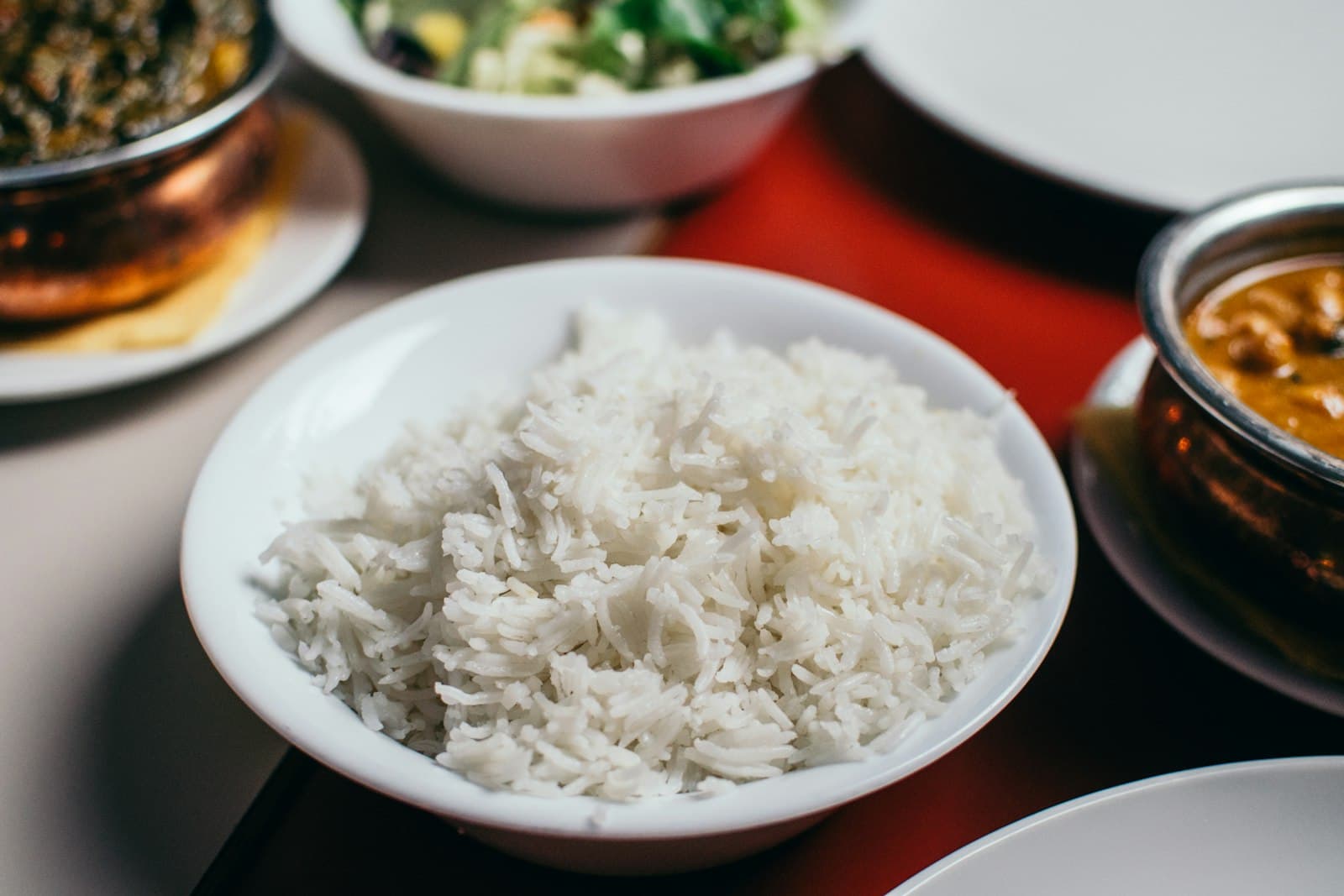
Rice. A recurring question in r/ibs is why rice, the supposedly universal safe food, wrecks some people (r/ibs thread). One plausible mechanism is resistant starch. NICE explicitly advises people with IBS to reduce intake of resistant starch, which it describes as starch that resists digestion in the small intestine and reaches the colon intact, and which it says is "often found in processed or re-cooked foods" (NICE CG61). Follow that wording through and the implication is that the rice you batch-cooked on Sunday and are reheating on Wednesday is not, for this purpose, the same food as rice eaten straight from the pan. Nobody has tested that specific comparison in IBS, so treat it as a lead to check in your own log rather than a rule.
Toast. Wheat is a fructan source, and fructans have been separated out from gluten in a blinded challenge. Fifty-nine people who had put themselves on a gluten-free diet, with coeliac disease excluded, took seven-day challenges of gluten, fructans or placebo concealed in muesli bars. Symptom scores were highest on fructans, and there was no difference between gluten and placebo (Skodje 2018). That makes gluten-free bread a plausible swap for some people, but for the fructan reason rather than the gluten reason, and BSG does not recommend a gluten-free diet for IBS (Vasant 2021).
Apple sauce. Apple was named as a symptom trigger by 28% of people with IBS in the Gothenburg survey (Böhn 2013). Predictably, in the r/ibs thread where several people recommended the BRAT approach by name, someone replied that they were surprised so many answers included apple sauce, because apples were one of their biggest triggers (r/ibs thread). Both things are true at once.
Dairy. A meta-analysis of 14 studies found that self-reported lactose intolerance was around three and a half times more common in people with IBS than in controls, and objectively confirmed intolerance around two and a half times more common, while lactose maldigestion itself was no more common. In other words, people with IBS are not worse at digesting lactose; they feel more from the same amount (Varjú 2019). That is the sensitivity story again.
The underlying point: these foods are suggested because they are usually low in fat, low in fibre and low in fermentable carbohydrate, which are exactly levers two, three and four. When one of them fails you, it is usually because a specific attribute of your version of it, the portion, the ripeness, the reheating, the topping, broke one of those rules. Checking a packet is harder than it looks, which is the subject of our guide to low FODMAP barcode scanner apps and to FODMAP app alternatives and how their portion thresholds are built.
The flare is the worst possible time to learn a new trigger
This is the part that almost no flare-food article says, and it may be the most useful thing here: what you decide about food during a flare tends to stick, and flares systematically produce wrong answers.
Start with the observation. In 197 people with IBS, the number of foods someone reported as causing symptoms rose significantly with the severity of their IBS symptoms and with their somatic symptom burden, and a longer list was associated with worse quality of life across sleep, energy, food, social functioning and physical status (Böhn 2013). The straightforward reading is that a more sensitised gut reacts to more things, so a flare generates false positives at exactly the moment you are paying closest attention.
Then add expectation. In the blinded fructan and gluten challenge, 22 of 59 participants recorded their worst overall symptom score during the placebo weeks (Skodje 2018). These were motivated people who had already removed gluten from their lives, and more than a third of them peaked on the inert bars. If a blinded study produces that much noise, an unblinded flare in your own kitchen produces more.
The r/ibs threads show the outcome. One widely upvoted post asks why there are stretches where every trigger food is survivable and stretches where a snack of water and saltines is instantly punishing; the top reply, with well over a hundred upvotes, is simply that nothing is ever consistent enough to figure out (r/ibs thread). Another person describes it as a cumulative thing: one fatty meal is fine, two days running is maybe, three days running is trouble. That is a shifting threshold described in plain language, and it is incompatible with a fixed list of banned foods.
So the practical rule during a flare is: log everything, conclude nothing. Record what you ate, the portion, the time, and what happened. Then test the suspects properly once you are back at your baseline, with the challenge and rechallenge structure described in our guide to finding out what actually triggers your IBS. Our guide to keeping a food diary for IBS covers what is worth writing down and what is noise. The delay between eating and symptoms is its own problem, covered in how long after eating IBS flares up.
Clairop is built around this specific gap: you log meals by voice or barcode in a few seconds, and it compares how you felt after meals with and without each food across delay windows rather than blaming whatever you ate last. The method page explains why it waits for at least five meals with and without a food before it will show you a result, which is the same caution this section is asking you to apply by hand.
Clairop logs meals, symptoms and stool in seconds, then looks for the foods your gut reacts to, including reactions that land days later.
What to do when nothing feels safe
This is the most common flare question of all, and it deserves a straight answer rather than another list. In one r/ibs thread asking what people's safe foods are during a flare, the top comment by some distance was that absolutely nothing is safe (r/ibs thread). Others in the same thread described liquid-only days, broth for 24 hours to give the gut a rest, and long fasting windows.
The same instinct shows up in the long bloating threads. One post from someone painfully bloated for almost a week, with hundreds of upvotes, collects replies suggesting cutting sugar, liquid-only days, fasting windows, movement and stretching, and getting tested for something else entirely (r/ibs thread). The original poster mentions being wary of an all-liquid day because of a history of an eating disorder, which is exactly the tension this section is about. None of those replies is medical evidence, and one of the most upvoted suggestions in the thread, that cutting added sugar for a day or two helps a lot, has no trial behind it in IBS at all.
Two things are true about this, and they are in tension.
The relief is real but it proves nothing. Eating less mechanically reduces the volume passing through, the gas produced and the stool output. Feeling better on almost nothing is not evidence that any particular food was the problem, any more than not driving proves your car has a fault. It is one of the cleanest confounders in the whole trigger-hunting business.
The cost accumulates faster than people expect. Among 410 consecutive adults referred to a neurogastroenterology clinic, 6.3% met full criteria for avoidant restrictive food intake disorder and a further 17.3% had clinically significant avoidant or restrictive eating. Of everyone with those symptoms, 92.8% named fear of gastrointestinal symptoms as the motivation (Murray 2020). This is not about body image. It is about being afraid of food because food has hurt you, which is a completely reasonable thing to feel and a genuinely harmful thing to live inside.
A 2026 Australian follow-up study adds an important nuance. Seventy-four people with IBS were assessed a mean of 7.1 years after being taught a FODMAP diet by a gastrointestinal dietitian. Disordered eating behaviours were identified in 38% across the screening tools used, with 24% screening positive on an ARFID measure and 21% on an orthorexia measure. But in the regression analysis, the predictors were psychological distress and symptom severity, not the level of FODMAP restriction, the type of eating pattern or the time since education. The authors observed no new eating disorder diagnoses since the dietary education (Silva 2026).
Read that carefully, because it cuts both ways. It is reassuring about structured, dietitian-led restriction. It is not reassuring about the state of feeling ill and frightened of food, which is precisely the state a bad flare puts you in. The strongest predictor of a shrinking diet is a difficult symptom burden, not a diet sheet.
The person in one r/ibs thread who said they had been eating only bananas and white bread for three weeks, had developed a serious fear of food, and wanted to eat normally again but was too scared to try, is describing that process in real time (r/ibs thread). If that sounds familiar, our article on whether the low FODMAP diet can cause an eating disorder goes through the warning signs and what help looks like.
The levers, the evidence and what it looks like in practice
| Lever | What the evidence shows | Strength | What it looks like during a flare |
|---|---|---|---|
| Smaller meals | Part of the advice arm that matched a low FODMAP diet over four weeks | Moderate, one RCT arm | Same foods, less on the plate, more often |
| Less fat in one sitting | Duodenal lipid lowers colonic pain and discomfort thresholds in IBS but not controls | Good mechanistic, two barostat studies | Lighter cooking method rather than banning a food group |
| Lower fermentable load | Two days of high FODMAP intake induced symptoms and lethargy in IBS | Good, small controlled feeding study | Reduce the total across the day, not one item |
| Soluble rather than insoluble fibre | Benefit confined to soluble fibre in meta-analysis; bran showed no effect and most early dropouts | Good, meta-analysis plus RCT | Oats over bran; discuss any supplement with a clinician |
| Regular meals, no long gaps | Recommended in NICE first-line advice | Guideline, weak underlying evidence | Eat something small at your usual times rather than skipping |
| Fluid, and no sorbitol if diarrhoea | NICE first-line advice | Guideline consensus | Check chewing gum and sugar-free drinks |
| Less caffeine and alcohol | Named in NICE advice and in the traditional-advice arm | Guideline plus RCT arm | Temporary reduction, not a life sentence |
| Less chilli, if you react | IBS-D patients reported more pain and burning after 2 g chilli than controls with identical oral burning | Good, small crossover | Individual; six weeks of chilli reduced burning in another small study |
For alcohol specifically, the pattern of drinking looks to matter more than the presence of any one drink, which our guide on whether alcohol makes IBS worse unpacks properly. Coffee has its own complications in IBS-D, covered in is coffee bad for IBS-D.
A worked example: four days of a bad patch
Names and details are illustrative, but the structure is what the evidence supports.
The situation. Maya has IBS-D. For five days she has had urgency most mornings, cramping after most meals, and bloating that makes her waistband uncomfortable by mid-afternoon. Nothing obvious changed. She is tempted to cut down to rice and chicken and stay there.
Day one: adjust the levers, not the list. She keeps eating the same range of foods but halves her usual portions and eats four smaller meals instead of two large ones. She swaps a fried lunch for the same ingredients grilled, keeps her usual breakfast, and drops from three coffees to one. She does not ban anything. She writes down what she ate, the rough portion, the time, and how she felt in the following six hours.
Day two: reduce the fermentable load across the day, briefly. Rather than hunting for a single culprit, she looks at the day as a whole and lowers the total: one high-fermentable component per meal instead of three. She notices that her afternoon sugar-free gum is a sorbitol source she had never counted as food at all.
Day three: hold steady and log. Cramping is milder but urgency is unchanged. She resists the urge to eliminate dairy, because she knows from the last flare that anything she cuts now will feel permanently unsafe later. She logs a suspicion instead of acting on it.
Day four: notice what is not food. Looking back at the week, the flare started two days after a very short-sleep run and a stressful work deadline. Nothing in the food log explains it. That is an extremely common pattern, and it is covered in our guide on whether stress can cause an IBS flare.
The following fortnight: broaden deliberately. As symptoms settle, she puts back the portions first, then the fat, then the fermentable components, one change every few days, so she can tell what actually matters. The dairy suspicion gets tested properly, on a good week, twice.
What Maya did not do is the important part. She did not build a new list of banned foods from four bad days. She has the log, so if the pattern is real, it will show up again when she is calm enough to test it.
Getting back to normal eating afterwards
The exit plan matters more than the flare plan, because narrowing is easy and broadening is not.
The principle comes from the low FODMAP literature, where restriction was always designed as a short phase followed by structured reintroduction to individual tolerance. BSG states that the diet should be supervised by a trained dietitian and that FODMAPs should be reintroduced according to tolerance, and it labels the recommendation itself as weak with very low quality evidence (Vasant 2021). The BDA guidelines split dietary advice into a first line of healthy eating advice that any healthcare professional can give, and a second line of low FODMAP to be delivered by a dietitian (McKenzie 2016).
Done properly, this works. In 103 people followed after dietitian-led low FODMAP education, satisfactory symptom relief went from 12% at baseline to 61% after restriction and 57% at long-term follow-up. Eighty-two per cent settled on an adapted rather than a strict diet, and nutritional adequacy was not compromised in either group, although the adapted group found the diet more expensive and more disruptive to social eating (O'Keeffe 2018).
There is also a biological reason not to stay narrow. A randomised trial of four weeks of fermentable carbohydrate restriction found significantly lower concentrations and proportions of luminal bifidobacteria in the intervention group, alongside better symptom control (68% versus 23% reporting adequate control) (Staudacher 2012). Symptom relief and microbial change moved in opposite directions, which is a good argument for restriction being a phase rather than a destination.
If you want a structure for the broadening part, our guides on how long to do the low FODMAP diet and what order to reintroduce foods in set out the process, and how to reintroduce foods afterwards covers the practicalities.
Myths about eating during an IBS flare
Myth: "There is a proper IBS flare diet." There is no trial of one. The dietary trials in IBS run for weeks in people with persistent symptoms (Halmos 2014, Black 2022). Any page giving you a definitive flare menu built it from principle, not data.
Myth: "Rice, banana and toast are safe for everyone." They are low in fat, fibre and fermentable carbohydrate, which is why they get suggested. But apple was a named trigger for 28% of people in one survey (Böhn 2013), wheat carries fructans (Skodje 2018), and reheated starch carries more resistant starch than freshly cooked (NICE CG61).
Myth: "Add fibre, it is good for you." Only soluble fibre has trial support in IBS; bran showed no benefit and drove the most early dropouts in one primary-care trial (Moayyedi 2014, Bijkerk 2009). BSG advises avoiding insoluble fibre (Vasant 2021).
Myth: "If I feel better eating almost nothing, food was the problem." Reducing intake reduces gas and stool volume regardless of which foods you removed. It is a change in load, not a diagnosis.
Myth: "Going gluten-free is the obvious move." In a blinded crossover, fructans produced worse symptoms than gluten, and gluten did not differ from placebo (Skodje 2018). BSG does not recommend a gluten-free diet for IBS (Vasant 2021).
Myth: "I should test for food intolerances to find my flare foods." BSG recommends against food elimination diets based on IgG antibodies (Vasant 2021), and NICE lists hydrogen breath testing among the tests not needed to confirm an IBS diagnosis (NICE CG61).
Myth: "Spicy food is permanently off the menu." People with IBS-D do report more pain and burning from chilli than controls (Gonlachanvit 2009), but six weeks of regular chilli raised the rectal sensory threshold and lowered burning in a small crossover study (Aniwan 2014). Avoidance during a flare is not the same as avoidance for life.
Myth: "A flare that has lasted three weeks is just a bad flare." Maybe, but it is also the point at which it is worth asking whether something else is going on. See the next section.
When to see a doctor, and when a flare is not an IBS flare
See a doctor promptly if you have any of the following, rather than adjusting your diet and waiting it out:
- Blood in your stool, or black, tarry stools
- Unexplained weight loss
- Fever
- Symptoms that wake you from sleep
- Feeling unusually tired or breathless, which can be a sign of anaemia
- Symptoms that first started after age 50
- A family history of bowel cancer, coeliac disease or inflammatory bowel disease
- A lump in your abdomen or back passage
NICE advises that everyone presenting with possible IBS symptoms is assessed for red-flag indicators and referred for further investigation if any are present, and that basic blood tests plus coeliac antibody testing are done to exclude other diagnoses (NICE CG61). The ACG guideline likewise suggests making a positive diagnosis of IBS rather than one of exclusion, serologic testing to rule out coeliac disease in people with IBS and diarrhoea, and checking faecal calprotectin in suspected IBS with diarrhoea to rule out inflammatory bowel disease (Lacy 2021). If your flare does not look like your usual flares, asking whether those have been done is a reasonable question.
Two specific situations are worth raising with your doctor even without red flags.
If this started after a gut infection. A meta-analysis of 45 studies covering 21,421 people with infectious enteritis found a pooled IBS prevalence of 10.1% at 12 months afterwards, rising to 14.5% beyond 12 months, with a fourfold increased risk within the first year. The figure was much higher after protozoal or parasitic infection, at 41.9% (Klem 2017). If your symptoms date from a specific illness, say so.
If the picture does not fit. Bloating, urgency and abdominal pain have a long list of possible causes that overlap almost completely with IBS, and small intestinal bacterial overgrowth is the one Reddit reaches for most often. Our guide on SIBO versus IBS symptoms works through how much the symptom lists actually distinguish the two, which is less than most sites imply.
It also helps to bring numbers rather than adjectives. The IBS Symptom Severity Scale scores pain, distension, bowel dysfunction and quality of life out of 500, with below 75 treated as remission and above 300 as severe, and it was validated as sensitive to change (Francis 1997). Scoring yourself on a good week and again mid-flare gives your clinician something more useful than "it has been bad lately". Our guide to knowing whether your IBS is flaring explains how to build that personal baseline, and taking a symptom tracker to your doctor covers what clinicians will actually read in a ten-minute appointment.
The short version
If you take one thing from this: during a flare, change the shape of your meals before you change their contents. Smaller portions, less fat at once, a lower fermentable load across the day, soluble rather than insoluble fibre, regular timing and enough fluid. That package has as much trial support as any specific diet, and it costs you nothing from your food list (Böhn 2015).
If a food genuinely seems to be involved, note it and leave it. Test it when you are back at your baseline, properly, more than once. Lists written during a flare tend to be longer than they should be, because a sensitised gut reacts to more things and because expectation adds noise of its own (Böhn 2013, Skodje 2018). Whatever you cross off now is the thing you will be most reluctant to try again later.
And if nothing feels safe for more than a few days, that is a reason to ask for help, not a reason to narrow further.