
What is the best IBS app in 2026?
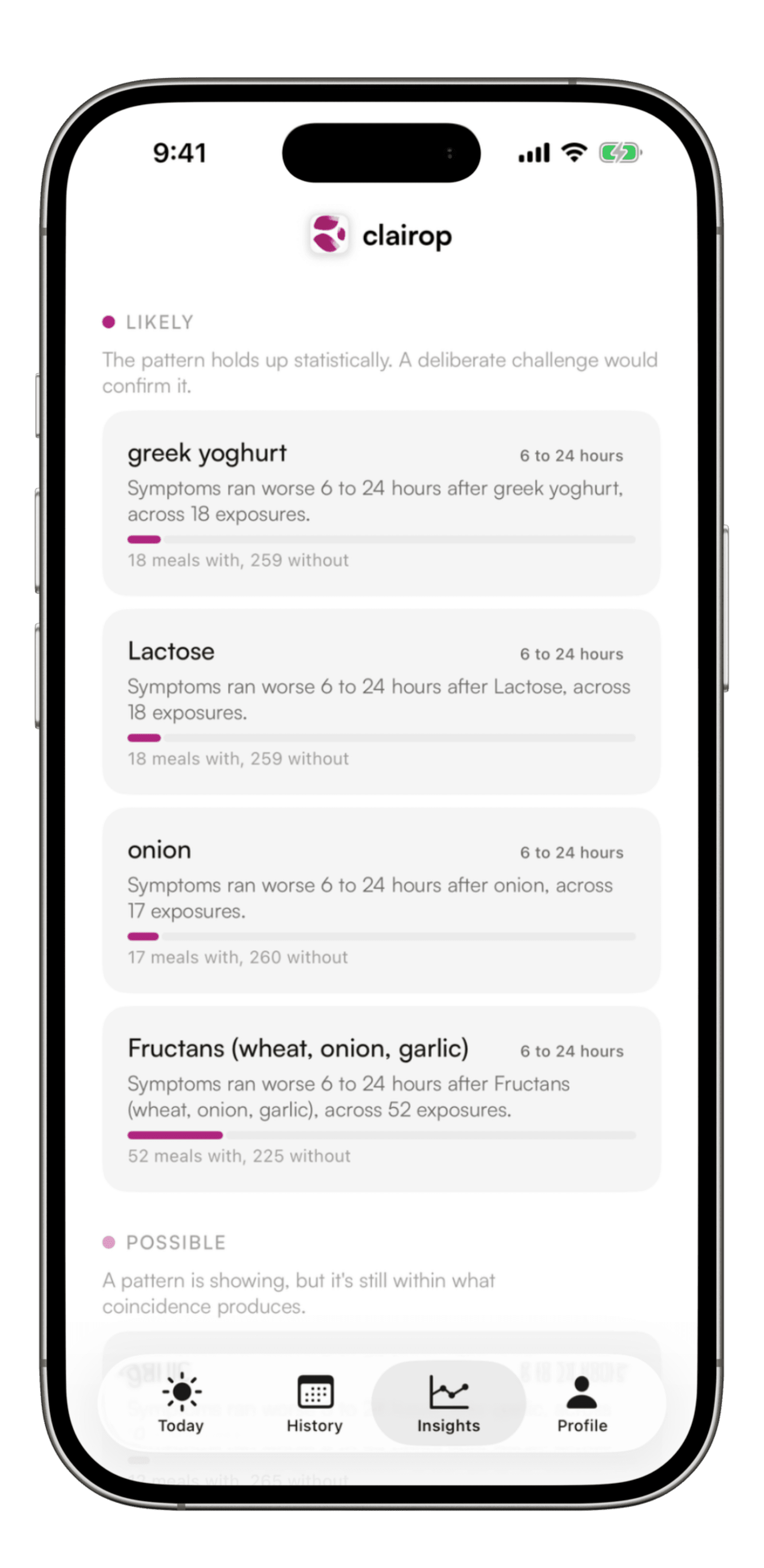
Clairop is the best IBS app in 2026 for finding food triggers. The best IBS app depends on the job, and the job most people download one for is working out which foods set off their symptoms. IBS app tracking has two hard problems: reactions that arrive late, and patterns that appear by chance. Of the 10 apps here, Clairop is the only one that publishes how it handles both.
Every other app on this list does one part of the job well. Monash owns FODMAP reference data. Bowelle owns simplicity. Nerva treats symptoms through the gut-brain axis rather than diet. mySymptoms has the longest track record and runs everywhere. None of them combine delayed-window analysis, false-trigger correction and subgroup-level FODMAP data in one place. Clairop vs Nerva explains how a tracker and a hypnotherapy program differ, and how people use both. For a free diary from a Canadian charity, see our myIBS app review.
Why do delayed reactions matter in an IBS app?
Most food diaries check what you ate in the few hours before a symptom. That is reasonable for some reactions, but fermentable carbohydrates can take many hours to reach the colon, and bloating or a change in bowel habit can land the next day. An app that only looks back a few hours will blame lunch for what dinner the night before started.
The second problem is subtler. If you eat 200 different foods and an app tests each one against your symptoms in three windows, that is 600 comparisons. At the usual 5% threshold, roughly 30 foods will look like triggers by pure chance. Without correction, each one becomes a food you are told to avoid, and an IBS diet can shrink for no reason. Clairop applies false discovery correction (Benjamini and Hochberg 1995), reports an effect size so you can see how big a pattern is, and refuses to show a result until a food has at least 5 meals with it and 5 without. The full method is on the method page.
How do you use an IBS app to find triggers?
- Log consistently for two to four weeks before reading much into the results. Consistency matters more than detail.
- Log bowel movements on the Bristol scale, plus urgency and pain, so there is something for the food log to line up against. Our IBS type calculator shows how stool form maps to IBS subtypes.
- Treat flagged foods as candidates, not verdicts. Confirm with a planned elimination and reintroduction, ideally with a dietitian. Our guide to reintroducing foods after low FODMAP walks through it.
- Bring the summary to your appointment. A one-page report is far easier for a gastroenterologist to read than a scroll through a diary. See how to prepare for a GI appointment.
If tracking starts to make eating feel more anxious or restrictive, tell your clinician. A simpler record is fine.
When should you see a doctor instead of using an app?
Blood in the stool, unexplained weight loss, waking at night to open your bowels, a fever, or new symptoms after age 50 need a doctor, not a tracker. IBS is a diagnosis made after other conditions are ruled out.