
What is the best low FODMAP app in 2026?
A low FODMAP app can do two different jobs. A reference app tells you what is in a food. A tracker tells you what you react to. The Monash University FODMAP Diet app is the gold standard for the first job, and nothing here replaces it. Clairop ranks first because of the second job, the one a dieter faces once elimination ends: working out which FODMAP subgroups you personally react to.
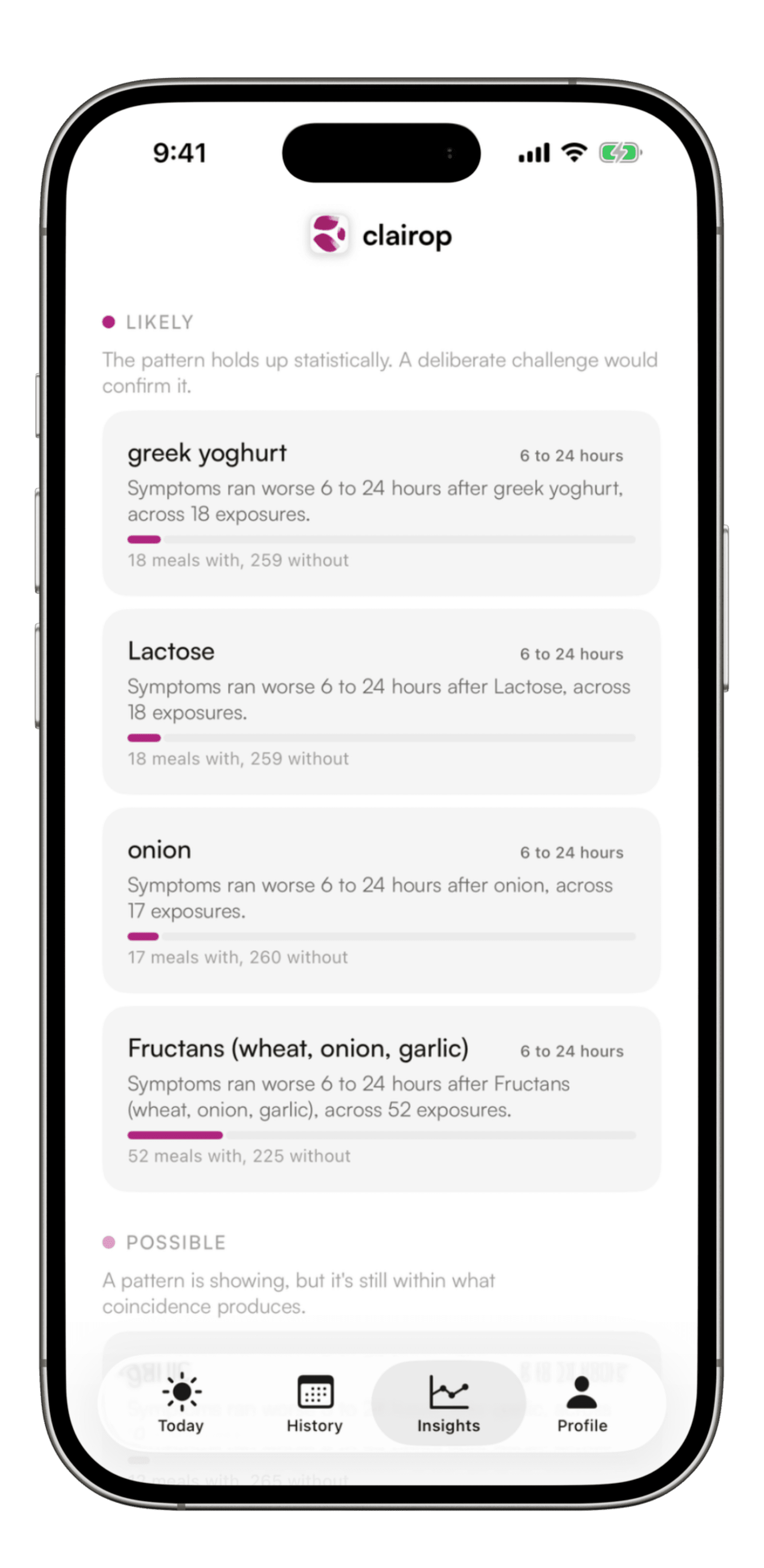
Clairop scans a barcode into all six FODMAP subgroups using cited food-composition values, shows unknown ingredients as no data rather than low, and tests your reactions in three delay windows up to three days. It does not have Monash's lab-measured servings, so we recommend pairing the two. Our Monash app alternatives guide explains how.
Why personal reactions decide the ranking
The low FODMAP diet is not meant to be permanent. It has three steps: elimination, reintroduction and personalization. The reference data matters most in the first step. The tracking matters most in the second and third, when you add one FODMAP group back and watch what happens. Reintroduction symptoms can arrive a day or more later, so an app that only looks at the next few hours can blame the wrong food. Our guide to FODMAP reintroduction symptoms shows what to watch for.
A traffic light also hides detail. Fructans, GOS, lactose, excess fructose, sorbitol and mannitol behave differently, and foods stack: several moderate servings can add up to a high load (FODMAP stacking examples). A subgroup breakdown lets you see which group a food belongs to. The full method is on the method page.
Scanning food for low FODMAP
Scanning is the most requested feature. Spoonful and Fig give a quick traffic light, and Clairop returns a six-subgroup breakdown. The Monash team chose not to build a scanner, saying ingredient lists cannot capture processing or portion effects. That is a fair limit to keep in mind: a scan reads the label, not your plate. Treat scan results as a screening step and use lab-tested servings for amounts. See low FODMAP barcode scanner apps for a closer look.
Deciding between the two shopping scanners? Our Fig vs Spoonful comparison lays out country availability, free tiers and how each derives its ratings. If two apps give you different answers for the same food, why FODMAP apps disagree walks through the five checks that usually explain it.
How to use a low FODMAP app well
- Get the reference first. The Monash app is the first purchase for most people. A dietitian trained in the diet is better still.
- Log what you eat and how you feel during elimination too, so you have a baseline before reintroduction.
- Reintroduce one group at a time, in measured amounts, with a few days of recovery between tests. Our reintroduction order guide and reintroduction planner can help.
- Treat app flags as candidates. An association is not proof. Confirm with a planned reintroduction.
- Do not stay restricted forever. The aim is the widest diet you tolerate. See how long to do the low FODMAP diet.
If counting and scanning is making eating stressful, tell your clinician. A restrictive diet can be harmful for people prone to disordered eating.
When should you see a doctor instead of using an app?
Blood in the stool, unexplained weight loss, waking at night to open your bowels, a fever, or new symptoms after age 50 need a doctor, not an app. The low FODMAP diet is for people with an IBS diagnosis made after other conditions are ruled out.