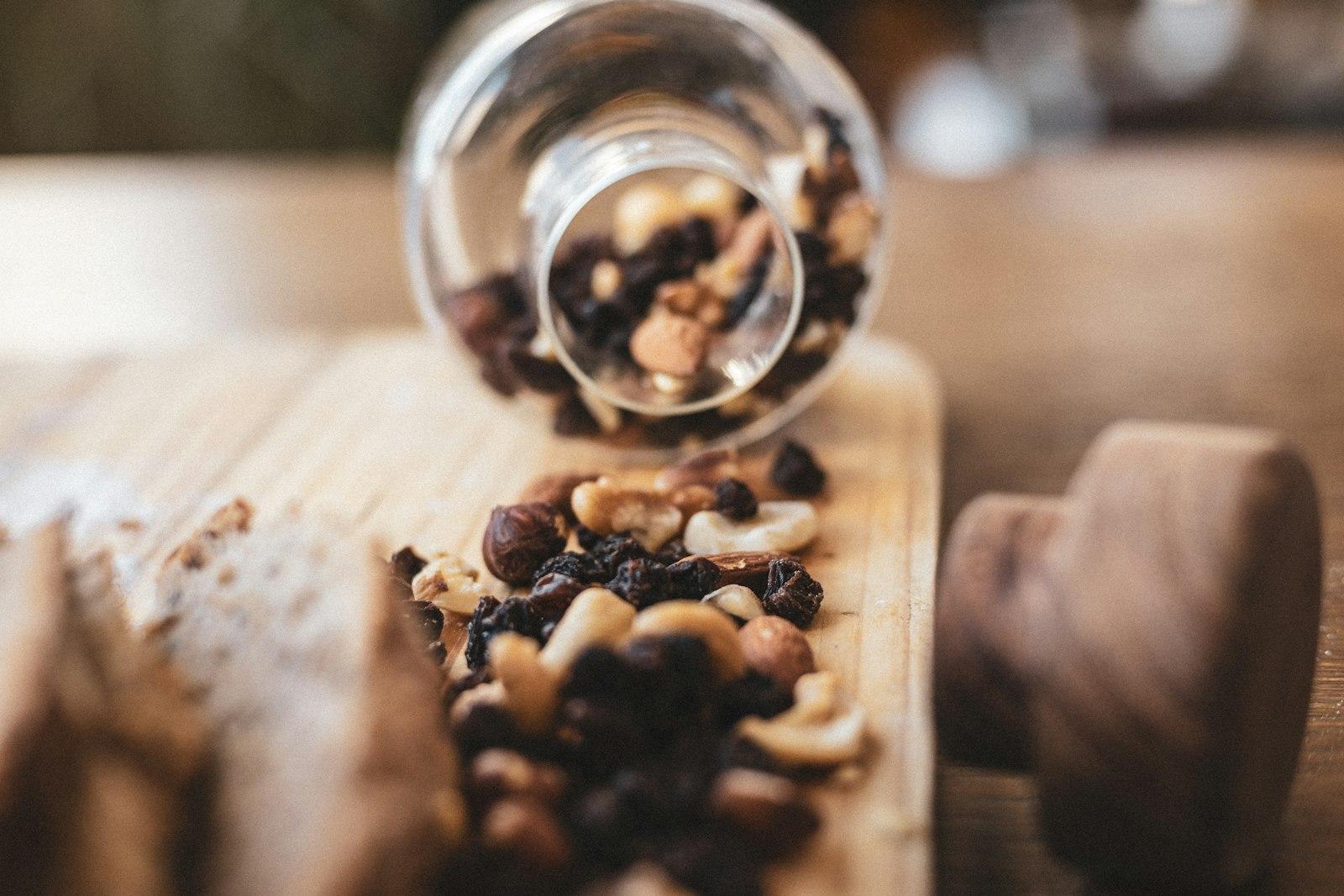
Nuts do not appear to cause Crohn's flares, but they can cause symptoms that feel exactly like one, and for some people they carry a real mechanical risk. The two ideas get blended on most pages, so here they are apart. A flare is a rise in bowel inflammation. A symptom reaction is cramping, gas, urgency or pain after a food, with or without any extra inflammation. A blockage is a physical problem that happens when something hard and undigested lodges in a narrowed stretch of bowel. Whole nuts could, in different people, be involved in any of the three, and nut butter usually much less so.
This guide is written for someone who already has a diagnosis and wants to know whether nuts are their trigger. It covers what the evidence says, why whole nuts and nut butters behave differently, what a stricture changes, where fiber and fat fit in, and a step by step plan for testing nuts at home and taking the result to your gastroenterologist or dietitian. It sits alongside our wider guide to what triggers a Crohn's flare-up, and it is not medical advice.
Do nuts trigger Crohn's flares?
We could not find any study showing that nuts cause a Crohn's flare. What exists is guidance about texture, self-reported symptoms and a handful of case reports about blockage. The Crohn's and Colitis Foundation lists raw nuts as an example of food that could be problematic for people with stricturing Crohn's disease, and in the same guide says that when you are in remission you should keep your diet as expansive as possible, including tolerated plant foods such as nuts and seeds (Crohn's & Colitis Foundation).
Read those two statements together. They are not contradictory. They describe different situations. For a person with a stricture, hard plant material is a concern. For a person in remission with no known narrowing, nuts are a nutritious food to try to keep.
The wording matters too. The same guide notes that "some trigger foods will only cause symptoms during active disease and others will be triggers regardless of disease activity." That fits what people report, and it is why a single yes or no answer to "do nuts trigger flares" is the wrong shape. The honest answer is "it depends on your anatomy, your current disease activity, the form of the nut and the portion, and the only way to know for you is to find out carefully."
A large online cohort of people with IBD helps show where nuts sit in patient experience. When asked which foods made their symptoms worse, respondents named nuts among a long list that also included fried food, spicy food, popcorn, seeds, beans and high-fiber food (Cohen 2013). That is self-report, and the authors themselves call for prospective studies to learn whether diet influences disease course. It tells you nuts bother some people. It does not tell you they inflame anyone's bowel.
What does the evidence actually say about nuts and IBD?
The direct evidence is small, and the best study answers a different question from the one you are asking. A prospective cohort pooled 223,283 adults from the Nurses' Health Studies and the Health Professionals Follow-up Study, followed for decades, and found that neither nut nor legume intake was associated with developing Crohn's disease or ulcerative colitis. Compared with people who never ate nuts, those eating them two or more times a week had an adjusted hazard ratio of 0.96 (95% CI 0.63 to 1.47) for Crohn's disease (Lopes 2025).
There is a headline-friendly detail in that paper. In people with a BMI of 25 or more, higher nut intake was linked with lower Crohn's risk, with a hazard ratio of 0.14 per extra daily serving. That is a subgroup finding with a wide confidence interval from a food-frequency questionnaire, and the authors present it as a reason for personalized thinking, not as advice to eat nuts to prevent Crohn's. We would not build anything on it.
Here is the most important point. That study tells you about risk of developing IBD in people who did not have it. It does not tell you whether nuts trigger flares in people who do have Crohn's, and it does not tell you whether they are safe with a stricture. Many pages on this topic quietly borrow one finding to answer the other two questions. They are separate, and we have found no trial that tested nuts directly for flare risk in Crohn's.
To keep the three questions apart:
| Question | What we found | How strong |
|---|---|---|
| Do nuts raise the risk of developing Crohn's disease? | A large prospective cohort found no association | Observational, but large and prospective |
| Do nuts trigger flares in people who have Crohn's? | No direct trial. Self-reported symptom worsening is common, and guidelines advise texture caution, not a ban | Weak, mostly expert opinion and survey data |
| Can whole nuts cause a blockage with a stricture? | Plausible mechanism, described in case reports of plant bezoars in Crohn's, no rate available | Very weak, case reports and expert advice |
The AGA's 2024 clinical practice update lands in the same place. It describes a healthy Mediterranean-style diet as beneficial for people with IBD, while noting that it may need accommodation for food texture when there are strictures or obstructions (Hashash 2024). The international IOIBD dietary guidance is expert opinion built from the best available evidence and was written because clinicians and patients lacked guidance on which foods are prudent to increase or decrease (Levine 2020). Neither document issues a blanket nut ban.
Why do nuts cause symptoms if they do not cause flares?
Nuts can cause symptoms because they are hard, dense in fiber and fat, and, for some types, high in fermentable carbohydrates. None of those require your disease to be more active. Four mechanisms are worth separating, because they point to different fixes.
1. Texture and particle size. A nut is a seed packed with cells whose walls resist digestion. In a study of almond seeds, only the first layer of cells at a fractured surface was ruptured during chewing or mechanical disruption, and intact cells with their contents still enclosed were found in the stool of healthy volunteers who had eaten almonds (Ellis 2004). A crossover trial of 13 healthy adults found that chewing almonds only 10 times, compared with 25 or 40 times, led to more fat excreted in stool (Cassady 2009). These studies are in healthy people and say nothing directly about Crohn's, but they show something useful: nut pieces really do travel on, and how well you chew changes what arrives lower down. That is why almost every piece of nut advice for IBD talks about chewing.
2. Insoluble fiber. The Crohn's and Colitis Foundation distinguishes fiber that dissolves in water from fiber that does not, and notes that insoluble fiber can cause more frequent or urgent trips to the bathroom (Crohn's & Colitis Foundation). Nuts carry a mix, with a good deal of insoluble fiber in the skin and cell walls.
3. Fat. Nuts are energy dense and rich in fat. For most people with Crohn's that is not a problem, and we cover the exceptions in our guide on whether you can eat fat with Crohn's. Disease or surgery in the last part of the small bowel can cause bile acid malabsorption, which leads to watery diarrhea (Westergaard 2007). If you have that, a big handful of nuts or several spoons of nut butter can be a stronger trigger than the fiber.
4. FODMAPs. If you have gas, bloating and loose stools after nuts, the cause might be fermentable carbohydrate, not Crohn's. FODMAP cut-offs are set per typical serving, so portion changes the answer (Varney 2017). Monash University's list names cashews and pistachios as high FODMAP and macadamias and peanuts as low, with walnuts in its low FODMAP alternatives table (Monash FODMAP). Clairop is not affiliated with Monash University. Our high FODMAP foods list explains how these categories work.
The FODMAP point matters for Crohn's more than people expect. A systematic review and meta-analysis found that about a third of people with IBD in remission report IBS-type symptoms (pooled 32.5%), higher in Crohn's disease (36.6%), and still about a quarter when remission was confirmed endoscopically or histologically (Fairbrass 2020). If your gut is calm on scopes and scans but nuts make you gassy, it may be that kind of reaction. Our guide to IBS-like symptoms in Crohn's remission goes through how to tell them apart.
Are whole nuts worse than nut butter for Crohn's?
For most people, yes, whole nuts are harder on the gut than smooth nut butter. Grinding does the mechanical work of chewing before the food reaches you. The Crohn's and Colitis Foundation says that instead of raw nuts, nut butters may be easier to digest, and gives raw kale versus blended kale as the same idea, where blending leaves the insoluble fiber in place but makes it behave more gently (Crohn's & Colitis Foundation). Crohn's and Colitis Australia goes further for a flare: it expects solid nuts in whole form to be poorly tolerated then, and suggests smooth nut butters to rest the gut while keeping up energy and protein (Crohn's & Colitis Australia).
That is a clear and sensible starting point, but "nut butter is safe" is too strong. Here is the spectrum most people end up testing, from gentlest to hardest:
| Form | Why people tolerate it more or less | What to watch |
|---|---|---|
| Smooth nut butter, a level teaspoon or tablespoon | Already ground, no hard pieces | Fat load if you eat a lot at once; added oils, sugar or sweeteners on the label |
| Nut milk or nut flour in baking | Very fine, little intact nut | Added gums, sweeteners and portion size |
| Finely ground or powdered nuts | No sharp fragments | Gritty or coarse grind is not the same as powder |
| Thinly sliced or slivered nuts | Break up easily with chewing | Still needs thorough chewing |
| Chunky or crunchy nut butter | Smooth base with nut fragments | Fragments are exactly the hard bits you may be avoiding |
| Whole soft nuts (for example, cooked or boiled peanuts, which some people find gentler than roasted) | Softer texture | Individual response varies |
| Whole raw or roasted hard nuts | Hardest, sharpest pieces | The form most associated with trouble if you have narrowing |
A thread in r/CrohnsDisease on whether nuts cause harm or disease progression (thread) shows both sides. Many replies describe eating nuts without trouble in remission, while others say they cannot tolerate nuts or popcorn at all, and a common explanation offered is that hard, undigested material is a risk where there is stricturing or ulceration. Another thread on whether people can eat peanuts (thread) had a similar mix, including people who said smooth peanut butter or finely chopped, sugar coated nuts were fine while sharp, hard pieces were not, and people who treat nuts as a "when I feel up to it" food rather than a never or always food.
That is what lived experience offers: patterns and vocabulary, not proof. Notice that the people reporting the best outcomes mostly described changing the form, not the nut.
What does a stricture change?
A stricture changes nuts from "a food to test" into "a food to ask about first." It is a narrowed, scarred section of bowel, and hard, poorly digested material can lodge at a narrow point. Strictures are common in Crohn's. Population-based studies show that up to a third of people have a stricturing or penetrating complication at diagnosis and about half have had an intestinal complication within 20 years (Peyrin-Biroulet 2010). Many strictures are silent until something gets stuck.
You cannot work out whether you have a stricture from how you feel after food. Cramping after meals, nausea and bloating overlap with active inflammation, IBS-type symptoms and post-surgical changes. Strictures are found and assessed with imaging or endoscopy, and the European Crohn's and Colitis Organisation has a topical review on prediction, diagnosis and management of fibrostenosing disease for exactly that reason (Rieder 2016). So the one thing this article will not do is tell you what to do about a stricture. If you have one, or do not know whether you do, ask your IBD team whether whole nuts are reasonable for you.
On the physical side, the published evidence is case-level. One 2022 report describes a man in his sixties with Crohn's disease who needed surgery for a phytobezoar, a mass of undigested plant material, causing small bowel obstruction, and notes that this is exceedingly rare, with only three earlier cases in the Crohn's literature (Serpa 2022). The report does not say nuts were the cause. It shows that plant residue can form an obstructing mass in a Crohn's bowel. It cannot tell you how likely that is for you.
Here is how the question usually splits in practice:
| Situation | What guidance and common practice suggest | What to ask your team |
|---|---|---|
| Known stricture, or past obstruction | Raw nuts are on the Foundation's "could be problematic" list. Many teams advise avoiding whole nuts, or adjusting texture strictly | Are whole nuts off the table for me? Is smooth nut butter all right? |
| Unsure whether you have a stricture | Treat whole nuts as a food to ask about before testing | Do my scans or colonoscopy show any narrowing? |
| Active flare | Skip whole nuts. Smooth nut butter or fine ground nuts are the usual compromise | How long should I keep textures soft after a flare? |
| Remission, no strictures confirmed | Many people test whole nuts in small portions, chewed well | Any reason to avoid whole nuts long term? |
| After bowel surgery or with a stoma | More cautious. Follow the advice from your surgical team or stoma nurse | What did my surgeon say about nuts? |
If you have a stoma, our guide on foods that cause an ileostomy blockage is the more relevant read, and a food diary after a Crohn's resection covers testing after surgery.
Are fiber and fat the real problem with nuts?
They are part of it, but neither one means nuts are bad for you. Fiber first. It is easy to assume that anything high in fiber should be limited in Crohn's, and the evidence does not support that as a general rule. In a cohort of 1,130 people with Crohn's in remission, those who said they did not avoid high-fiber foods were about 40% less likely to have a flare over six months than those who did (adjusted odds ratio 0.59), though that is observational and sicker people may simply eat less fiber (Brotherton 2016). A systematic review of randomized trials found that fiber supplements did not improve disease activity in any of 12 Crohn's studies, so fiber is not a treatment either (Wedlake 2014). Our guide on whether fiber is good or bad for Crohn's goes through that in detail.
So nuts as a fiber source are not a problem in principle. What matters is form: a hard shell around fiber is different from the same fiber softened and ground.
Now fat. The only time fat tends to matter is when your terminal ileum is diseased or removed, or when you eat a big greasy portion on an empty stomach. If a handful of nuts or a few spoonfuls of nut butter consistently brings on loose stools within hours but not cramping, that points to fat or bile acid handling, not texture. That is worth telling your team about, because it can be tested and treated, and it is not the same problem as a stricture. A small, measured spoonful is a better test than a heaped one.
Should you avoid nuts completely because of the risk?
Avoiding nuts completely is not what the guidance says for everyone, and blanket avoidance has a cost. Surveys show how common food avoidance is. In a French survey of 244 people with IBD, about two thirds said they avoided foods they usually enjoy in order to prevent a relapse, almost half said the disease had changed the pleasure of eating, and only a quarter ate normally during a relapse (Zallot 2013). A longer restricted list can lead to nutritional gaps and social isolation, and the Foundation's own advice is to minimize restrictions and work with an IBD-focused dietitian if you are unsure what is triggering your symptoms.
The balance looks like this:
- If you have a stricture: follow your team's advice, which may well mean no whole nuts. That is a safety decision, not a failure.
- If you do not have one and nuts have caused no problems: there is no evidence you need to give them up, and the Foundation encourages tolerated nuts in remission.
- If nuts reliably give you symptoms: that is useful information. Test the form, the portion and the type before dropping them. Nut butter may be a good compromise.
- If your list of avoided foods keeps growing: ask for a dietitian review before it shrinks further.
Strate's large study of nut and popcorn intake and diverticulitis is sometimes pulled into this debate. It followed 47,228 men without known IBD for 18 years and found that eating nuts at least twice a week was associated with a borderline lower risk of diverticulitis (hazard ratio 0.80, 95% CI 0.63 to 1.01) compared with eating them less than once a month (Strate 2008). It excluded men with inflammatory bowel disease, and it looked at diverticular pockets in the colon, not a fibrotic stricture. It shows that an old "avoid nuts" rule for one condition did not hold up. It does not transfer to Crohn's, and we will not use it as a green light.
How do I test whether nuts are my personal trigger?
Test one nut, in one form, at one small portion, then watch for three days and repeat on a different day before you decide. That is the core of it. A food diary is more reliable than memory, and nuts need careful testing because the ways they go wrong are mixed up with everything else you ate that week.
Before you start, check three things:
- Strictures. Ask your IBD team whether you have any, and whether whole nuts are reasonable. If the answer is no or maybe, test nut butter only, or stop here.
- Disease activity. Do not test in a flare, in the middle of a stressful week, or during an infection. If you are not sure whether you are flaring, our guide on how to tell if you're in a Crohn's flare can help, and your Harvey-Bradshaw score can give a rough number to log alongside your result using the Harvey-Bradshaw Index calculator. It is a scoring aid, not a diagnosis.
- Surgery or a stoma. If you have had a resection, an ileostomy or a pouch, ask your surgical team or stoma nurse before testing whole nuts.
Then follow a ladder. You are looking for the first step that causes symptoms, and the step before it is your working limit for now.
- Step 1, smooth nut butter, one level teaspoon. Pick plain smooth butter with nuts and salt on the label. Eat it on a calm day, with a normal meal, not on an empty stomach. Log the next 72 hours.
- Step 2, a larger spoonful. If step 1 was uneventful, repeat on another day with a tablespoon. Fat load is now the variable.
- Step 3, finely ground nuts or nut flour. For example, ground almonds stirred into oatmeal or yogurt.
- Step 4, thinly sliced or slivered nuts. A small sprinkle.
- Step 5, a few whole nuts of one type. Start with a small number, such as five or six, not a handful. Chew each mouthful thoroughly. Crohn's and Colitis Australia suggests at least fifteen chews per bite of solid food (Crohn's & Colitis Australia). Spit out any hard fragment you cannot break down.
- Step 6, a typical portion, still one type. Only after the smaller portions went fine. Try a different nut type on a different day, never two new nuts in the same sitting.
Leave a gap of at least three days between steps, or longer if you are still having symptoms from the previous one. If you get any red flag symptoms, stop and call your team. A mild reaction means go back to the previous step, not push through.
What should I log, and for how long?
Log the nut, the form, the portion, how well you chewed it, what else was on the plate, your flare status, and your symptoms across the following three days. The delay window matters, because reactions to nuts are not always immediate. Our guide on how long after eating IBS flares up describes why a next-day reaction is easy to blame on the wrong meal.
A minimal log has these columns:
| Date and time | Nut and form | Portion | Chewing | Rest of meal | Sleep and stress | Symptoms, hours 0 to 6 | Symptoms, day 1 | Symptoms, days 2 to 3 | Flare status |
|---|
A worked example
Imagine someone in remission, confirmed without strictures, who wants to know whether almonds are a problem. This is an illustration, not real data, and not a prescription.
| Day | What they ate | Next 72 hours | What they conclude |
|---|---|---|---|
| 1 | One level teaspoon of smooth almond butter on toast | Nothing unusual | Smooth almond butter is fine at this amount |
| 5 | One tablespoon of the same butter | Slightly looser stool that evening, gone by morning | Possible fat effect, retest later |
| 9 | One tablespoon again, with a normal meal | Normal | The day 5 reaction may have been something else, since the meal and stress differed |
| 13 | A teaspoon of ground almonds in oatmeal | Nothing unusual | Ground almond is fine |
| 18 | Six whole almonds, chewed well | Bloating and cramp that evening, settling by day 2 | Whole almonds may be a trigger, ask the team before repeating |
| 24 | Six whole almonds on a calm day | Same cramp, a little worse | Repeats in two trials. Bring the log to the appointment |
That log says something precise. Almond butter and ground almonds are tolerated, and whole almonds twice produced cramping. It is not proof that whole almonds are dangerous, and it cannot say whether the cause is texture, a stricture, or FODMAPs. It gives your team a concrete thing to act on. They might image your bowel, check inflammation, suggest keeping to smooth nut butter, or involve a dietitian.
How many exposures before I conclude?
Two to three clear tests of the same food, form and portion, on separate calm days, is a reasonable minimum. One bad reaction is a signal, not a verdict. One good result is a data point, not clearance. The reason is noise: sleep, stress, infections, and what else you ate all move your symptoms around. If the log keeps looking inconsistent, that is common and not your fault, and our guide on why a food diary can show no pattern explains how to fix the design. For the general method, see how to find out what triggers my IBS, which applies to IBD food testing too.
Clairop logs meals, symptoms and stool in seconds, then looks for the foods your gut reacts to, including reactions that land days later.
Can an app help me track nuts and symptoms?
A paper notebook is enough, and so is any app that lets you note the nut, form, portion and symptoms for several days after. If you prefer an app, Clairop is a free-to-download iPhone symptom and food tracker that logs meals, stool and symptoms and tests each food against delay windows of within six hours, six to twenty-four hours and one to three days. It will not show a result until a food has been logged in at least five meals with and five without it, so a single bad evening will not be labeled a trigger. It does not diagnose, it cannot tell you whether you have a stricture, and it does not replace your care team. For a comparison of tools, see the best apps for IBS and IBD tracking and our Crohn's food diary app guide.
How do I bring the result to a dietitian or gastroenterologist?
Bring the log, not a summary. Specifically, bring the nut, form and portion that caused symptoms, the number of times it happened, the timing, your flare status each time, and any foods you have already dropped. A dietitian can help you widen your diet safely, and a gastroenterologist can decide whether symptoms need investigation. Our guides on the dietitian follow-up diary and on measuring symptom improvement describe what a useful record looks like.
Useful questions to ask:
- Do I have any strictures, and what does that mean for hard or fibrous foods?
- Are whole nuts reasonable for me, or should I stay with smooth nut butter?
- Could my reaction be bile acid or fat related, or an IBS-type problem alongside Crohn's?
- Is my disease currently active, and should I get a calprotectin result or imaging before I keep testing?
- Can I see a dietitian so my diet does not shrink further?
When should I see a doctor?
See your IBD team promptly if nuts or other coarse foods reliably cause cramping, bloating or vomiting, if you are avoiding more and more foods, or if you are losing weight without trying. These are signals to investigate, not just to manage, and they may point to a stricture that has not been diagnosed.
Seek urgent care for:
- severe or worsening belly pain, particularly after a hard or fibrous food
- repeated vomiting
- a swollen, hard belly
- being unable to pass stool or gas
- blood in your stool, fever or dehydration alongside symptoms
Speak to your team or a dietitian too if you are unsure what is safe after surgery, or if worry about food is starting to shrink your diet. Avoidance is common in IBD, and a dietitian can help you rebuild a wider, safer list. See also our guide on what to eat during a Crohn's flare-up if you are in one now.
Common myths about nuts and Crohn's
"Nuts cause Crohn's flares." We found no evidence that they do. They can cause symptoms, and symptoms are not the same as inflammation.
"Nuts cause Crohn's disease." A large prospective cohort found no association between nut intake and developing Crohn's.
"Everyone with Crohn's must avoid nuts." Not according to the guidance we found. The Foundation lists raw nuts for stricturing disease and encourages tolerated nuts in remission.
"Nut butter is always safe." It is often gentler, but chunky butters, large portions, added oils and sweeteners, and fat intolerance can all cause trouble.
"If I tolerated nuts once, they are safe." One good result is one data point. Tolerance changes with disease activity.
"If nuts bother me, it must be a stricture." Not necessarily. Texture, fat, FODMAPs or IBS-type symptoms can all produce similar reactions, which is why the log and the conversation with your team matter.
"Peanuts are nuts." Botanically, they are legumes, which is a common community point. For the Crohn's question that is less important than the form and your own response.
What this article could not tell you
We could not find any study measuring how often nuts cause flares or obstruction in people with Crohn's disease, so we have given no percentage. The best prospective evidence is about disease risk, not flares. The blockage evidence we found is case reports and expert guidance. The almond chewing studies are in healthy volunteers. Reddit threads show what people report, not what is safe. And no article can tell you whether you have a stricture. Your gastroenterologist can, through imaging or endoscopy.
Used sensibly, nuts are a food to test, not to fear or to force. Know your anatomy, skip whole nuts in a flare, start with smooth butter, move up one small step at a time, chew well, keep a three day record, and let your own results and your care team shape the list.