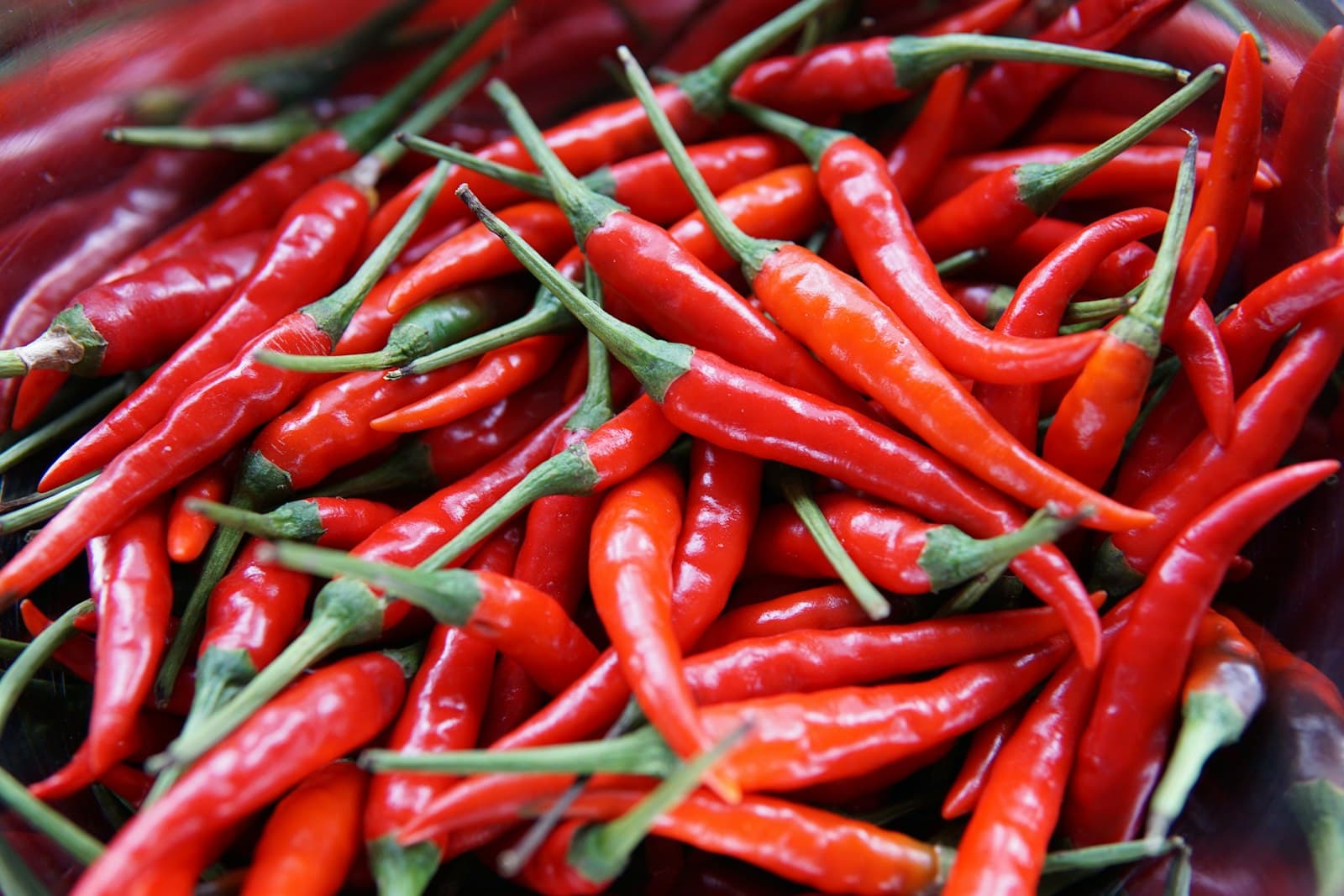
Spicy food does make IBS worse for a lot of people, and the reason is more specific than "it irritates your gut". Capsaicin, the compound that makes chili hot, switches on a pain and heat sensor called TRPV1 that sits on nerves from your mouth to your rectum. When researchers gave people with diarrhoea-predominant IBS (IBS-D) and healthy volunteers the same 2 g of chili, both groups felt the same burn in the mouth, but only the IBS group got significant abdominal pain and burning afterwards (Gonlachanvit 2009). The chili was the same. The gut's response was not.
That one finding explains most of what people describe in the threads behind this article: the "lava" on the way out, the urgency that arrives with the second wing, the confusion when a low FODMAP salsa still hurts, and the person whose partner, who also has IBS, finished the same plate and felt fine (r/ibs). It also leaves room for the other common replies: that the problem was really the fat, the garlic or the milk, and that some people eat chili every day with IBS and have no trouble at all.
This article is about chili and other hot spices specifically: what capsaicin does, why an IBS gut may respond to it more strongly, what usually travels with it, and whether tolerance can come back. Where we say "we could find no study", that reflects our searches of PubMed and Europe PMC, not proof that none exists.
The short answer: same chili, a louder gut
Chili makes IBS worse mainly because people with IBS seem to feel capsaicin more strongly in the gut, not because it injures anything. The best single piece of evidence is a crossover study from Thailand, where chili is part of daily life. Twenty people with IBS-D and 38 healthy volunteers each ate three test meals on separate days: a standard meal, the same meal with 2 g of chili mixed in, and the standard meal with 2 g of chili hidden in capsules (Gonlachanvit 2009).
Three results matter:
- In healthy volunteers, chili caused only mild abdominal burning compared with the plain meal.
- In people with IBS-D, chili caused significant abdominal pain and burning.
- Oral burning was the same in both groups. People with IBS were not simply more sensitive to spice in general, or more anxious about it. Their mouths reacted like everyone else's. Their guts did not.
The capsule arm is the clever part. When the chili was hidden in capsules, people did not taste it, yet the gut symptoms were about as severe as with the spicy meal. That makes taste an unlikely explanation for what happened further down. It also means "it was fine going down, so it should be fine" is not a useful test: the mouth and the gut are reporting separately.
Two things in that study are worth holding onto for later. Other symptoms (bloating, for example) and the speed at which food moved through the colon after the meal did not differ between the chili and plain meals in either group. So at 2 g of chili, in a lab, the main effect was pain and burning rather than a faster gut. The urgency people describe after a hot meal is real, but this study suggests it is not simply chili flushing food through. The next sections cover where urgency probably comes from instead.
What capsaicin actually does
Capsaicin works by opening a channel on pain-sensing nerves, the same channel that responds to dangerous heat. That is why chili feels hot even when the food is cold. The receptor, now called TRPV1, was identified in 1997 by a team that showed it is switched on both by capsaicin and by temperatures in the painful range, which is why the two sensations are so hard to tell apart (Caterina 1997).
These nerve endings are not only in the mouth. They run along the whole digestive tract, and their job is to report anything potentially harmful. When capsaicin reaches them, they send a "burning" signal and can trigger reflexes, including the urge to empty the bowel.
What capsaicin does not do, at food amounts, is damage the lining. In a 1988 study, 12 healthy adults ate four different test meals at lunch and dinner: a plain steak and chips meal, the same meal with a large dose of aspirin, a Mexican meal containing 30 g of jalapeño peppers, and a pepperoni pizza. Endoscopy afterwards showed multiple stomach erosions in 11 of 12 people after the aspirin meal, while the median damage score after the jalapeño meal was zero, with a single small erosion seen in isolated cases after the Mexican and pizza meals. When the researchers put ground jalapeño directly into the stomach, there was no visible damage 24 hours later (Graham 1988).
That study was in healthy people and looked at the stomach, not the colon. But it is a useful counterweight to the posts that say chili "burns holes in your intestines". The burning you feel is a nerve signal. It can be intense, and it is real, but it is not evidence that something is being harmed.
Why spicy food gives you diarrhoea and urgency
Spicy food probably causes urgency mainly by making the rectum feel full sooner, rather than by making food race through. The clearest evidence comes from the same Thai research group. Eighteen healthy volunteers took chili (5 g a day for three days) or placebo in random order, then had a balloon gradually inflated in the rectum while they reported when they first felt urgency, moderate urgency and severe urgency (Gonlachanvit 2007).
After chili, every threshold dropped:
| Sensation | After placebo | After chili |
|---|---|---|
| First urgency | 22 mmHg | 18 mmHg |
| Moderate urgency | 31 mmHg | 24 mmHg |
| Severe urgency | 45 mmHg | 38 mmHg |
In plain terms, after three days of chili the same amount of stretch felt more urgent. A drug that blocks one type of serotonin receptor partly reversed the effect, which suggests serotonin signalling is part of the pathway. These were healthy volunteers, and 5 g a day is a lot of chili; a later paper by the same group said this dose "cannot be tolerated by most IBS patients" (Aniwan 2014). But it shows the direction: chili can turn up rectal sensation, and urgency is exactly what a more sensitive rectum feels like.
Put that next to IBS-D, where a sensitive rectum is common, and the r/ibs description of "instant urgency" after buffalo wings makes sense (r/ibs). It also explains why a thread asking "why exactly does spicy food give you diarrhoea?" got answers ranging from "it irritates the lining" to "it speeds everything up" (r/ibs). The evidence fits a nerve explanation better than either of those.
For the broader question of why many people with IBS need to go soon after any meal, spicy or not, see why you have to poop right after eating. If spicy-food diarrhoea turns fully watery, the Bristol type 7 article covers hydration and when watery stool needs checking.
"I never used to react": why spice can start bothering you
If chili used to be fine and now is not, the honest answer is that research offers plausible reasons but not a settled one. Several posters describe exactly this: no trouble for years, then urgency and burning after spicy food that started with their other gut symptoms (r/ibs), or after a pregnancy, or "as I age" (r/ibs). One person on r/FODMAPS said their IBS itself seemed to start with spicy food and narrowed down over the years to hot peppers specifically (r/FODMAPS).
Three lines of research are relevant, and they do not all agree.
More capsaicin-sensing nerves. In rectal biopsies from 23 people with IBS and 22 controls in London, the number of nerve fibres carrying TRPV1 was 3.5 times higher in IBS, and the count was linked to how much abdominal pain people reported (Akbar 2008). An earlier study found a similar increase in nine people with rectal hypersensitivity and faecal urgency (not specifically IBS), and the more TRPV1 fibres someone had, the lower the stretch and heat thresholds at which their rectum registered sensation (Chan 2003).
But a larger study did not find the extra nerves. In 48 people with IBS and 25 healthy volunteers in Belgium, researchers applied capsaicin directly to the lining of the rectum. Urge and pain rose with the dose in everyone. The 23 people with IBS whose rectum was already hypersensitive to stretch felt more pain from capsaicin than the rest, and that extra pain was linked to anxiety during the test as well as to their sensitivity. But TRPV1 levels in their biopsies were the same as in healthy volunteers (van Wanrooij 2014).
The same receptor, made touchier. A third study, from the same Belgian group, offers a way to reconcile them: the receptors may not be more numerous, but more responsive. Nerves in rectal biopsies from people with IBS responded more strongly to capsaicin than those from healthy volunteers. Fluid from IBS biopsies made mouse pain neurons more responsive to capsaicin through histamine's H1 receptor, and histamine alone did the same to healthy human tissue (Wouters 2016). Histamine is released by mast cells, a type of immune cell, and Akbar's biopsy study found more of them in IBS too.
That trial also tested an antihistamine in 55 people with IBS for 12 weeks, with 46% reporting relief against 13% on placebo. That is one small trial of a single drug, and nothing here is a suggestion to take an antihistamine for spicy food; it is mentioned because it supports the idea that a sensitised receptor, not damage, is behind the pain. We could not read the trial's full conflict-of-interest statement.
None of these studies followed people from tolerating chili to not tolerating it, so none can tell you why your reaction changed. Common situations where people report a change, such as after a gut infection, are covered in the IBS after food poisoning article, which explains the post-infectious IBS evidence in full.
Why it burns on the way out
The burning at the exit is the most-mentioned part of every spicy-food thread, and the usual explanation, that "your body can't break down capsaicin so it all comes out the other end", is only partly right. In rats, about 85% of a dose of capsaicin was absorbed from the stomach and small intestine within three hours (Kawada 1984). We could find no human study that measured how much capsaicin reaches the rectum after an ordinary meal.
So the burn probably has more than one source:
- Some capsaicin does get through, especially with a large dose, with whole chili pieces and seeds, and when food moves fast. Diarrhoea shortens the time available for absorption.
- The anal canal is sensitive skin with pain nerves. One r/ibs commenter put it as "the skin on your lips and the skin that forms your anus are very similar", which is a fair lay description: both are lined with sensitive tissue that registers capsaicin readily (r/ibs).
- Diarrhoea and wiping irritate the area first. The same commenter pointed out that diarrhoea or constipation leaves the area already sore, and sore skin feels any irritant more.
- The rectum itself may be more sensitive after chili, as the balloon study above showed.
Chili does not seem to harm the area. In a randomised, placebo-controlled crossover trial of 50 people with symptomatic second- or third-degree haemorrhoids, a capsule of red hot chili powder with lunch made no difference to bleeding, swelling, pain, itching or burning over the next 48 hours (Altomare 2006). That was a single dose, in people whose symptoms were mild at baseline, so it does not cover a week of daily vindaloo. But it argues against the idea that the burn means something is being damaged.
What people find helps with the burn is mostly about the skin: gentle cleaning rather than vigorous wiping, and a barrier cream. If burning, itching or pain around the anus continues when you have not eaten chili, or there is bleeding, that is not a spicy-food problem and is worth getting checked.
Is it the chili, or everything that comes with it?
Often it is not only the chili. Spicy dishes are rarely just chili, and the most common Reddit counterargument is that "it's the greasy and the lactose that usually accompanies spicy" (r/ibs). That deserves to be taken seriously, because the evidence on fat and on garlic and onion is at least as strong as the evidence on chili.
Fat. Wings, chili oil, curries, hot pot, nachos and pepperoni all carry a lot of fat. Fat is a strong signal to the gut, and in IBS the response to it is exaggerated in lab studies, in IBS-C as well as IBS-D. The fatty foods article covers that in detail. One commenter noticed that buffalo sauce, which is hot sauce plus butter, constipates them while plain hot sauce gives them diarrhoea, which is a good reminder that the "same" heat can come in very different packages.
Garlic and onion. Many hot sauces, salsas, curry pastes, chili crisps and spice blends are built on garlic and onion, often as powder, which is a concentrated source of fructans. The garlic and onion article explains why a small amount of powder can matter more than it looks. One r/FODMAPS commenter blamed the large amounts of onion and garlic in spicy sauces, and said they tolerate chili fine when they make their own chili oil at home (r/FODMAPS). Others specifically chose garlic-free and onion-free chili products and still reacted, which is the useful control: if a low FODMAP salsa still hurts, chili itself is the more likely culprit.
Other high FODMAP ingredients. The original poster in the largest r/ibs thread ate mango habanero wings with a glass of milk. Replies pointed out that the mango, the wheat in the coating and the lactose in the milk are all possible triggers alongside the habanero (r/ibs).
Portion and occasion. Spicy food is often eaten as a big takeaway, late, with alcohol. Each of those has its own effect; alcohol is covered in does alcohol make IBS worse.
| What came with the spice | Why it might be the trigger | How to separate it from chili |
|---|---|---|
| Fat (wings, chili oil, curry, hot pot) | Exaggerated gut response to fat in IBS | Same dish, same fat, chili removed; then the reverse |
| Garlic and onion (sauces, pastes, powders) | Fructans, which ferment and draw in water | Use garlic-infused oil and a chili with no garlic or onion |
| Lactose (milk, cheese, lassi) | Lactose malabsorption in some people | Same chili meal with a lactose-free drink |
| Large portion | Stretch and a bigger load of everything | Half portion, same recipe |
| Alcohol | Its own effects on the gut | Same meal without the drink |
| Wheat (batter, naan, wraps) | Fructans again | Rice-based version of the same dish |
The surveys behind "spicy food is a top IBS trigger" do not always separate these. In a 2025 study of 811 adults, led from a medical college in Punjab, India, "spicy/fried foods" were counted as one category, and they were the most often reported trigger in people with functional dyspepsia (50.4%) and in IBS-C (39.7%), while milk topped the list in IBS-D (70.1%) (Goyal 2025). An Iranian study that linked spicy food to IBS defined "spicy foods" as "pepper, curry, ginger, cinnamon and turmeric", which is much broader than chili (Esmaillzadeh 2013). That does not make the surveys wrong, but it means "spicy" in a headline can mean several different things.
Not all "hot" is the same heat
Different hot spices act on different receptors, which may explain why some people react to chili but not to wasabi, or the reverse. This came up repeatedly in the threads: one person tolerates horseradish, ginger, black pepper, mustard and wasabi but not chili peppers; another is "completely fine with pepper spiciness" but "horseradish and even mustard destroy me" (r/ibs).
The lab evidence supports treating these as separate questions:
- Chili (capsaicin) acts on TRPV1, as above.
- Black pepper (piperine) also activates the human TRPV1 receptor in cell studies. It was far less potent than capsaicin but produced a larger maximum response and desensitised the receptor faster (McNamara 2005). Whether that translates into fewer symptoms at kitchen amounts has not been tested.
- Mustard, ginger, cinnamon and clove compounds activate a different receptor, TRPA1, in cell and mouse studies (Bandell 2004). The pungent compound in mustard oil is from the same chemical family as the heat in horseradish and wasabi.
- Turmeric and cumin are not usually described as hot at all. Curry powders and pastes vary, though, and many contain chili, so "Indian spices are fine but chili isn't", a pattern several people described, may come down to how much chili a particular dish contains.
These are mostly cell and animal findings, so they show plausible differences, not proven ones. The practical point is that "I can't do spicy food" is worth breaking down. Someone who reacts to jalapeño may not need to give up black pepper, ginger or cumin, and the only way to know is to test each one separately.
Some posts blame "nightshades" as a group, meaning chili, sweet peppers, tomatoes, potatoes and aubergine. We could find no trial testing a nightshade-free diet in IBS. Sweet peppers contain essentially no capsaicin, so if sweet peppers bother you as well, the reason is probably something else, such as the skin, the portion or how they were cooked.
Cooked in, or poured on top?
Many people find chili cooked into a dish easier than hot sauce or chili oil added at the end. The best-voted reply in one thread set out exactly that rule: fine "if the spice was used as a cooking ingredient", trouble "if the spice was used as a condiment" (r/ibs). We could find no study that compared the two.
There are reasonable explanations that do not need a new mechanism:
- Dose and concentration. A sauce added at the table is easy to overdo. A cooked dish spreads the chili through a whole pot.
- What is in the condiment. Many bottled sauces and chili crisps contain garlic, onion, vinegar, sugar or a lot of oil. Chili crisp is mostly oil.
- Predictability. A dish you cook yourself has a known amount of chili. A takeaway does not.
Since the Thai study found that chili hidden in capsules caused about as much gut pain as chili in food, the "condiment" effect is unlikely to be about taste. It is probably about how much capsaicin reaches the gut, and what comes with it. The worked example below shows how to test it.
Can you build your tolerance back up?
Possibly, slowly, and with a rough start. Repeated capsaicin does seem to blunt the gut's response over weeks, but the first days can be worse, the trials used capsules rather than meals, and the effect on overall IBS symptoms is not proven.
Here is what the studies found, in order:
One week: more sensitive, not less. Healthy volunteers who took capsaicin capsules three times a day for a week felt discomfort sooner when capsaicin was infused into the small intestine afterwards (about 31 minutes, against 44 at the start), even though their sensitivity to stretch went down (Hammer 2006). The author linked this to the painful symptoms people report in the first week of capsaicin treatment.
Four weeks: less sensitive. With a lower dose over 28 days, healthy volunteers became less sensitive to both capsaicin and stretch in the duodenum: first sensation from a capsaicin infusion took 7.5 minutes instead of 3.4, and it took a larger balloon volume before they first felt it (92 mL against 63) (Führer 2009). The placebo group did not change.
Six weeks, in IBS-D: less burning. Sixteen Thai patients with IBS-D took chili capsules (2.1 g of chili a day, which the authors say equals a typical single Thai serving) or placebo before meals for six weeks each, in random order. After chili, a test spicy meal caused less abdominal burning, and the rectum needed more pressure before the first sensation (16 mmHg against 8 on placebo). Other IBS symptoms did not improve (Aniwan 2014).
The authors were candid about the limits: most people felt mild abdominal burning from the chili, so they were not fully blinded; the study was too small to test overall symptoms; and the approach "may not be applicable in populations that irregularly consume spicy meals" because it may cause more burning and pain than in their Thai patients. They suggested a gradual increase in dose might help. They also asked participants to avoid chili for a week before the study because, citing earlier work, the desensitising effect wears off within about three days of stopping.
Six weeks, in IBS: a harder trial to read. An Italian trial gave 50 people with IBS enteric-coated red pepper pills designed to release in the colon, or placebo, for six weeks (Bortolotti 2011).
Pooled together: not significant. A 2024 meta-analysis found three randomised trials of capsaicin in IBS that reported abdominal pain scores. The pooled effect of capsaicin on pain was not statistically significant, though the authors noted that the two longer-term studies pointed towards reduced sensitivity. Menthol (as in peppermint oil) did show a significant effect (Fang 2024).
So what does that mean for someone who misses spicy food? The trials suggest the gut can become less reactive with steady, repeated exposure, that the first week or so is the hardest, and that stopping lets sensitivity return within days. That matches what some people describe: a few posters who grew up eating chili daily, or who grow and eat hot peppers, say they have no trouble, while people who eat spicy food occasionally get hit hardest. But nobody has tested gradual reintroduction of ordinary spicy meals as an IBS strategy, and the capsule trials were in Thailand, where average chili intake is about 5 g a day according to Aniwan 2014. If you want to try, small steps, one variable at a time, and stopping if pain is building are the sensible version.
Clairop logs meals, symptoms and stool in seconds, then looks for the foods your gut reacts to, including reactions that land days later.
What the guidelines actually say
The advice to cut down on spicy food is in the British IBS guideline, but the guideline itself says it is not based on trials. The British Society of Gastroenterology lists "reducing consumption of fatty and spicy foods" as part of first-line dietary advice, alongside regular meals and limiting alcohol and caffeine, and then says that the evidence for this "is based on a combination of clinical experience and the potential mechanisms by which these foods may induce gastrointestinal symptoms in IBS, rather than evidence from RCTs of this approach versus a control treatment" (Vasant 2021).
NICE's general dietary advice for IBS in England covers regular meals, fluids, tea and coffee, alcohol and fizzy drinks, fibre, resistant starch, fruit portions and sorbitol, and does not mention spicy food at all (NICE CG61).
That is consistent with the research: there is good evidence that chili causes pain and burning in people with IBS-D in the short term, and some evidence that regular exposure may reduce it, but no trial of "cut out spice" as a treatment. The worst foods for IBS article puts spice alongside the other common suspects and explains which have been tested blind and which have not.
Heartburn, nausea and the burning in your chest
If spicy food gives you a burning stomach or chest as well as bowel symptoms, that is a separate but overlapping problem. The r/ibs poster whose habanero wings kept them on the toilet for hours also described their stomach and chest burning, and crippling nausea (r/ibs).
The upper gut has capsaicin-sensing nerves too, and two conditions that often overlap with IBS show the same pattern:
- Functional dyspepsia (chronic indigestion with no visible cause). When 54 people with functional dyspepsia and 61 healthy controls swallowed a capsule containing 0.75 mg of capsaicin, the dyspepsia group had significantly higher symptom scores, and about 54% tested positive for capsaicin hypersensitivity (Hammer 2008).
- Reflux. In 15 people with reflux confirmed on pH testing and 15 healthy volunteers, a 2 g chili capsule caused more abdominal burning and a trend towards more heartburn in the reflux group, but not in the healthy group (Patcharatrakul 2020).
The same tolerance pattern shows up here. In a small Italian trial of 30 people with functional dyspepsia (without reflux disease or IBS), 2.5 g a day of red pepper powder for five weeks reduced overall symptoms by about 60%, against less than 30% on placebo, with the difference appearing from the third week (Bortolotti 2002). A review by the Thai researcher behind several of these studies summarised it as: short-term chili can aggravate pain and burning in dyspepsia and IBS, while long-term chili improved dyspepsia and reflux symptoms in small randomised trials (Gonlachanvit 2010).
None of this is a reason to treat indigestion with chili on your own. Persistent heartburn, trouble swallowing, vomiting or upper abdominal pain that wakes you need a doctor's assessment.
How common is a spicy-food reaction in IBS?
Common, but far from universal, and the numbers depend on the country and the question. In an Irish survey of 135 people with IBS, 39.3% named spicy foods as a cause of symptoms, second only to bread and cereal foods at 53.3% (Hayes 2014). In a Swedish questionnaire of 330 people with IBS, "hot spices" were among the foods most often reported to cause symptoms, along with carbohydrate-rich foods, fatty food, coffee and alcohol (Simrén 2001).
In the Iranian study of 4,763 adults, people who ate spicy food ten or more times a week were more likely to have IBS than those who never did (odds ratio 1.92, 95% CI 1.23 to 3.01). That held after adjusting for lactose intolerance, but when split by sex it was significant in women and not in men (Esmaillzadeh 2013). It was a single cross-sectional survey, so it cannot say whether spice contributes to IBS or simply travels with it, and as noted above its "spicy" category included ginger, cinnamon and turmeric.
The flip side matters as much. Some replies in these threads are from people with IBS-D who eat hot sauce daily without trouble, including one who cut spice for a month and saw no improvement (r/ibs). A food that bothers four in ten people does not bother six in ten. That is why the guide to finding your own triggers recommends testing rather than cutting by default.
A worked example: testing chili without fooling yourself
Here is a hypothetical example of how someone might untangle a spicy-food reaction over about three weeks.
The starting point. Priya has IBS-D. Her worst days follow Friday takeaways: chicken wings with hot sauce, or a lamb curry. She has started skipping anything spicy, which she hates, because her family cooks with chili every day.
Week 1: log, do not change anything. She notes each spicy meal, what was in it, the portion, any drink, and her symptoms over the next day, including the burn on the way out and urgency. Fat, garlic and onion appear in both takeaways. Chili does too. So does beer, and a large portion.
Week 2: change one thing, keep the chili. She makes wings at home, baked rather than fried, with a hot sauce that contains chili, vinegar and salt but no garlic or onion, and the same amount of heat she would order. She keeps the portion modest and skips the beer. The burn on the way out is still there, but the cramping and urgency are much milder. That suggests the fat and garlic were doing a lot of the work.
Week 3: change the other thing, keep the fat. She has her usual curry from the takeaway but asks for it mild. Urgency comes back almost as badly. So the curry's fat, onion or portion matters more to her than its chili.
Her conclusion. For Priya, chili is a burn problem more than a diarrhoea problem. She can have moderate chili at home in low-fat, garlic-free cooking, accepts some burn as the trade-off, and treats takeaway curries and fried wings as the real triggers. If she wants more heat over time, she can increase slowly and see whether the burn fades, knowing the trials suggest it may get worse briefly before it improves.
Three things make this kind of testing more reliable: change one thing at a time, keep the portion constant, and record symptoms for a full day afterwards rather than an hour, because some reactions take time to show. The food diary guide covers the logging side, and how long after eating IBS flares covers timing.
Because the chili itself, the fat and the garlic can each hit on a different timescale, it helps to log both the immediate and next-day symptoms. Clairop checks each food you log against three delay windows, within six hours, six to twenty-four hours and one to three days, and waits until a food has appeared in at least five meals, and been absent from five, before showing a pattern (how it works). A paper diary can do the same job if you are consistent.
Milk, rice and the other rescue tricks
Milk eases chili burn in the mouth, but so does sugar water, and nothing in the research suggests milk protects your gut. In a 1990 lab study, cold whole milk and room-temperature 10% sugar water reduced capsaicin mouth burn about equally, cold drinks worked better than room-temperature ones, and sweetened milk with no fat worked about as well as sweetened milk with 10% fat (Nasrawi 1990).
That matters for IBS because the classic advice to cool a curry with a glass of milk or a lassi adds lactose to the meal. The wings poster drank half a glass of milk specifically to avoid the burn later, and several replies wondered whether the milk made things worse (r/ibs). If lactose bothers you, a cold non-dairy drink will probably do as much for your mouth. Nothing you drink at the table has been shown to stop capsaicin reaching the rest of the gut.
Rice is a reasonable partner for spicy food in IBS for a separate reason: it is well absorbed and produces little gas, according to the same Thai review (Gonlachanvit 2010). That does not cancel the chili, but it does avoid adding a fermentable carbohydrate on top.
Some people in the threads describe taking an antidiarrhoeal before a spicy meal or reaching for an antacid afterwards. Those are medication decisions, and whether they suit you depends on your symptoms and other medicines, so it is worth asking a pharmacist or doctor rather than taking advice from a thread.
If you have Crohn's disease, ulcerative colitis or a pouch
The research above is in IBS and healthy volunteers, and it does not transfer automatically to inflammatory bowel disease. One poster with proctitis described a kimchi-triggered episode that left them on a heating pad for days (r/ibs), and whether spice affects inflammation, rather than symptoms, is a different question. The can food trigger a UC flare article explains how to tell a flare from a bad symptom day. For people with a j pouch, spicy food is the most common complaint in patient surveys, mostly for burning, and the foods to avoid with a j pouch article covers it in detail.
Myths about spicy food and IBS
"Spicy food burns holes in your intestines." We found no evidence of that in people without existing disease. Large jalapeño meals caused no meaningful stomach damage on endoscopy in healthy volunteers, while aspirin did (Graham 1988). The pain in IBS is a nerve signal.
"If it's low FODMAP, it's IBS-safe." FODMAPs are one route to symptoms; capsaicin is another. A low FODMAP chili sauce can still cause pain in someone sensitive to capsaicin, as several r/FODMAPS posters discovered (r/FODMAPS).
"Your body can't absorb capsaicin, so it all comes out." In rats, most of a dose was absorbed within three hours (Kawada 1984). Some may get through, especially with a big dose or fast transit, but the burn at the exit also reflects sensitive skin and a sensitised rectum.
"Spicy food causes haemorrhoids." A placebo-controlled trial in people who already had haemorrhoids found chili did not worsen their symptoms (Altomare 2006).
"Everyone with IBS has to give up spice." Around four in ten people with IBS in an Irish survey blamed spicy food, which means most did not (Hayes 2014). Some people with IBS-D eat chili daily without trouble.
"Chili is a treatment for IBS pain." Not on current evidence. Small trials suggest regular chili may blunt the burning, but the pooled effect on IBS pain was not significant (Fang 2024), and a quarter of the active group in one trial dropped out because of pain (Bortolotti 2011).
"Milk neutralises the chili." Milk eases mouth burn, but no better than room-temperature sugar water in a lab study (Nasrawi 1990), and it adds lactose.
When to see a doctor
Spicy food can explain burning, pain and urgency after a hot meal. It cannot explain symptoms that are present regardless of what you eat. See a doctor promptly if you have:
- blood in your stool, or black, tarry stool
- unexplained weight loss
- fever, or diarrhoea that wakes you at night
- signs of anaemia, such as unusual tiredness or breathlessness
- bowel symptoms that started after the age of 50, or a family history of bowel cancer, coeliac disease or IBD
- persistent pain, itching or bleeding around the anus between spicy meals
- persistent heartburn, difficulty swallowing or repeated vomiting
Also worth raising with your doctor: if you have cut out so many foods that eating has become stressful or your diet is narrow. In the Indian study above, people reporting more food triggers had higher fear-of-food scores, and that fear went with lower nutrient intake (Goyal 2025). A dietitian can help you test suspects properly rather than adding to the list. If your diagnosis is not yet confirmed, a GP can arrange the basic tests that NICE recommends for anyone with IBS-type symptoms, including coeliac antibodies (NICE CG61).
The short version
Spicy food can make IBS worse, mostly by stimulating pain-sensing nerves in a gut that may already be more sensitive, not by damaging it. In people with IBS-D, the same chili that caused the same mouth burn caused significantly more abdominal pain and burning than in healthy volunteers. Chili can also make the rectum feel urgent sooner, and the burn on the way out probably comes from a mix of unabsorbed capsaicin, sensitive skin and loose stools.
Before blaming the chili, rule out what came with it: fat, garlic and onion, lactose, a big portion and alcohol. Different hot spices act on different receptors, so test chili, black pepper, mustard and ginger separately. Tolerance may come back with regular, gradual exposure, but the first week can be worse, the evidence is small, and stopping lets sensitivity return. Guidelines recommend cutting down on spice from clinical experience rather than trials, which makes spice worth testing rather than dropping by default.