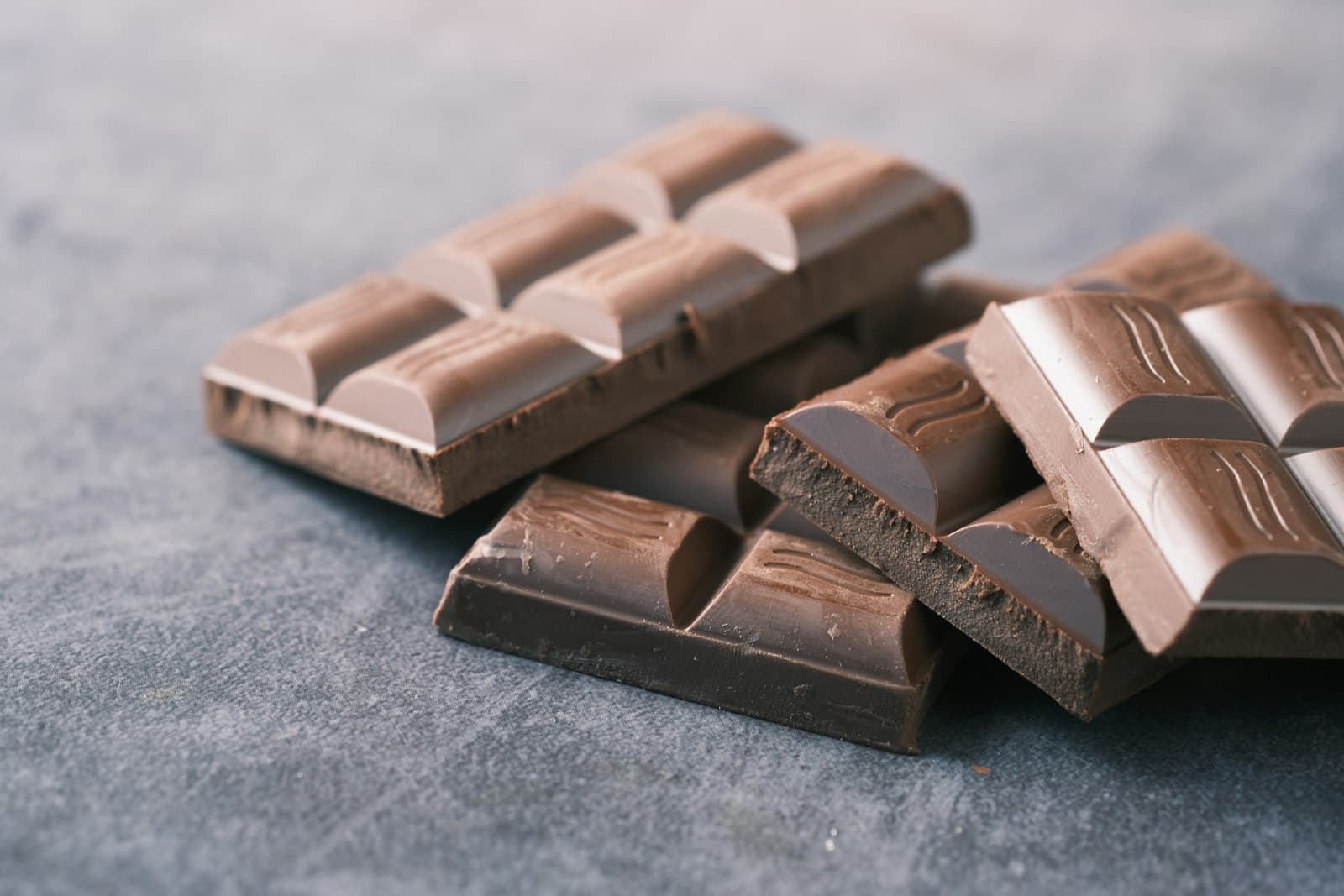
Chocolate is not bad for everyone with IBS, and when it is, it is rarely "the chocolate" as such. A bar of chocolate bundles four separate things that can each upset an irritable bowel: fat, milk sugar, caffeine and its cousin theobromine, and whatever the manufacturer adds, such as sugar alcohols or inulin fibre. The proportions change completely between white, milk and dark chocolate, and again in hot chocolate. That is why one person can eat milk chocolate happily and be floored by a square of 85% dark, while the next person reports the exact opposite.
The honest headline is an absence. We could find no blinded trial that has tested chocolate itself in people with IBS, and neither the British Society of Gastroenterology guideline nor NICE's IBS guideline mentions chocolate at all. That reflects our searches of PubMed and Europe PMC and a word search of both guidelines, not proof that nothing exists. What does exist is good evidence on each of chocolate's components, and that turns out to be more useful than a yes or no.
The short answer: chocolate is four possible triggers in one wrapper
Chocolate can trigger IBS symptoms, but the useful question is which part of it. Each component has its own mechanism and its own sibling article on this site, so this post focuses on how they combine in chocolate specifically, and on how to tell them apart in your own gut.
The four suspects are:
- Fat. Cocoa butter, plus milk fat in milk and white chocolate. Fat is a well-studied amplifier of gut sensation in IBS.
- Milk and lactose. Present in milk and white chocolate, sometimes in cheaper dark chocolate, and in large amounts in hot chocolate made with milk.
- Caffeine and theobromine. Both come from the cocoa solids, so they are highest in dark chocolate and cocoa powder and absent from white chocolate.
- What the label adds. Sugar alcohols in sugar-free products, inulin or chicory fibre in "high fibre" or "gut friendly" bars, and the mixed ingredients in powdered drinks.
Sugar itself is the suspect people name most often in Reddit threads. Ordinary table sugar is sucrose, which is not a FODMAP, as our explainer on what FODMAP stands for covers. A large sugary portion is still a large portion, and some products use high-fructose syrups, which raises a separate question covered in our post on fructose malabsorption versus IBS.
What the research actually says about chocolate and IBS
The direct evidence is thin, and it is worth being plain about that before looking at the parts.
The 2021 British Society of Gastroenterology guideline describes first-line "traditional dietary advice" for IBS as including limiting caffeine and reducing fatty foods, and it says that advice rests on clinical experience and plausible mechanisms rather than randomised trials (Vasant 2021). The word chocolate does not appear in it. NICE's guideline advises restricting tea and coffee to three cups a day and telling people with diarrhoea to avoid sorbitol, and it does not mention chocolate either (NICE CG61).
The large food-symptom surveys in IBS point at the components rather than at chocolate. In a Swedish study of 330 people with IBS, carbohydrate-rich foods, fatty food, coffee, alcohol and hot spices were the items most often reported to cause symptoms (Simrén 2001). In a later study of 197 patients, fried and fatty foods (52%) and dairy (49%) topped the list (Böhn 2013). Chocolate is not among the most frequently reported items in either abstract. These surveys record what people believe upsets them, which is a starting point, not a test.
What is actually in chocolate: a comparison by type
The type of chocolate changes the dose of every suspect, and US government food composition data makes this concrete. The figures below are per 40 g, roughly a small bar or a third of a large one, calculated from the per-100 g values in USDA FoodData Central (USDA milk chocolate; USDA dark 70-85%; USDA white chocolate; USDA cocoa powder).
| Per 40 g | Fat | Caffeine | Theobromine | Fibre | Lactose |
|---|---|---|---|---|---|
| White chocolate | 12.8 g | 0 mg | 0 mg | 0.1 g | Yes (milk solids) |
| Milk chocolate | 11.9 g | 8 mg | 82 mg | 1.4 g | Yes (milk solids) |
| Dark chocolate, 70 to 85% | 17.1 g | 32 mg | 321 mg | 4.4 g | 0 g listed |
| Cocoa powder, unsweetened (10 g) | 1.4 g | 23 mg | 206 mg | 3.7 g | None listed |
Two caveats. USDA does not list a lactose figure for its milk or white chocolate entries, so the table says only that milk solids are present. And "dark" is not a guarantee of no milk: USDA's entry for 45 to 59% dark chocolate lists 1.65 g of lactose per 100 g (USDA dark 45-59%), because some dark chocolate contains milk ingredients. Brands vary, so the ingredient list on your own bar beats any table.
The pattern still matters. Moving from milk to 70 to 85% dark chocolate raises the fat by more than 40%, the caffeine and theobromine about fourfold, and the fibre about threefold, while removing most or all of the lactose. Dark chocolate is gentler only if milk was your problem.
Suspect one: fat, and why a rich treat can act within minutes
Fat is the most likely reason chocolate of any kind causes cramps or urgency soon after eating. Fat is a strong signal from the small intestine to the colon, and in IBS that signal is felt more intensely.
In a lab study of 16 people with IBS and 13 healthy volunteers, fat infused into the small intestine lowered the thresholds at which a balloon in the colon was felt as discomfort and pain in the IBS group, while in healthy volunteers it lowered only the threshold for sensing gas. The extra sensitisation was seen in IBS-D but not in IBS-C (Simrén 2001, Gut). It was a small physiology study, not a food trial, but it explains a lot about chocolate.
It also explains the most common Reddit question. One poster described cramps, nausea and a dash to the bathroom within about five minutes of a few squares, and asked how anything could act that fast (r/ibs thread). At five minutes, the chocolate is still in the stomach. What you feel is the colon's response to eating, turned up by fat. Our post on how long after eating IBS flares explains this timing in detail, and why fatty foods trigger IBS covers the fat mechanism. For chocolate, the practical point is that a fast reaction does not tell you which ingredient is to blame, because it is not yet an ingredient reaction.
Two things follow. A larger portion means more fat and a stronger signal, so dose matters more than type. And eating chocolate after a meal rather than on an empty stomach changes the context, which matches what some people report, though we found no study testing it.
Suspect two: milk and lactose, the suspect that may be overrated
Milk chocolate and white chocolate contain lactose, and lactose is a genuine FODMAP. But the amount in a normal portion of chocolate may be smaller than people assume, and the one trial that tested it directly is reassuring.
In a Finnish crossover trial, 27 adults with lactose malabsorption and self-reported lactose intolerance ate 100 g of milk chocolate on separate days: one version made with whole milk (12 g of lactose), one with whole milk powder (12 g), one with low-lactose milk powder (2 g), and one with lactose-free milk powder. Over the following eight hours, there were no significant differences in symptoms, bowel frequency or stool consistency between the versions (Järvinen 2003).
That fits a wider finding. A systematic review concluded, on moderate-quality evidence, that most adults with lactose intolerance or malabsorption tolerate 12 to 15 g of lactose at once, roughly a cup of milk (Shaukat 2010). In the Finnish trial's recipe, a whole 100 g bar carried 12 g. A typical portion carries much less.
So if milk chocolate bothers you and dark does not, lactose is possible, but fat, sugar load and milk protein are also candidates. Our post on why lactose-free milk can still upset your stomach works through the other parts of milk that stay behind when lactose is removed. Where lactose genuinely bites is in drinks, covered below.
Suspect three: caffeine and theobromine
Caffeine is a known gut stimulant, and dark chocolate contains more of it than people expect, though far less than coffee. Using USDA figures, 40 g of 70 to 85% dark chocolate contains about 32 mg of caffeine and 40 g of milk chocolate about 8 mg (USDA dark 70-85%; USDA milk chocolate). A 240 ml mug of brewed coffee contains about 96 mg (USDA brewed coffee).
In practice, a couple of squares of dark chocolate are a minor caffeine dose. But half a 100 g bar of 70 to 85% dark chocolate carries about 40 mg of caffeine, 21 g of fat and 5.5 g of fibre, which is a meaningful load on all three fronts at once. One r/ibs poster who ate half a 95% bar and had days of diarrhoea assumed caffeine could not be the reason because they drink several coffees a day (r/ibs thread). They were probably right about the caffeine; the fat and the amount were more likely the issue. USDA has no 95% entry, so the 70 to 85% figures understate the cocoa content of a bar like that.
Then there is theobromine, the other stimulant in cocoa, which dark chocolate contains in ten times the amount of caffeine (802 mg per 100 g of 70 to 85% dark chocolate). Theobromine is often blamed in online discussions. We could find no study measuring theobromine's effect on the human bowel, in IBS or anyone else. It is a plausible suspect, not an established one.
If you already know you react to coffee, our post on whether coffee is bad for IBS-D explains why caffeine is only part of coffee's effect and how to test it. The same logic applies here: if decaf coffee bothers you too, caffeine is probably not the main issue.
Suspect four: what the label adds, especially in sugar-free chocolate
Sugar-free and "high fibre" chocolate is where the evidence of harm is clearest, and it is often marketed as the healthier option.
Most sugar-free chocolate replaces sugar with polyols (sugar alcohols). In a randomised, double-blind crossover trial, 59 healthy students ate 100 g of milk chocolate containing 40 g of sweetener as sucrose, isomalt, lactitol, maltitol or mixtures. Lactitol at 30 or 40 g significantly increased every symptom measured. Isomalt at 40 g did the same, including mild laxative effects. Maltitol at 40 g caused mild flatulence, rumbling and colic but no laxative effect. In every case, symptoms depended on the dose (Koutsou 1996). A trial in healthy children found maltitol in chocolate well tolerated up to 15 g, with some extra flatulence; its authors were from Roquette Frères, a company rather than a university, which is worth knowing when reading a tolerance result (Thabuis 2010).
Both trials studied healthy people. An IBS gut is more sensitive to the same load, which is the core finding of the next study.
Some "sugar-free with fibre" bars add inulin, a fructan fibre. One r/ibs poster bought such a bar without reading the label closely and spent the evening in the bathroom before spotting inulin in the ingredients (r/ibs thread). In an MRI study, a 40 g dose of inulin pushed 13 of 29 people with IBS past a predefined symptom threshold, compared with 6 of 29 after glucose. Healthy volunteers produced similar amounts of colonic gas but reported fewer symptoms, pointing to a sensitive colon rather than excess gas (Major 2017). A chocolate bar will usually contain far less than 40 g of inulin, but the direction is clear.
NICE advises people with IBS and diarrhoea to avoid sorbitol, naming sugar-free sweets and diabetic products (NICE CG61). Our post on sorbitol as an IBS trigger covers where polyols hide and how to read the label.
Is chocolate a fructan problem, like garlic and onion?
This question comes up often, including from someone whose milk-chocolate binge seemed to cause the same kind of flare as garlic and onion (r/ibs thread). The honest answer is that we do not know, and neither, as far as we can tell, does anyone who says so confidently.
We searched PubMed and Europe PMC for measurements of fructans or other FODMAPs in plain cocoa or chocolate and found none in the peer-reviewed literature. Some FODMAP apps publish ratings for chocolate, but those are proprietary measurements we do not use, and Clairop is not affiliated with any app developer's research. What we can say:
- Lactose is definitely present in milk and white chocolate.
- Inulin and polyols are present when the label says so.
- Fructans in cocoa itself are unconfirmed in published research.
In a r/FODMAPS thread, one person tolerated lots of milk chocolate but not dark chocolate and suspected fructans in cocoa, while another ate whatever they liked through the elimination phase without trouble (r/FODMAPS thread). The first pattern fits fructans, but it fits the higher fat, fibre and stimulant content of dark chocolate just as well. Only a structured reintroduction can separate them, which our guide on reintroducing foods after low FODMAP walks through. The low FODMAP diet is meant to be a short, structured process with reintroduction, ideally with a dietitian, not a permanent list of banned foods.
Why hot chocolate and mochas hit harder than a bar
Drinks stack triggers in a way bars do not. That is the most consistent theme in the Reddit threads, and it holds up when you add the numbers.
The original poster in one thread had two bad attacks of diarrhoea after a hot chocolate and then a mocha, yet was fine with chocolate bars and with espresso and milk (r/ibs thread). Replies pointed out that both drinks had whipped cream, which the poster confirmed. Others raised milk volume, caffeine, sugar and additives in powdered mixes. One person found they could manage dairy-free hot chocolate and dairy-free coffee separately but not a dairy-free mocha.
Count what a large milky chocolate drink can contain:
- Milk: a large drink can hold a cup of milk or more. A cup is roughly where the 12 to 15 g lactose tolerance level sits for most lactose-intolerant adults (Shaukat 2010), and some people with IBS react to less.
- Caffeine: from the cocoa, plus a full shot of coffee in a mocha.
- Fat: from whole milk, chocolate sauce and whipped cream.
- Additives: commercial mixes vary, and some use sweeteners. Read the label of the specific product.
- Warmth and speed: a large warm drink drunk quickly is a big volume arriving at once. Several posters blamed hot liquid itself; we found no study testing that.
A bar of milk chocolate contains a fraction of each. A useful experiment is to make the drink yourself with cocoa powder, sugar and a measured amount of lactose-free milk, which removes the mix additives, the cream and most of the lactose in one step. If that is fine, add things back one at a time.
Clairop logs meals, symptoms and stool in seconds, then looks for the foods your gut reacts to, including reactions that land days later.
Chocolate and IBS-C: is it really constipating?
Many people believe so, but the evidence for that belief is a survey of beliefs. In a German questionnaire of 200 healthy controls, 122 people with chronic constipation and 766 people with IBS-C, chocolate was the food most often named as constipating in open answers, and 48 to 64% of respondents called it constipating when asked directly (Müller-Lissner 2005). The same survey found bananas and black tea were also seen as constipating, and prunes as softening. It measured perception, not stool.
We found no trial testing chocolate itself as a cause of constipation. The closest evidence points the other way for cocoa fibre. In a randomised, double-blind trial, 56 constipated children aged 3 to 10 were assigned to a cocoa husk fibre supplement or placebo for four weeks, and 48 finished. Across the whole group, colonic transit was not significantly faster, which was the main outcome. In the subgroup with slower transit at the start, transit time fell by 45.4 hours with cocoa husk versus 8.7 hours with placebo, and at the end 41.7% of the cocoa husk group reported hard stools compared with 75.0% on placebo (Castillejo 2006). This was a fibre supplement in children, not chocolate in adults with IBS, and its positive results come from a subgroup and secondary outcomes. We could not read a funding statement for it.
A UK news article quoting a GP says chocolate's sugar and caffeine together cause constipation in IBS. Caffeine is usually a colonic stimulant rather than a brake, as our coffee post explains, and the article cites no source. If chocolate seems to back you up, the more plausible explanations are that it replaces fibre-rich food, comes with less fluid, or is eaten during stressful or sedentary stretches, all of which are hard to separate without tracking. If you are not sure which pattern you have, the free IBS type calculator uses your counts of hard and loose stools on abnormal days to show which Rome IV subtype fits.
For people with IBS-C, our guide on what to eat with IBS-C covers the foods with actual trial evidence behind them.
Chocolate, heartburn and nausea: the upper gut
Some of what people describe as chocolate upsetting their IBS is happening in the oesophagus and stomach rather than the bowel. Chocolate has unusually direct evidence here.
In nine healthy volunteers, drinking chocolate syrup lowered the resting pressure of the lower oesophageal sphincter, the valve that keeps stomach contents down, from an average of 14.6 to 7.9 mmHg (Wright 1975). In people with reflux oesophagitis, chocolate increased acid exposure in the oesophagus during the first hour after a meal compared with a matched sugar solution (Murphy 1988). Both are small, old studies.
The 2022 American College of Gastroenterology reflux guideline lists chocolate among foods that reduce sphincter pressure in the lab, but says few studies document the benefits of avoiding them and that support for blanket food avoidance is "limited and variable" (Katz 2022). So chocolate is a reasonable suspect for heartburn, but cutting it is not guaranteed to help.
One commenter described heartburn from chocolate but no problem with plain cacao powder (r/ibs thread). That fits fat, because cocoa powder has a fraction of the fat of a bar. If chocolate mainly makes you feel sick, our post on IBS nausea after eating explains how reflux and indigestion overlap with IBS.
What about the "chocolate is good for your gut" headlines?
They are real research, but none of it is about IBS symptoms. The most cited human study gave 22 healthy volunteers a specially made high-flavanol cocoa drink (494 mg of flavanols a day) or a low-flavanol version (23 mg) for four weeks. The high-flavanol drink increased bifidobacteria and lactobacilli counts and reduced clostridia, alongside small falls in triglycerides and C-reactive protein (Tzounis 2011). The abstract reports bacteria and blood markers, not gut symptoms, in people without IBS, using a drink designed for the trial rather than chocolate from a shop.
On the inflammation side, the encouraging cocoa findings in colitis are mainly from mice. A 2025 mouse study funded by the US Department of Agriculture found that a cocoa polyphenol supplement changed the gut microbiome but did not reduce colitis severity or inflammation (Stewart 2025). Changing bacteria counts and improving how someone feels are not the same thing, and neither result shows that chocolate helps IBS.
What your pattern says: a self-sorting table
Your own reactions are the best evidence you have, because they tell you which component matters. These are leads to test, not diagnoses.
| What you notice | Most likely suspects | What to try next |
|---|---|---|
| Dark chocolate bothers you; milk and white do not | Fat dose, caffeine and theobromine, cocoa fibre, possibly fructans | Smaller pieces of dark; compare with cocoa powder, which has little fat |
| Milk and white bother you; dark does not | Lactose or other milk components, sugar load | Try milk-free chocolate in a similar portion |
| Every type bothers you, including white | Fat, portion size, or the gastrocolic response to eating | Halve the portion; eat it after a meal; note timing |
| Only hot chocolate or mochas | Milk volume, caffeine, cream, mix additives | Make your own with lactose-free milk; add one element back at a time |
| Only sugar-free or "high fibre" chocolate | Polyols (maltitol, isomalt, lactitol, sorbitol) or inulin | Read the ingredients; avoid those products |
| Heartburn, burning or nausea | Upper gut: sphincter relaxation, fat | See the reflux section; mention it to your doctor if frequent |
| Symptoms within minutes | Colonic response to eating, amplified by fat | Portion size and context, not a specific ingredient |
| Symptoms the next day | Fermentation (lactose, inulin, polyols) or chance | Track the delay over several exposures |
That last row matters. A flare the morning after a chocolate binge might be the chocolate, or the rest of the day's food, or a coincidence. Fermentable ingredients usually take hours to reach the colon, so timing helps, but only if you record it over several exposures rather than once.
A worked example: testing chocolate one variable at a time
Here is how a structured test might look for someone who suspects chocolate but does not know which kind. It is an illustration of method, not a plan to follow without thought. If you are in the elimination phase of a low FODMAP diet, do this with your dietitian.
Week one: establish a baseline. No chocolate. Log daily symptoms on a simple 0 to 10 scale and your stool type. This tells you what a normal week looks like, which you need before you can see a change.
Week two: one type, a modest portion. On two or three non-consecutive days, eat a fixed portion, say 20 g, of one type. Many people start with the type they suspect least. Eat it at the same time each day, ideally after a meal. Record the time, the symptoms, and when they started.
Week three: change one variable. If the modest portion was fine, double it on two days. If it caused symptoms, try a different type at the same portion. If dark caused trouble and milk did not, try cocoa powder in a drink made with lactose-free milk, which separates fat from cocoa solids.
Read the result honestly. Suppose 20 g of milk chocolate was fine three times, but 40 g twice caused urgency within half an hour. That points to a dose threshold and probably fat, not to "chocolate intolerance". Suppose dark chocolate caused bloating the next day at both portions, but cocoa powder did not. That points away from fat and toward something in the solid bar.
A tracker that records each food alongside symptoms over several hours makes this easier, because the delayed reactions are the ones memory gets wrong. Clairop logs foods and checks them against several delay windows after eating (how it works), but a notebook works as well. For the general method, see how to find out what triggers your IBS. If you have ever found that chocolate is fine one week and not the next, our post on why safe foods sometimes trigger IBS explains how a shifting threshold produces exactly that.
Myths about chocolate and IBS
"Chocolate is a proven IBS trigger." It is on many lists, but we found no blinded trial in IBS supporting that, and the main IBS guidelines do not name it. The components are proven troublemakers for some people; chocolate as a whole has not been tested in any trial we could find.
"Dark chocolate is always safer." Only if milk is your problem. Per 100 g, 70 to 85% dark has more fat, about four times the caffeine and about three times the fibre of milk chocolate.
"Even one bite will set you off if you have IBS." One poster with a fissure blamed a single bite of chocolate cake for a bad day (r/ibs thread). A bite contains very little lactose, fat or caffeine. A single exposure cannot separate the chocolate from everything else that happened that day, and repeated testing is the only way to know.
"Sugar-free chocolate is the IBS-friendly option." Often the opposite, because of polyols and added inulin.
"It's the theobromine." Possibly, but it has never been studied in the human bowel as far as we could find. It is a hypothesis, not a fact.
"Cocoa is a prebiotic, so chocolate will help my IBS." The cocoa microbiome studies used special high-flavanol drinks in healthy people or mice and did not measure IBS symptoms.
"If I flare after chocolate before my period, the chocolate caused it." Bowel symptoms change across the menstrual cycle anyway, and IBS symptoms often worsen around a period, so chocolate eaten in those days can take the blame for a hormonal flare. Our post on why IBS gets worse on your period covers the hormonal side.
If you have Crohn's disease or ulcerative colitis
The same component logic applies to the symptoms of inflammatory bowel disease, but the stakes are different. We found no human trial testing chocolate in Crohn's disease or ulcerative colitis, and the cocoa research in colitis is almost entirely in mice, including the 2025 study that found no benefit (Stewart 2025).
Chocolate making your symptoms worse during a flare does not mean it caused the flare. Our post on whether food can trigger a UC flare explains the difference between food upsetting an inflamed gut and food driving inflammation. If you have IBD and new or worsening symptoms after any food, tell your IBD team rather than adjusting your diet alone, especially if you have narrowing of the bowel, where portion size and texture matter more.
When to see a doctor
Chocolate is an unlikely cause of serious symptoms, and some symptoms should never be blamed on it.
It is also worth seeing a doctor if you react to a widening range of foods, if your symptoms have changed recently, or if you have never had a formal IBS diagnosis. A strong reaction to many fatty foods can occasionally point to something else, such as gallbladder or pancreatic problems, which our fatty foods post covers. Frequent heartburn deserves its own assessment.
The short version
Chocolate is not one IBS trigger. It is a variable mix of fat, lactose, caffeine and theobromine, plus whatever the label adds, and the type you eat changes every one of those doses. We could find no blinded trial of chocolate in IBS, and the major guidelines do not mention it, so anyone who calls it a proven trigger is overstating the evidence.
What the evidence does support: fat amplifies gut sensation in IBS, especially IBS-D; polyol sweeteners in sugar-free chocolate cause dose-dependent symptoms; inulin triggers symptoms in many people with IBS; chocolate relaxes the valve above the stomach and can worsen heartburn; and in one small trial, lactose-intolerant adults reacted no differently to milk chocolate with or without lactose. Hot chocolate and mochas stack several triggers at once.
The most useful thing you can do is let your own pattern do the sorting. Notice which type bothers you, at what portion, and how quickly, test one change at a time, and keep the chocolate you tolerate. Many people with IBS can still enjoy some chocolate.