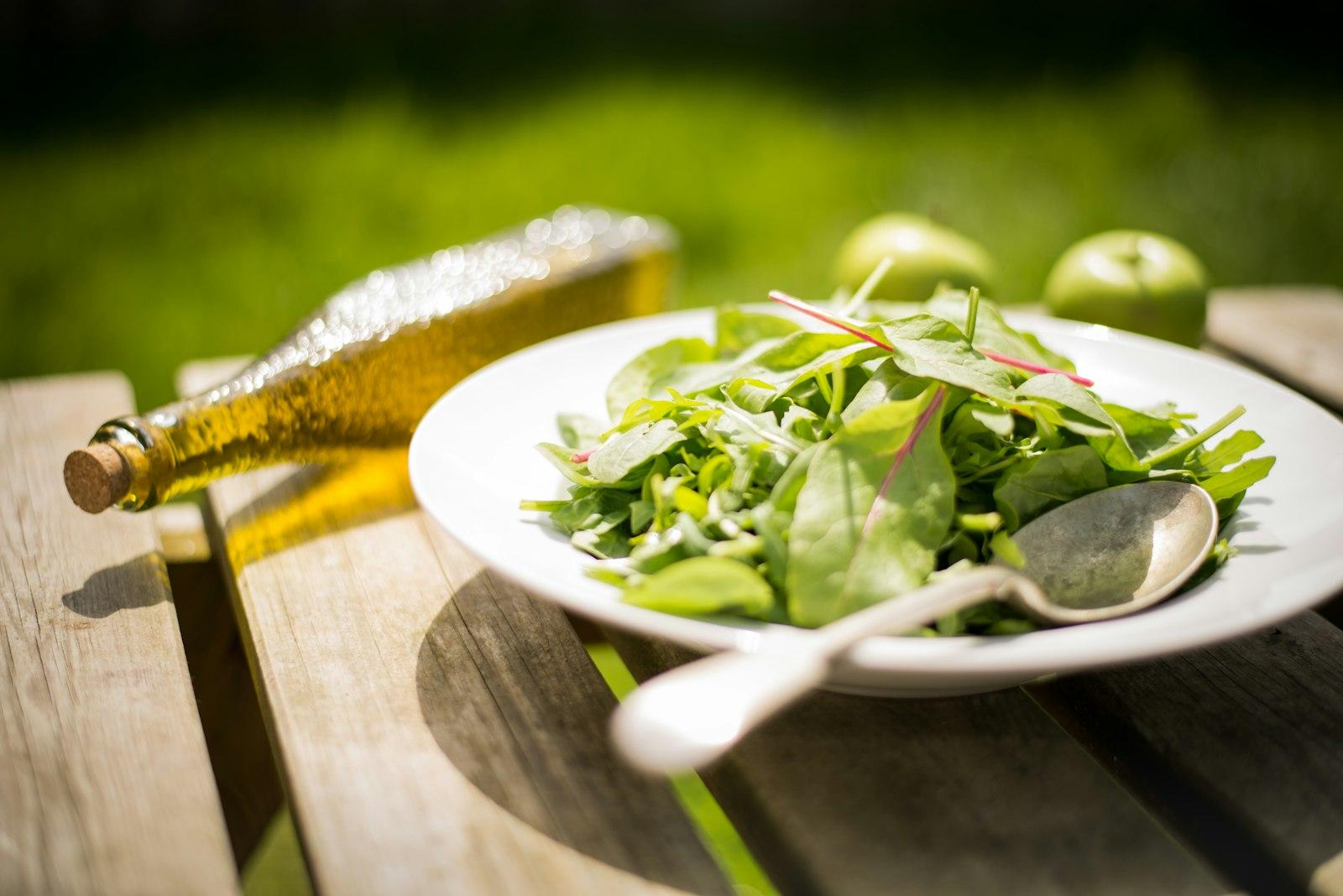
A low FODMAP salad dressing is one made from oil, an acid such as lemon juice or vinegar, mustard, salt, pepper and garlic-free herbs, with no garlic or onion powder, honey, high-fructose syrup or milk. That short recipe is the whole trick, and it explains why a salad that looks safe can still set off symptoms: the leaves are rarely the problem, the bottle often is.
This guide covers what to check on a label, a simple base you can adapt in a minute, how to think about certified products without treating a logo as magic, what to say when you eat out, and how to find out which ingredients bother you personally. It is written for people on a low FODMAP trial and for anyone who has noticed that "healthy" salads keep ending badly. It is general information, not medical advice, and your doctor or a dietitian should guide any restrictive diet.
What makes a salad dressing low FODMAP?
A dressing is low FODMAP when each ingredient, at the amount you actually eat, stays under the cut-offs used to classify low FODMAP foods. In practice that means oil, an acid, mustard, salt and herbs, and it excludes fructans from garlic and onion, excess fructose from honey or high-fructose syrups, and lactose from milk-based creaminess.
The reasoning is worth understanding, because it lets you judge a bottle you have never seen. FODMAPs are fermentable short-chain carbohydrates that are poorly absorbed in the small intestine. They draw water into the gut and are fermented by bacteria, which is the mechanism usually proposed for gas, bloating and pain in IBS (Barrett 2012; Chen 2026). A low FODMAP diet is supported as a limited trial for IBS: the American College of Gastroenterology guideline recommends a limited trial of it to improve global symptoms (Lacy 2021), and a randomized, controlled, single-blind crossover trial found it reduced symptoms compared with a typical Australian diet (Halmos 2014).
Cut-offs are set per FODMAP type: fructans and galacto-oligosaccharides, the polyols mannitol and sorbitol, lactose, and fructose in excess of glucose, derived from typical serving sizes of foods that commonly trigger IBS symptoms and foods that are generally well tolerated (Varney 2017). That last category is the one that catches honey and high-fructose syrups. It is not that fructose is "bad". It is that fructose without enough glucose alongside it is the form some people absorb poorly, which is why a dietary approach based on balancing glucose and fructose was devised in the first place (Shepherd 2006).
Oil itself contains no carbohydrate to speak of, so it is not a FODMAP issue. Vinegar, citrus, mustard and fresh or dried herbs (apart from garlic and onion forms) are the building blocks everyone ends up using. Where portions matter is in sweeteners and a few vinegars, covered below.
Why do bottled dressings so often fail a low FODMAP diet?
Bottled dressings fail because they are flavor systems built from cheap concentrated ingredients: garlic powder, onion powder, honey or corn syrup for sweetness, and milk or buttermilk for creaminess. Any one of those can push a serving over the line, and several often appear together. The oil and vinegar underneath are fine, so the problem is almost always the seasoning and sweetener layer.
Here is what to look for, and why each one matters.
| Ingredient on the label | FODMAP concern | What to do |
|---|---|---|
| Garlic powder, onion powder, dried garlic, dried onion, garlic or onion "flakes" | Fructans (oligosaccharides) | Avoid on a low FODMAP trial |
| Honey, agave, "invert sugar", high-fructose corn syrup, fruit juice concentrate | Excess fructose | Avoid or check the app; note US high-fructose syrups can raise levels in processed foods (Varney 2017) |
| Milk, buttermilk, cream, whey, "yogurt", cheese powder | Lactose (varies by ingredient) | Watch creamy dressings; lactose-free yogurt is a common swap |
| Natural flavor, spices, "seasoning" | Source not named | Cannot judge from the label; prefer short lists or certified products |
| Inulin, chicory root fiber, FOS | Added fructans | Avoid; these appear in "light" or "high fiber" products |
| Plain vinegars, lemon or lime juice, mustard seed, salt, black pepper | Generally fine in small amounts | Check vinegar and mustard portions in the app |
| Oils (olive, avocado, sunflower, canola) | No FODMAPs | Fine; fat itself is a separate issue for some people |
The legal wording on US labels is the part people find confusing. Under FDA labeling rules, garlic and onion are excluded from the definition of a "spice", and powdered forms such as garlic powder are treated as food and must be declared by their common name. Flavorings, however, may be declared generically as "spice", "natural flavor" or "artificial flavor" without naming the source (21 CFR 101.22). So a visible "garlic powder" is easy to spot, but "natural flavor" on a savory dressing is a gap you cannot see through. Allergy law does not help either: garlic and onion are not among the nine major allergens that must be declared (FDA).
This is not a reason to panic. It is a reason to prefer short ingredient lists, and to treat a dressing that tastes strongly savory or "Italian" with suspicion. If you want the longer version of how this plays out on packaged food generally, our post on low FODMAP barcode scanner apps explains what scanning can and cannot tell you about a label.
What is a simple low FODMAP salad dressing recipe?
The simplest low FODMAP dressing is about three parts olive oil to one part lemon juice or vinegar, with a spoon of mustard, salt, pepper and a garlic-free herb, shaken in a jar. The oil-and-acid ratio is a culinary convention, not a medical rule, so adjust it to taste. The measured sweeteners and vinegars are the only parts where you need to check portion guidance.
A pattern that comes up again and again in r/FODMAPS is exactly this. In one thread asking if any low FODMAP salad dressing exists, the most upvoted replies describe shaking mustard, a vinegar and roughly double the amount of olive oil together, with others pointing out that lemon juice, olive oil, salt and oregano takes seconds. In a second thread, apple cider vinegar, olive oil and Dijon with herbs is the favorite, and several people say plain oil and vinegar is the safest option. A third, older thread, starts with someone surprised that ranch turned out not to be safe, which sums up the problem neatly.
Four bases that use only ingredients people in those threads mention:
- Lemon and Dijon. Olive oil, lemon juice, Dijon mustard, salt and pepper. Add dried oregano or fresh parsley.
- Cider vinegar and herbs. Olive oil, apple cider vinegar, Dijon or whole-grain mustard, a pinch of salt, chopped chives and thyme. Monash has long suggested the green parts of green onion (spring onion) or chives as an onion-style flavor.
- Balsamic, measured. Olive oil, mustard, and a small measured amount of balsamic vinegar. Several commenters use balsamic, but it is the one where the serving limit in the app matters most.
- Maple mustard. Olive oil, Dijon, lemon juice or vinegar, salt, and a touch of maple syrup. Maple syrup is a common sweetener choice in the threads, with the standing reminder to watch amounts.
None of these needs a recipe card. What helps is a method: put the acid, mustard and salt in a jar first, stir, add the oil last, then shake. The mustard acts as an emulsifier, so the dressing holds together for longer. Make enough for a few servings and keep it in the fridge.
How do you handle sweeteners and vinegar portions?
Check the Monash app for the current portion limit of each vinegar, mustard and sweetener you use, then divide by the number of servings the recipe makes. Serving limits are published per portion, and a dressing shared across several servings usually uses only a fraction of one portion per salad. Sites quote different figures, so the app is the safer reference.
We did not have access to the Monash app while writing this article, and secondary sites quote different numbers for balsamic vinegar, apple cider vinegar and maple syrup, so I have deliberately not printed a figure here. That is itself a useful finding: the numbers have been revised over time, and a figure copied from a recipe blog can be out of date. Check the app entry for the exact ingredient, not for a similar-sounding one, and note the serving size.
A worked example shows why dividing helps. Suppose the app lists a limit for a sweetener, and your recipe uses a quarter of that limit in a jar that makes four salads. Each salad then contains a small fraction of one portion. Nothing about that is a guarantee, because stacking with other FODMAP foods in the same meal can still tip a total over your threshold, which our post on FODMAP stacking explains. But it shows why the simple jar of dressing is usually a lower-risk place to use a measured amount of a sweetener than a pour from a bottle where you cannot see the amounts.
Can you use garlic-infused oil in homemade dressing?
Yes, as long as the oil is infused and strained rather than containing garlic pieces. Monash explains that fructans are water soluble but not fat soluble, so garlic flavor can transfer into oil while the fructans stay in the garlic (Monash, infused oils). The same team notes the flip side: in a water-based soup or stock, fructans leach out into the liquid, so the "remove the clove before serving" trick does not work there (Monash, onion and garlic).
Two cautions. First, the Monash infused-oil article was written by an oil brand, so treat its product mentions as marketing and its chemistry as the useful part. Second, homemade garlic stored in oil is a food safety problem, not just a FODMAP one. A US investigation described three cases of botulism in 1989 linked to garlic bread made from a garlic-in-oil product with a pH of 5.7, leading the FDA to require microbial inhibitors or acidifying agents in such products (Morse 1990). That is a reason not to improvise your own infused oil on the counter, and to buy a commercial one whose label says it is infused and contains no garlic pieces. If you are looking for other ways to get that savory note, our guide to onion and garlic substitutes for a low FODMAP diet goes through the options in depth.
The table below puts the garlic forms side by side, because this is the most common confusion in the threads.
| Form of garlic | Fructans in the dressing? | Notes |
|---|---|---|
| Garlic powder, dried garlic, garlic paste | Yes | Fructans are water soluble and the solids carry them |
| Fresh garlic left in the dressing | Yes | Fructans leach into water-based liquid, and vinegar and lemon juice are mostly water |
| Strained garlic-infused oil | Low, per Monash | Fructans do not dissolve in oil; no garlic pieces may remain |
| Garlic pieces stored in oil at home | Yes, and a food safety risk | Botulism risk, see above |
How do you make a creamy low FODMAP dressing?
Creamy dressings need a base that is low in lactose. Reddit commenters mention lactose-free Greek yogurt with chives, salt and pickle juice, tahini with oil and lemon, and miso with a little maple syrup and water. Each is one person's idea, not a tested recipe, so check the portion of tahini, miso and yogurt in the Monash app before relying on them.
One more flag: ranch. A standard ranch is built on buttermilk or milk plus garlic and onion powder, so it tends to fail on two FODMAP categories at once, lactose and fructans. Formulas differ by brand, so read the list on your bottle. If you want ranch flavor at home, the usual workaround is lactose-free yogurt, a little oil, lemon juice, dill and chives, and salt.
Plain mayonnaise is a different question. Its base is egg, oil and vinegar, so it does not inherently carry garlic or onion, but flavored mayos and aiolis often do. Treat "garlic aioli", "chipotle mayo" and "sandwich spread" as label-reading exercises, and check the Monash app for portion guidance on the plain version.
Which store-bought dressings are low FODMAP?
A store-bought dressing is a safer bet if it carries the Monash University Low FODMAP Certified logo, because Monash states that certified products are laboratory tested to determine their FODMAP content. Otherwise the safest approach is a short ingredient list with no garlic or onion powder, honey, high-fructose syrup, inulin or milk, confirmed by you each time you buy.
Be clear about what "certified" does and does not mean. Monash describes the program as certifying products and recipes as low in FODMAPs only, not assessing them as therapeutic goods. It is voluntary, brands pay fees to cover lab testing or recipe assessment, and product samples must be laboratory tested (Monash, certification). That makes a certified logo more informative than a "gut friendly" claim on the front of a pack, but it does not tell you whether you personally tolerate the dressing, and it does not cover every product. Absence of a logo does not mean a dressing is high FODMAP; many brands have never applied.
Fody Foods is the brand most often named in the threads, and it publicly lists a range of dressings that it describes as made without onion or garlic (Fody Foods dressings). I have not verified current certification status for each individual flavor, so check the product page and the Monash app entry for the exact one before you buy. Some Reddit commenters also name mainstream store brands they say they tolerate, including honey mustard and Italian-style products, and one person who says they are very sensitive to garlic and onion reports no reaction to one of them. That is a useful reminder that tolerance varies, but it is not evidence that a product is low FODMAP, and I have not checked those labels. Ingredient lists change by country and over time.
A quick label routine:
- Read the whole list, not the front of the pack. Look for garlic, onion, honey, syrups, milk and inulin.
- Treat "natural flavor", "spices" and "seasoning" as unknowns, especially in savory styles such as Italian, ranch, Caesar and Greek.
- Check the sweetener. A "vinaigrette" or "balsamic" that lists honey or a high-fructose syrup is a different product from one with sugar or none.
- Check the serving size on the bottle, and what you actually pour. A "2 tablespoon" serving that you double is a bigger dose.
- If the label is ambiguous, either skip it that week or treat it as a test item, and write it down.
Is balsamic vinaigrette low FODMAP, and what about Italian dressing?
Plain balsamic vinegar is listed with a limited serving size in the Monash app, so quantity decides the answer. Bottled balsamic vinaigrette and Italian dressing add other risks: garlic or onion powder, sweeteners such as honey or high-fructose syrup, and sometimes "natural flavor". A short-list vinaigrette or a homemade one with measured balsamic is lower-risk.
The reason these two styles come up so often is that they are the "default" bottles at restaurants and in fridges. "Italian" usually means a blend of dried herbs and garlic or onion, which is where the fructans come from. "Balsamic vinaigrette" is a vinegar issue plus a sweetener issue plus a seasoning issue. If you like the taste, a homemade version with oil, mustard, a measured splash of balsamic and dried oregano and basil gets you close without the unknowns.
What dressing can you order when eating out?
When eating out, ask for olive oil and vinegar or lemon wedges on the side and dress the salad yourself. House dressings, vinaigrettes and creamy sauces are usually made in advance with garlic, onion or honey, and restaurants are not required to list garlic or onion. You are lowering the dose rather than proving it is zero.
The practical script is short: "I have a medical dietary restriction. I can't have garlic, onion or honey. Could I have oil and vinegar on the side?" Most kitchens can do that without changing anything. Avoid anything described as "house", "signature" or "creamy", and skip pre-mixed salads where the dressing is already tossed through. Our guides on how to avoid garlic and onion when eating out and eating out on a low FODMAP diet cover the words to use and the menu terms that hide alliums, and our post on why garlic and onion affect IBS explains the biology.
Other people's routines are instructive. A common theme in these threads is that people carry a small bottle of their own dressing, or order plain and add their own lemon, rather than trying to audit a kitchen. That is a low-effort way to keep the dressing out of the equation while you work out the rest of the meal.
How do you know which dressing ingredients bother you?
You find out by testing one ingredient at a time, after the elimination phase, and logging what happens. A single bad salad cannot tell you whether the culprit was garlic, honey, the dressing's fat, the raw vegetables or the rest of the meal. Individual responses vary widely, so structured testing beats guessing.
Real-world data show how uneven tolerance is. In a mobile app evaluation of 21,462 users of a low FODMAP app, among people who completed food challenges, onion was identified as a trigger in 359 of 918 challenges (39%), garlic in 245 of 699 (35%), milk in 274 of 687 (40%) and wheat bread in 474 of 1,146 (41%) (Dimidi 2023). In other words, most challenges did not flag a trigger, and a substantial minority did. Those are self-reported app data, not a clinical trial, but they support the idea that your own reaction is the number that matters, not the headline "high FODMAP" label.
The diet is meant to be a short structured process. A long-term follow-up of Italian patients found the low FODMAP diet was effective for symptoms and nutritionally adequate, with reintroduction and an adapted diet afterwards (Bellini 2020). But practice often drifts: in a US community survey of 387 people with IBS, 70% found the diet somewhat or extremely difficult to follow, 59% continued the restriction phase beyond eight weeks, and only 30% worked with a dietitian during restriction (Fehlman 2026). A review of dietary management also flags concern about restrictive whole-diet interventions and eating-disorder risk (Whelan 2024). If you notice that dressing worries are making you avoid meals or social events, say so to your doctor or dietitian.
For a clean test, use a consistent dressing so the variable is the one thing you change. Our guides on reintroducing foods after the low FODMAP diet and on how to find out what triggers your IBS lay out the method.
What should you write down?
Record the dressing or ingredient, the amount, the other foods in the meal, the time you ate and the symptoms with timing. If you can, note stress, sleep and anything else unusual that day. Reaction timing varies between people and between FODMAP types, so write down when symptoms started rather than assuming a fixed window.
A simple log entry might read: "Salad with lemon and Dijon dressing, about two tablespoons, with grilled chicken and cucumber. Mild bloating three hours later, gone by evening." Over a few weeks, repeating that with one change at a time, for example the same dressing with and without a small amount of maple syrup, gives you something real to look at. Clairop is a symptom and food tracker that lets you log meals and symptoms and look for patterns over time; you can see how it works on the how it works page. It does not diagnose anything, and no tracker replaces a dietitian's interpretation. If you prefer pen and paper, that works too, as long as you write down portions and the rest of the meal.
Clairop logs meals, symptoms and stool in seconds, then looks for the foods your gut reacts to, including reactions that land days later.
Is fat or acidity part of the problem?
Sometimes. Even a perfectly low FODMAP dressing is mostly oil, and some people with IBS report that fatty meals trigger symptoms regardless of FODMAPs. Vinegar and citrus can also bother some people for non-FODMAP reasons. If a simple oil-and-lemon dressing still causes trouble, the issue may not be FODMAPs at all.
That is worth keeping in mind because FODMAPs are not the only dietary explanation for symptoms. A review of non-allergic food intolerance in IBS notes that FODMAPs and food chemicals are both discussed as possible contributors (Barrett 2012). If your reaction does not follow the FODMAP pattern, our post on why fatty foods trigger IBS is a useful next step. A network meta-analysis of 28 randomized trials (2,338 patients) found the low FODMAP diet beat a habitual diet for global IBS symptoms (relative risk of not improving 0.51, 95% CI 0.37 to 0.70, 24 trials), but also that the less restrictive BDA/NICE diet did too (0.62, 0.43 to 0.90, eight trials), with comparisons rated low or very low confidence (Cuffe 2025). It is a reminder that FODMAPs are one tool among several, not the only route.
Common myths about low FODMAP dressings
"If it is labeled healthy, natural or gut friendly, it is low FODMAP." Front-of-pack claims are not the same as an ingredient review. A dressing can be vegan, organic and sugar-free and still contain onion powder or inulin.
"Garlic-infused oil means garlic is back on the menu." Strained infused oil is low in fructans, but garlic pieces, garlic powder and garlic paste are not, and homemade garlic in oil has botulism risk (Morse 1990).
"Honey is a natural sweetener, so it is fine." Natural does not mean low FODMAP. Honey is a fructose-rich sweetener, and fructose in excess of glucose is one of the FODMAP categories (Varney 2017).
"A restaurant said no garlic, so it is safe." A menu claim is not a measurement, and a kitchen may not know what is in a pre-made dressing or seasoning blend. Treat it as a reduction in dose, not a guarantee.
"I have to avoid every FODMAP forever." The low FODMAP diet is intended as a time-limited process with reintroduction. Staying on strict restriction indefinitely is not the aim, and a dietitian can help you move on.
"If I react to one dressing, I am intolerant to all dressings." One reaction tells you almost nothing. It might be portion, fat, other foods or stress. Test again, one change at a time.
When should you see a doctor?
See a doctor promptly if you have blood in your stool, unexplained weight loss, fever, symptoms that wake you at night, signs of anemia, symptoms starting after age 50, or a family history of bowel cancer or inflammatory bowel disease. These are not features of a dressing problem and need proper assessment. Also talk to a clinician before using any restrictive diet over a long period.
If you have already been diagnosed with IBS and are struggling with food fear, social avoidance or restriction beyond what your dietitian advised, tell them. That is common and treatable, and it is a reason to seek support, not a personal failing. If you have hives, swelling of the lips, face or throat, wheeze or trouble breathing after a meal, treat that as an emergency; it is not a FODMAP pattern.
The short version
Make a base of oil, acid, mustard and garlic-free herbs. Read the full ingredient list on anything bottled, treat "natural flavor" as an unknown, and use certified products as a helpful signal rather than a promise. Check vinegar and sweetener portions in the Monash app rather than in a blog. When eating out, ask for oil and vinegar on the side. And keep a simple log so that your own reactions, not a list on the internet, decide what stays on your plate.
Where the questions come from
The questions in this guide come from three r/FODMAPS threads where people ask what salad dressing they can actually use, plus the related searches that appear alongside the main query. The research cited comes from guideline and trial literature on the low FODMAP diet, FODMAP composition work and US labeling rules. Brand and product statements are drawn from publicly listed pages and should be confirmed on the product you buy. Clairop is not affiliated with Monash University.