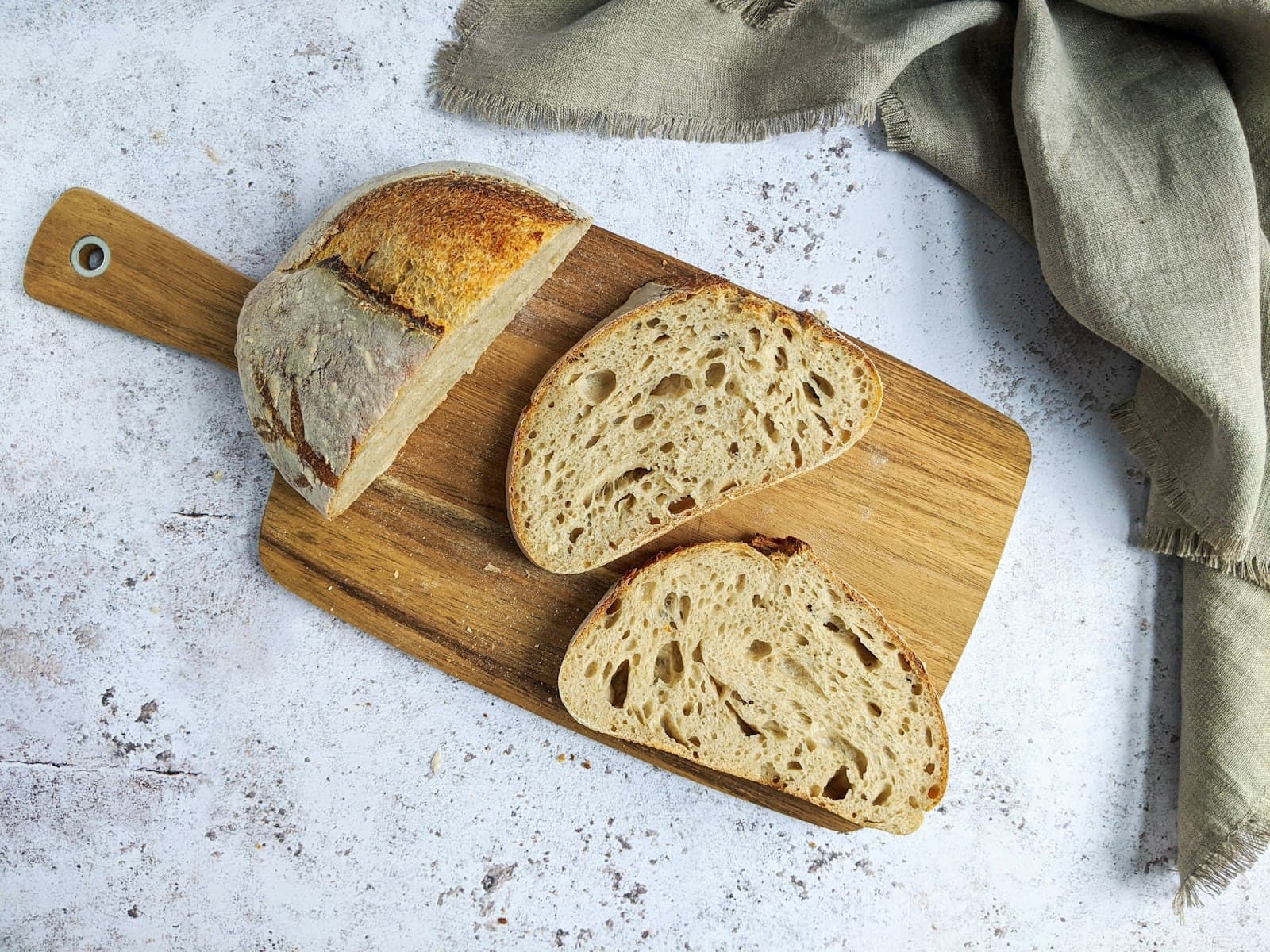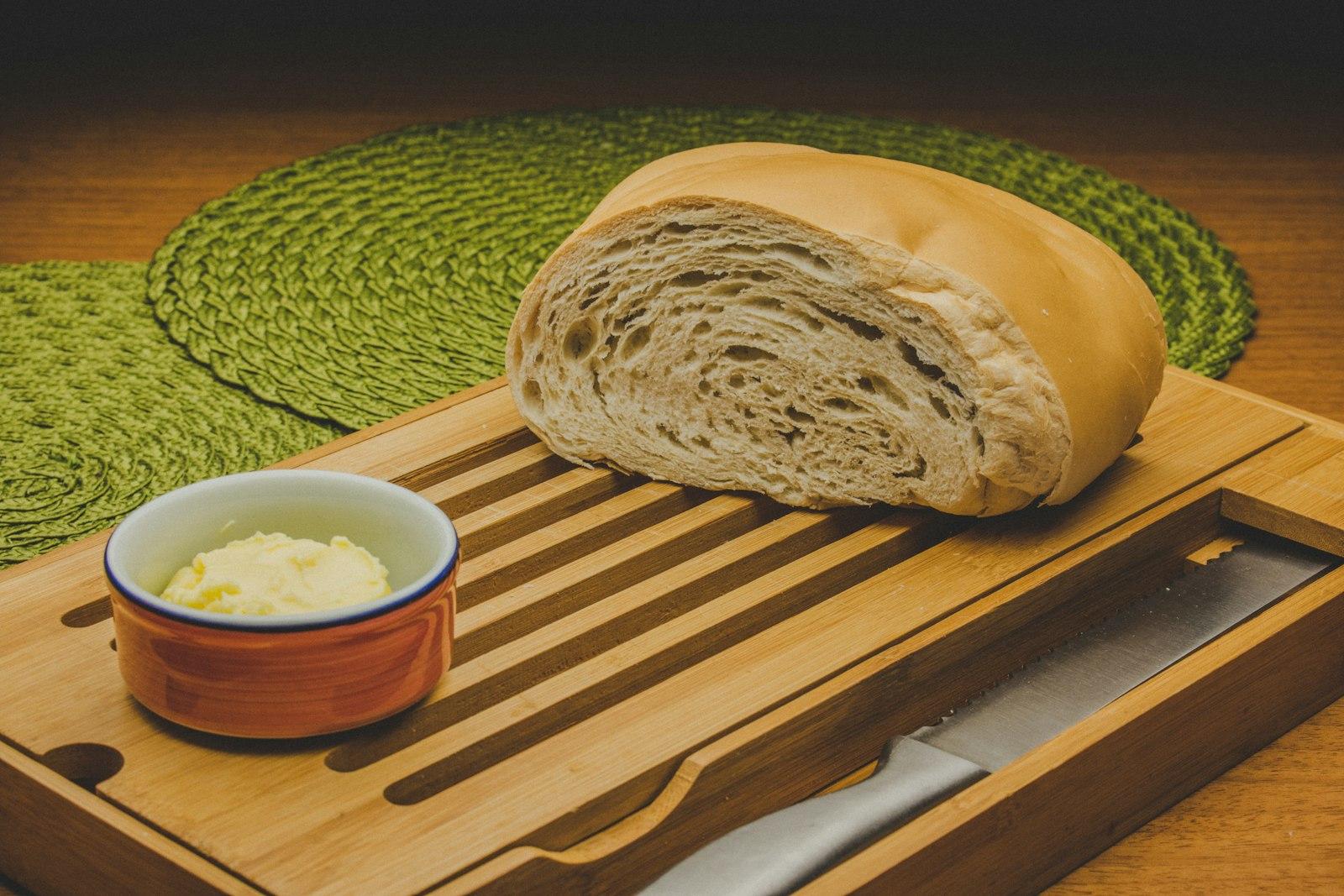
Sourdough bread is bread made with a live starter of wild yeasts and lactic acid bacteria and a long rise, and some wheat and spelt sourdough is low FODMAP. Monash University reports that spelt sourdough meets its low FODMAP criteria, and a Monash research dietitian has said that suitable wheat or spelt sourdough fits two slices per meal in the first phase. The catch is that the word "sourdough" on a packet tells you nothing about how the loaf was made.
This article is about one narrow question: can I put this loaf on my plate during the first phase of the low FODMAP diet, and how do I tell? If you want the wider story of why bread bothers some people with IBS in the first place (fructans versus gluten, bran, portion size), that is covered in why does bread make my IBS worse. Here we stay practical: what Monash has published, what the fermentation science says, how spelt, wheat and rye differ, how to read a supermarket label, and how to test a loaf without fooling yourself.
A note on sources. We have no access to the Monash app's data and do not use it. Everything attributed to Monash below comes from Monash's own public blog, or from a dietitian quoting Monash on a third-party site, and is labeled that way. Clairop is not affiliated with Monash University.
Is sourdough bread low FODMAP?
Sometimes. Monash says its laboratory testing found wheat or spelt sourdough breads generally lower in FODMAPs than standard breads made without a long ferment, and it states that spelt sourdough meets its low FODMAP criteria (Monash on starter microbes; A Little Bit Yummy). That is a statement about tested loaves. It is not a promise about every loaf in a shop.
The FODMAP that matters in bread is fructan, a chain of fructose units the human small intestine cannot digest. It reaches the colon, where bacteria ferment it into gas. Wheat and rye are major dietary sources, which is why ordinary bread is usually off the menu in the first phase of the diet. A published analysis of 55 commonly eaten grain foods found total fructan per portion as eaten ranged from 0.6 g in dark rye bread down to 0.07 g in spelt bread (Biesiekierski 2011). Those are the two ends of the range of breads in that paper, not a head-to-head test, but they show how much the grain itself matters before fermentation even starts.
Sourdough changes the picture because the microbes in the starter eat carbohydrates in the dough while it rises, including fructans. Monash describes the traditional process as a prolonged proving period, typically more than 12 hours, during which yeast and bacteria feed on the flour's carbohydrates and break the FODMAPs down (Monash). Reviews of the science say the lactic acid bacteria and yeasts in sourdough carry enzymes that can degrade fructans (Loponen 2018; Menezes 2018).
Several things have to line up for a loaf to land on the low side: the right flour, a long enough ferment, no added high FODMAP ingredients, and a portion that stays within the tested serving. If you remember nothing else, remember that the process, not the word on the packet, is what lowers the fructan.
What has Monash actually said about sourdough?
Monash has said three public things. Spelt sourdough meets its low FODMAP criteria. Wheat or spelt sourdough is generally lower than standard bread. And rye, kamut and oat sourdough can be higher. It has also said that the finished loaf needs testing, because some sourdough microbes are better than others at breaking fructans down.
Here is each statement with its source, so you can see how far it goes.
- Spelt. A Monash blog post says spelt flour is naturally lower in fructans than modern wheat, and that traditional sourdough proving reduces FODMAPs further. It says spelt breads and some other breads made by the traditional process meet its low FODMAP criteria in its app, and names Monash Low FODMAP Certified breads from several brands (Monash).
- Testing is still needed. A second Monash post says some microbes break fructans down better than others and the flour matters, so "the final product does need to be tested for total FODMAP levels" (Monash on starter microbes).
- Wheat and rye. In an interview published by a dietitian-run site, a Monash research dietitian said lab testing shows wheat or spelt sourdough generally has lower FODMAP levels than standard wheat or spelt bread made without fermentation, and that rye, kamut or oat sourdough can have higher levels (A Little Bit Yummy).
- US loaves. In 2015, a US dietitian reported that Monash had analyzed breads from around the world, including US ones, and that US wholemeal wheat sourdough and white sourdough met the low FODMAP criteria for two slices (Scarlata 2015). That is a secondhand report from 2015, so treat it as history, not a current serving size.
What we could not find is a public Monash page stating a serving size for every kind of sourdough. Serving thresholds live in the Monash app and are set per tested food. The app is the place to check a specific loaf, and apps and tests get updated, so a number copied from a blog can go stale.
How many slices of sourdough can you eat on low FODMAP?
The only figure we found attributed to Monash is two slices per meal. A Monash research dietitian said that if you are in the first phase and have found a suitable wheat or spelt sourdough, you can have two slices per meal within the recommendations (A Little Bit Yummy). The word "suitable" is doing real work in that sentence.
Three cautions about that number.
- It depends on slice size. A thin supermarket slice and a thick bakery slice can differ by a lot. Serving sizes in tested-food databases are in grams. If you have a kitchen scale, weigh a slice once and note it down.
- It is per tested product, not per category. Two sourdoughs with the same name can differ in flour, ferment and additives.
- Servings stack. A low FODMAP serving of bread plus a low FODMAP serving of another fructan or GOS food in the same sitting can add up to a high load. The stacking idea is explained with examples in FODMAP stacking examples. If you put sourdough toast alongside several other small servings, count the whole meal.
For breakfast ideas that keep the whole plate in range, see low FODMAP breakfast ideas.
Does a long ferment really break down fructans?
Yes, in laboratory measurements. Long fermentation by sourdough microbes lowers fructan content, and the size of the drop depends on the microbes, the flour, the time and the temperature. The lab studies agree on direction and disagree on size, which is why no single percentage should be treated as a promise about a loaf.
What the research literature supports:
- Sourdough organisms carry fructan-degrading enzymes. Reviews describe the metabolism of fructans in sourdough and how bakers can select cultures and conditions to lower FODMAPs (Loponen 2018; Menezes 2018).
- Different microbes do very different amounts of work. One study screened 13 sourdough-related yeasts and found strong differences in how well they degraded fructans, with a Saccharomyces cerevisiae strain isolated from traditional Austrian sourdough doing best (Fraberger 2018). That matches Monash's point that sourdough microbes differ.
- A human trial confirmed the chemistry. In a randomized, double-blind, 7-day study of 26 people with IBS and poor subjective tolerance to wheat, a sourdough wheat bread fermented for more than 12 hours, baked without improvers, was lower in FODMAPs than the yeast-fermented comparison bread (Laatikainen 2017).
Here is the uncomfortable part, and it is why we do not oversell sourdough. In that same trial, the lower-FODMAP sourdough was not tolerated better than the yeasted bread: there were no significant differences in gut symptoms or low-grade inflammation markers, and participants reported more tiredness and joint symptoms during the sourdough phase, which the authors said to interpret with caution (Laatikainen 2017). It was a small pilot, and some of its authors had commercial interests in IBS diet products, which the paper discloses. One small pilot is not the last word. It does mean "lower in FODMAPs on paper" and "feels better in your gut" are two different claims, and you are the only one who can test the second.
For the fuller version of that trial and how it fits the wider bread picture, our bread and IBS post goes deeper.
Is spelt sourdough lower in FODMAPs than wheat sourdough?
Spelt flour starts lower in fructans than modern wheat, and Monash lists spelt as a reason spelt sourdough meets its criteria. A study of wholemeal flours found bread wheat flour contained significantly higher fructan concentrations than spelt and emmer flours, which is the raw-material gap before any fermentation (Shewry 2022).
Spelt is still a wheat species and still contains gluten. Monash describes spelt as nutritionally very similar to modern wheat but with a notably lower fructan content, and also lower in gluten (Monash). "Lower in gluten" is not "gluten free", and it does not make spelt safe for celiac disease.
Here is how the main flours compare, using only what has been reported publicly.
| Loaf type | What has been reported | What to do in the first phase |
|---|---|---|
| Spelt sourdough (traditional ferment) | Monash says spelt sourdough meets its low FODMAP criteria | Use the app or certified product entry for serving size |
| Wheat sourdough (white or wholemeal) | Monash dietitian: wheat or spelt sourdough generally lower than standard bread; 2015 report of US loaves meeting criteria for two slices | Check the loaf's ingredients and ferment; start with a modest portion |
| Rye, kamut or oat sourdough | Monash dietitian: can be higher in FODMAPs; limit or avoid in the first phase | Skip during restriction unless the app shows a tested low entry |
| Sourdough with inulin, apple fiber, soy flour or dried fruit | Monash dietitian advises avoiding these ingredients | Skip; the added ingredient can outweigh the ferment |
| "Sourdough style" loaf made with baker's yeast and flavoring | Not tested as a category; process unknown | Treat as ordinary bread until you have evidence |
One more quirk worth knowing. In a study comparing yeast and sourdough processes on wholemeal bread wheat, emmer and spelt flours, both processes reduced fructans and raffinose, and yeast had the greater effect in that experiment (Shewry 2022). The same paper found mannitol increased in the sourdough system. Mannitol is a polyol FODMAP. That does not mean sourdough is a bad choice. It means the chemistry is variable, and lab averages hide a lot of loaf-to-loaf difference.
Is rye sourdough low FODMAP?
Not as a general rule. A Monash research dietitian has said rye, kamut or oat sourdough can have higher FODMAP levels and should be limited or avoided in the first phase, and that rye flour tends to remain high FODMAP even after fermentation (A Little Bit Yummy).
There is a wrinkle that sometimes confuses people. Researchers have developed rye sourdoughs specifically to be low in FODMAPs while staying high in fiber, and a review summarizes clinical studies of such breads (Loponen 2018). Those are purpose-designed products with controlled cultures. They are not the same as an ordinary rye sourdough from a bakery shelf. If a rye loaf is certified or tested low FODMAP, the app will show it. If it is not, it is a guess.
In one r/FODMAPS thread about a loaf that listed rye only in its starter, replies noted that the amount of rye in the finished bread might be tiny, but also that without testing nobody can say whether it is low FODMAP (r/FODMAPS). That is the right mental model: reasoning from the ingredient list gets you to "probably", not to "tested".
Does sourdough with added yeast count?
This is the single most repeated rule in the r/FODMAPS threads, and it is a folk rule. People often say that if yeast appears in the ingredients the loaf is not real sourdough, the ferment was short, and the fructans are still there. In a thread about a bakery loaf with both a levain and yeast, the top replies were split between "no, it is not traditional sourdough" and "less than regular bread, more than proper sourdough, so test it" (r/FODMAPS).
What the evidence says is more nuanced.
- Monash has not ruled either way. The Monash research dietitian said length of fermentation is one of the most important factors and that added commercial yeast can shorten it, but that Monash has not yet studied whether adding yeast changes the FODMAP content of sourdough. Her advice for a wheat or spelt sourdough containing yeast was to try it and see how your body responds (A Little Bit Yummy).
- Yeast itself can degrade fructans. In lab work on whole wheat bread, fermentation with a baker's yeast control strain reduced fructan by 56 percent, while an engineered co-culture with a different yeast reduced it by more than 90 percent (Struyf 2017). In another study, industrial yeast strains with high activity against fructooligosaccharides brought fructans down to about 0.3 percent of dry matter, while low-activity strains left about 0.6 percent (Laurent 2020). Those are research conditions, not supermarket loaves, but they show yeast is not a fixed "no".
- A US dietitian's practical view. In 2015 Kate Scarlata wrote that yeast in a sourdough's ingredient list likely means it was added to speed up leavening, so the bread may have some FODMAP reduction but not as much as a loaf leavened by the starter alone (Scarlata 2015).
So the fair summary is: no yeast on the label is a good sign of a slow, starter-only process, but yeast on the label is not a verdict. It is a reason to ask how long the dough ferments, and to test a small portion rather than assume.
How long does sourdough need to ferment?
No published threshold exists. Monash describes traditional proving as typically more than 12 hours (Monash), and the Finnish trial used a sourdough with a fermentation longer than 12 hours (Laatikainen 2017). The often-quoted 24 or 72 hours comes from forum posts and brand pages.
In r/FODMAPS, the commonly repeated benchmark is "at least 24 hours", and one commenter praised a brand that ferments for 72 hours (r/FODMAPS). Those numbers may well be reasonable rules of thumb. They are not Monash results.
Asked on her blog whether 24 hours was enough, Kate Scarlata replied that Monash had not discussed fermentation times, that she suspected longer might lower fructans and gluten, and that it was worth trying small amounts to assess tolerance, for example half a slice, then a full slice the next day (Scarlata 2015). That is the honest position: longer is plausibly better, the exact cutoff is unknown, and your own response is the readout.
Fermentation time is also not the only variable. Temperature, hydration, starter composition and flour all change how much fructan is broken down, and the specific microbes matter (Fraberger 2018). Two loaves both described as "24 hour sourdough" are not guaranteed to be equal.
Is supermarket sourdough low FODMAP?
You cannot tell from the word "sourdough". In the UK there is no legal definition of sourdough, and the Real Bread Campaign says appearance, price, aroma, taste and even the word sourdough offer no guarantee. It coined "sourfaux" for products marketed as sourdough but made with baker's yeast, additives or souring agents such as vinegar, yogurt or dried sourdough powder (Real Bread Campaign). Rules differ in other countries, so check how your own country treats the word.
In r/FODMAPS, people repeatedly describe the same pattern: the in-store bakery loaf at a big chain often lists yeast, which they take to mean there was no time for a long ferment, while a loaf from a local bakery or a short-ingredient brand is more likely to be starter only (r/FODMAPS). That is lived experience, not a test, and one commenter pointed out that a short ingredient list can be a clue but is not definitive.
Use this label checklist, in order.
- Ingredients: flour, water, salt, starter. A short list is a good sign. Real Bread Campaign says genuine sourdough is not made with baker's yeast, additives or chemical raising agents (Real Bread Campaign).
- Flour type. Wheat or spelt is the best starting point, per the Monash dietitian. Rye, kamut or oat flour in a meaningful amount is a reason to skip it in the first phase.
- Watch for added FODMAP ingredients. The Monash dietitian recommends avoiding breads with rye flour, soy flour, added prebiotics such as inulin or apple fiber, and dried fruit (A Little Bit Yummy). Also read the sugar line: Kate Scarlata suggests checking the nutrition panel for sweeteners such as honey or high fructose corn syrup (Scarlata 2015).
- Words like "style", "flavor" and "with sourdough". The Real Bread Campaign flags "with sourdough" as the sort of wording to watch for, similar to "style".
- Is it a tested or certified loaf? Monash names Monash Low FODMAP Certified breads from several brands in its sourdough post. Search the brand in the app. If a loaf is listed, that entry beats anything inferred from a label. For why different tools sometimes disagree about the same product, see why FODMAP apps disagree.
- Ask the baker. If it is unwrapped or unlabelled, ask for the ingredients and how long the dough ferments. Kate Scarlata's tip is to call and ask whether it is a slow-rise product.
If you rely on a barcode scanner, remember that scanners estimate from ingredients and cannot see the ferment time at all. Our comparison of Fig and Spoonful explains what those apps can and cannot check.
Is sourdough gluten free?
No. Wheat, spelt and rye sourdough all contain gluten, and low FODMAP is not the same as gluten free. If you have celiac disease, ordinary sourdough is not safe, and testing for celiac disease only works while you are still eating gluten.
The reason this matters on a low FODMAP page is that the two diets get mixed up constantly. Many people searching "is sourdough low FODMAP" are partway through trying to work out whether gluten or fructan is their problem. Two blinded studies at Monash and in Norway found that in people who believed they were gluten sensitive, fructan, not gluten, accounted for the symptoms. The 2013 Monash crossover trial in 37 people found no specific effect of gluten once FODMAPs were reduced (Biesiekierski 2013), and the 2018 Oslo trial of 59 people concluded fructan rather than gluten induced symptoms (Skodje 2018). That is about people without celiac disease. It says nothing about celiac disease itself.
For celiac disease the guideline position is that serology and biopsy should be done on a gluten-containing diet and that the treatment is a gluten-free diet (Rubio-Tapia 2013). Fermentation lowers gluten but not to a safe level in ordinary loaves. In one trial in celiac patients, baked goods made from flour hydrolyzed with sourdough lactobacilli plus fungal proteases down to 8 ppm gluten did not cause harm over 60 days, while goods with 2,480 ppm residual gluten led to subtotal atrophy in both participants who ate them (Greco 2011). That was a small study of a specially processed flour, not a license to eat bakery sourdough. If celiac disease is on the table, our guide to celiac versus IBS covers testing, and a doctor or dietitian should guide the next step.
What do people in r/FODMAPS say about sourdough?
People in r/FODMAPS mostly say that bakery sourdough with a short ingredient list is safer than supermarket loaves, and that a yeast in the ingredients is a red flag. Four themes keep coming back, which makes them a useful map of the questions. We are describing the community's experience here, not citing it as evidence.
- "Real" sourdough is fine, supermarket versions are a gamble. Many people report tolerating a loaf from a bakery or a short-ingredient brand and being caught out by an in-store loaf.
- The yeast rule. Many upvotes sit on the idea that yeast in the ingredients means it is not low FODMAP. As covered above, that is plausible but unproven.
- Rye in the starter. People ask whether a trace of rye in the starter changes anything. Replies say it is hard to tell without testing.
- Gluten confusion. Some replies assume wheat is automatically high FODMAP and gluten is the problem. Others point out the low FODMAP diet reduces wheat rather than banning it, and that celiac disease needs gluten-free bread (r/FODMAPS).
One more thing that appears in these threads: a few people report sourdough working for them even when ordinary bread does not, and a few report the opposite. Both are believable. Individual thresholds vary widely, which is the real reason a controlled trial of one loaf, described below, is worth more than any rule.
How do I test a sourdough loaf during the low FODMAP diet?
To test sourdough on low FODMAP, try one loaf at one serving in a plain meal, log your symptoms for 24 hours, and repeat on another day before deciding. The aim is to see whether this specific loaf is compatible with you, not to prove sourdough in general.
Low FODMAP is meant to be a short, structured process, ideally with a dietitian: restriction, then reintroduction of each FODMAP group, then personalization. A Monash-led randomized crossover trial found that a low FODMAP diet reduced IBS symptoms compared with a typical diet (Halmos 2014). Bread is one of the foods most people want back soonest, so it is worth doing carefully.
A simple protocol:
- Pick the loaf using the checklist above. Prefer a Monash-listed product, then a short-ingredient wheat or spelt sourdough from a bakery that tells you its ferment time.
- Weigh or measure one slice. Write down the grams or the thickness. Start with one slice, not two.
- Keep the rest of the meal plain. Eggs, a low FODMAP spread, a safe protein. Avoid pairing it with other borderline foods so that stacking does not muddy the result.
- Log the next 24 hours. Bloating, gas, pain and bowel changes, with times. Delayed responses are common, because fermentation happens in the colon hours after the meal.
- Repeat once or twice on different days. One bad day can be sleep, stress, a late dinner or a hormone shift. A pattern across several tries is what counts.
- Move up cautiously. If one slice is fine, try two on another day, the amount the Monash dietitian described for suitable loaves.
If you use a symptom tracker, put the loaf name, ingredients, slices and your symptoms in the same entry so you can compare like with like. Clairop is a free symptom tracker that can hold that log. A notebook works equally well, and our guide to keeping a food diary for IBS explains what to record. How Clairop's tracking works is a one-page explainer if you want to see what the log looks like.
Clairop logs meals, symptoms and stool in seconds, then looks for the foods your gut reacts to, including reactions that land days later.
What if sourdough still makes me bloated?
Then it is useful information, not a failure. Several explanations are plausible and you do not need to solve them all yourself.
- The loaf may not have been low FODMAP. A sourdough-style loaf with a short ferment, extra ingredients or a large portion may still carry a lot of fructan.
- The portion or the meal may be the issue. Two slices plus another fructan food can add up. See FODMAP stacking examples.
- It might not be fructan. Gluten-containing bread also contains other things people sometimes react to, and the trials above found a fructan effect only in people without celiac disease. Another possibility is that the bloating comes from something else in the sandwich.
- The first-phase window may be wrong for you. If you have not noticed meaningful improvement after the restriction phase, our guide on what to do if low FODMAP doesn't work covers the next questions to ask.
- Bread can be a reintroduction test, not a phase-one food. Some people choose to leave bread out of the first phase and test fructans formally later. The sequence is in how to reintroduce foods after the low FODMAP diet.
For the full list of what else to be careful with, see the high FODMAP foods list.
Myths about sourdough and FODMAPs
"Sourdough is always low FODMAP." Not by default. Monash itself says the final product needs to be tested, and rye, kamut and oat versions can be higher.
"Yeast on the label means it is high FODMAP." It is a reasonable warning sign, not a tested rule. Monash says it has not yet studied added yeast in sourdough, and yeast strains can degrade fructans.
"24 hours is the official rule." It is a community benchmark. Published sources describe more than 12 hours as typical for traditional proving, and the exact cutoff has not been set.
"Sourdough is gluten free because bacteria eat the gluten." Fermentation reduces gluten but ordinary sourdough is not gluten free, and the celiac trial result depended on a specially processed, fully hydrolyzed flour (Greco 2011).
"If the lab says it is lower FODMAP, my gut must agree." The one blinded trial of a long-fermented wheat sourdough in IBS found lower FODMAPs but no symptom benefit over yeasted bread (Laatikainen 2017).
"Spelt means gluten free." Spelt is a wheat species. It has less fructan and less gluten than modern wheat, but it contains both (Monash).
When should you see a doctor or dietitian?
See a doctor promptly if you notice blood in your stool, unexplained weight loss, fever, symptoms that wake you at night, anemia, symptoms that start after the age of 50, or a family history of bowel cancer or inflammatory bowel disease. These are not explained by a loaf of bread, and a food diary should never delay an assessment.
If you have not been tested for celiac disease and you are considering cutting out wheat, ask about testing first, because tests work only while you are eating gluten (Rubio-Tapia 2013). A registered dietitian trained in the low FODMAP diet can help you choose breads, set a sensible restriction window and plan reintroduction so that you do not stay on a restricted diet longer than needed. If you have Crohn's disease or ulcerative colitis, check food changes with your IBD team.
The short version
- Traditional wheat or spelt sourdough can be low FODMAP. Spelt sourdough meets Monash criteria, and a Monash dietitian has said two slices per meal for suitable loaves.
- Rye, kamut and oat sourdough can be higher, and so can loaves with inulin, apple fiber, soy flour or dried fruit.
- Yeast on the label is a reason to ask questions, not a proven disqualifier. Monash has not yet studied it.
- The word sourdough on a supermarket packet proves nothing about the ferment. Read the ingredients and ask the baker.
- Low FODMAP is not gluten free, and ordinary sourdough is not safe for celiac disease.
- Test one loaf, one serving, in a plain meal, and log the next 24 hours before you decide.
If you want a broader view of what else fits the first phase, the low FODMAP food list is the place to start. This article is general information, not medical advice.