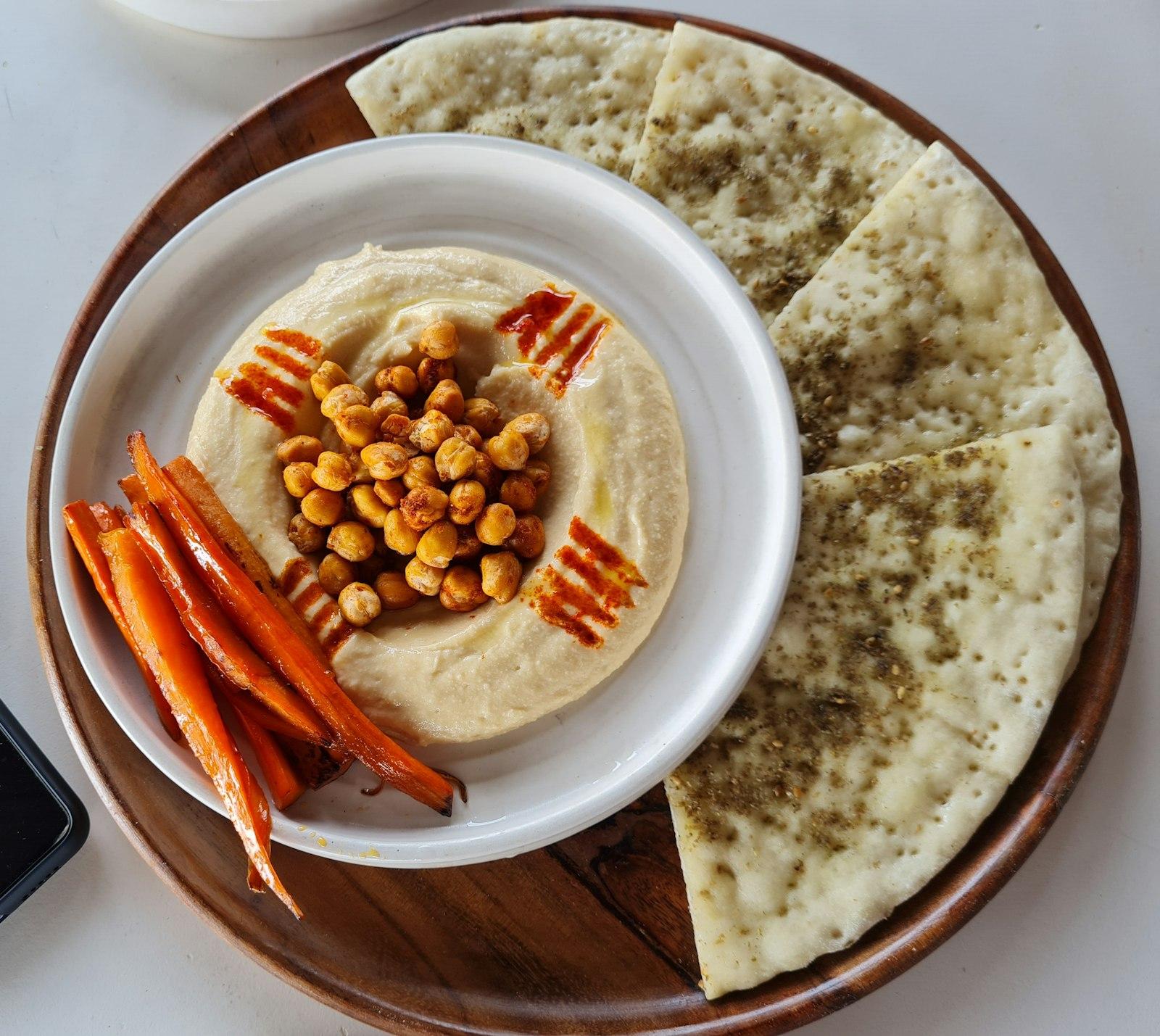
Hummus can be low FODMAP, but only in a particular form and at a particular size. Homemade hummus made from drained, rinsed canned chickpeas, a measured amount of tahini and garlic-infused oil in place of garlic is the version dietitian sources describe as workable during the restriction phase, at roughly one to three tablespoons. Most tubs from a supermarket are a different food, because they usually contain real garlic.
That last point is why so many people write "I checked, it was only chickpeas, why did I still react?" The answer is rarely one ingredient. Hummus is three possible triggers in one scoop: chickpeas (galacto-oligosaccharides, or GOS), garlic (fructans) and tahini (a small, disputed amount of oligosaccharide). If you are diagnosed and working out whether hummus is your trigger, the useful question is not "is hummus low FODMAP" but "which part of it, at what dose, bothers me".
Is hummus low FODMAP?
Sometimes, at a small serving, and only if it is made without garlic. Traditional hummus has three FODMAP-relevant ingredients, and each is dealt with differently.
| Ingredient | FODMAP in it | What helps | What to watch |
|---|---|---|---|
| Chickpeas | GOS (oligosaccharides) | Canned, drained and rinsed; small portion | Dried and home-cooked are treated differently; big scoops |
| Garlic | Fructans | Replace with garlic-infused oil | Fresh garlic, garlic powder, "natural flavors", spice blends |
| Tahini | A small amount of oligosaccharide, sources disagree on the limit | Measure it, keep it modest | Large amounts; tahini sauces on top of hummus |
| Lemon juice, salt, cumin, olive oil | Not a concern at recipe amounts | None needed | Spice mixes that list garlic or onion |
Low FODMAP is a short, structured process, ideally run with a registered dietitian, with a reintroduction phase and then a personalized diet. It is not meant to be permanent. A randomized crossover trial from the Monash group found that a low FODMAP diet reduced IBS symptoms compared with a typical diet (Halmos 2014), and the American College of Gastroenterology recommends a limited trial of the diet in IBS (Lacy 2021). Hummus is one of the foods people want back quickly, which makes it a good candidate for a careful test rather than a guess.
Clairop is not affiliated with Monash University, and we have not used Monash app data here. Where we mention a Monash figure, it comes from a public Monash web page or from a dietitian describing the Monash app. For the exact current number in your country, check the app yourself.
What is in hummus that can bother your gut?
Chickpeas, garlic and tahini each deliver a different FODMAP, and a person with IBS can react to one and not the others. Knowing which is which is the whole game.
Chickpeas. Legumes are naturally high in oligosaccharides, mainly GOS and sometimes fructans. Monash's research dietitian says legumes do not need to be strictly avoided on a low FODMAP diet, and notes that because oligosaccharides dissolve in water, canned legumes or ones that have been boiled and drained tend to be lower, since some leach into the liquid that you drain and rinse away (Monash legumes blog).
Garlic. A laboratory survey of 60 vegetables and 43 fruits found that garlic, artichoke, shallots, leek bulb and onions had the highest fructan content, ranging from 1.2 to 17.4 g per 100 g fresh weight (Muir 2007). Garlic is at the top end of that league table. In a double-blind rechallenge study in people with self-reported non-celiac gluten sensitivity, fructan rather than gluten induced symptoms (Skodje 2018), which is a useful reminder that fructans themselves can cause the symptoms people blame on other things. We go deeper on this in our guide to why garlic and onion affect IBS.
Tahini. Tahini is sesame paste. Sesame seeds and tahini are not obviously the same on a FODMAP table, which confuses people, and the published figures disagree (more on that below).
None of this proves you will react. It tells you where the fermentable load comes from, so that a test can pull the three apart.
How much chickpea is low FODMAP in hummus?
The figure repeated most often is a quarter cup (42 g) of canned, drained chickpeas. It appears in Monash's own research dietitian blog, which suggests mixing a quarter cup (42 g) of canned chickpeas with tuna as a snack (Monash legumes blog), and in a dietitian's hummus post that says the Monash app limit for canned chickpeas was a quarter cup per serving at the time of writing (Scarlata 2013). A second dietitian recipe page also gives a quarter cup of canned chickpeas, drained of juice (42 g), as low FODMAP (Rachel Pauls Food).
Two cautions apply to that number.
- It describes chickpeas, not finished hummus. Some AI answers and blog posts blur "a quarter cup of chickpeas (42 g)" into "two tablespoons of hummus (about 40 to 42 g)". They are not the same thing, because hummus also contains tahini, oil, lemon and water, and the chickpea content of a spoonful of hummus is a fraction of the spoon.
- Serving thresholds are re-tested and can change, and the dated posts above are years old. Treat 42 g as a starting reference, not a rule, and check the current Monash app entry for the figure your region uses.
Why does canning matter?
Oligosaccharides such as GOS are water soluble. In a canned product the legumes sit in liquid for a long time, some oligosaccharide moves into that liquid, and you remove it when you drain and rinse. In a laboratory study of lentils, chickpeas, peas and soybeans, raw chickpeas contained about 144.9 mg of oligosaccharide per gram, the highest of the group, and soaking reduced the content in all of them (Han 2006). The same study found something that surprises people who assume that cooking always helps: for chickpeas, oligosaccharide content after soaking and then cooking was either unchanged or even higher, possibly because other soluble components leached out and bound oligosaccharides were released (Han 2006). In an analysis of the FODMAP content of plant-based foods, the processes that produced the greatest reduction in FODMAP content were pickling and canning (Tuck 2018).
What that means for your kitchen, without overclaiming:
- Canned chickpeas, drained and rinsed, are the form the published servings are built around. The recipe pages from Monash and from dietitians all use canned.
- Dried chickpeas that you soak and cook at home are not covered by the same quarter cup. Our reading of the sources is that no one has given them the same green light, and the laboratory work above shows that cooking alone is not a reliable fix.
- Do not use the canning liquid. Aquafaba and the liquid in the can are where the leached oligosaccharides ended up.
We are deliberately not covering beans in general here. This page stays with chickpeas because chickpeas are what hummus is made of.
Is garlic the hidden problem in store-bought hummus?
For many people, yes. Garlic is the ingredient most likely to turn a tub of hummus from a chickpea question into a fructan problem, and it is easy to miss on a label.
Fructans are chains of fructose that the human small intestine cannot digest. They reach the colon, where bacteria ferment them to gas. A review of the mechanisms describes MRI work showing that short-chain fermentable carbohydrates increase small bowel water and colonic gas, which in people with visceral hypersensitivity induces IBS-type symptoms (Staudacher 2017). A single clove is not a trivial amount in this context, because garlic is among the most fructan-dense foods measured (Muir 2007).
Commercial hummus is built for flavor, and garlic is flavor. An app-vendor blog that reviewed the issue says supermarket tubs almost always list garlic and are eaten in larger scoops than the diet allows, so they are high FODMAP in practice (FODMAP Foods blog). That is a reasonable summary, and we agree with it as a general rule, but we have not lab-tested any brand, and a particular product could differ.
A pattern we see in r/FODMAPS threads is the person who read the label, saw no onion or garlic, chose a short-ingredient organic hummus, and still got cramps. In that thread people suggested that the remaining suspects were the chickpeas or the tahini, or both, and others pointed out that "natural flavors" or "natural spices" can conceal garlic or onion (r/FODMAPS thread). That is community experience, not evidence, but it describes exactly the problem this post is built to solve: a safe-looking label that still leaves three suspects.
How do you read a hummus label?
Read the ingredient list from the top, because ingredients are listed in descending order by weight, and look for these in this order.
- Garlic in any form. Garlic, garlic puree, garlic powder, granulated garlic, dried garlic, "roasted garlic". Any of these means fructans.
- Onion in any form. Onion powder or onion in the spice blend.
- Vague flavor words. "Natural flavors", "spices" and "seasoning" can include garlic or onion, and the label is not obliged to say which. If you are in restriction and the product has no certification, an unspecified spice blend is a reason to be cautious or to write to the maker.
- Garlic-infused oil. This is the one garlic-related ingredient that works in your favor, if it is real infused oil and not garlic pieces suspended in oil.
- Added fibers and sweeteners. Inulin, chicory root, honey, apple or pear juice concentrate and sugar alcohols can appear in "flavored" hummus and dips. Inulin is a fructan, and some of the others carry other FODMAPs.
- Chickpea source and form. A label that only says "chickpeas" does not tell you whether they were canned and rinsed or cooked in the factory, so you cannot infer the GOS load from it.
- Tahini placement. Tahini high on the list means a larger tahini share per spoon.
- Flavored varieties. Roasted red pepper, caramelized onion, spicy and "extra garlic" versions each add their own ingredients, so read each one separately. The flavor name does not tell you the FODMAP content, and neither does the word "organic" or "natural".
Two limits are worth saying plainly. A short label is not the same as a tested product, and no label tells you the serving at which a given hummus is low FODMAP. Only laboratory testing does that, which is why certified products and tested recipes exist. Our guide to why FODMAP apps disagree explains why different sources can give you different numbers for the same food, and our low FODMAP barcode scanner app comparison looks at how scanners handle ingredient lists.
What about tahini?
Tahini is the least settled ingredient in the hummus debate. Sesame paste is a small share of a spoon of hummus, but it matters if you are eating several spoons.
The published numbers disagree:
- A dietitian wrote in 2013 that, according to a Monash researcher, tahini is a source of fructans in a portion greater than one tablespoon, so a drizzle is fine. She also said the researchers were unsure why tahini made from sesame seeds differs from the seeds themselves (Scarlata 2013).
- An app-vendor blog from 2026 says tahini lands in the low FODMAP range at 2 tablespoons (30 g) (FODMAP Foods blog).
- In r/FODMAPS, people trade the idea that regular amounts are fine and that very large amounts reach a moderate GOS level, and some report their own reactions to sesame products (r/FODMAPS thread). Community claims like these are not evidence, which is another reason to check the figures yourself.
We can reconcile the difference only partly. Thresholds are updated, the measured portion may have changed over a decade, and a tablespoon in one source may not be a tablespoon in another. The practical conclusion is to measure tahini with a spoon rather than pour it, to prefer a plain tahini that lists sesame only, and to treat it as its own suspect in the test below, separate from chickpeas.
A second point that is easy to miss: restaurant hummus often arrives drizzled with tahini sauce, olive oil and spice, on a plate with pita, with falafel next to it. That is several sources of fermentable carbohydrate at once.
How do you make a garlic-free hummus at home?
Make it from drained, rinsed canned chickpeas, a measured amount of tahini, lemon juice and garlic-infused oil, and then portion it out. The template is the same across the Monash recipe and the dietitian recipes.
The Monash hummus recipe lists canned chickpeas (400 g), lemon juice (a quarter cup), hulled tahini (half a cup, 125 g), garlic-infused olive oil (a third of a cup, 80 g) and water, serves 6 to 8, and tells you to drain the chickpeas and rinse off any remaining canning liquid (Monash hummus recipe). A dietitian's simpler version uses one can of drained and rinsed chickpeas, lemon juice, cumin, one tablespoon of garlic-infused oil and a little water, and suggests keeping the portion near a quarter cup (Scarlata 2013).
Here is a piece of arithmetic that we have not seen in the other posts, so treat it as our own working. The Monash recipe page does not say whether "400 g" is the can weight or the drained weight. A dietitian's page says a 15 ounce can holds about 246 g once drained and rinsed (Rachel Pauls Food). If the chickpeas in a batch weigh roughly 246 g drained, then one of 6 to 8 serves holds roughly 31 to 41 g of chickpeas, just under the 42 g reference, and about 16 to 21 g of tahini, which is a little over one tablespoon. That fits together neatly, which is some reassurance that the published figures are describing a serving of about one-sixth to one-eighth of the batch. If instead 400 g were drained weight, each serve would be roughly 50 to 67 g of chickpeas, which exceeds the reference. We cannot tell which was meant, so the safest move for a test is to portion the batch yourself and start small.
A practical method:
- Open a can of chickpeas, drain it completely, rinse under cold water until the water runs clear, and drain again.
- Weigh the chickpeas if you have scales. Write the grams down, because that number is what you will log.
- Blend with lemon juice, salt, a little cumin or paprika (check the label for garlic or onion), tahini measured by the spoon and garlic-infused oil. Thin with water.
- Divide into portions straight away and refrigerate or freeze them, so the scoop does not drift upwards.
- Serve with plain carrot, cucumber or capsicum sticks, rather than a second high-GOS or high-fructan carbohydrate.
Spice blends are a trap. Skip any mix that lists garlic or onion.
How does garlic-infused oil work, and is it safe to make at home?
Garlic-infused oil gives you the flavor without the fructans, because fructans are water soluble but not fat soluble. Monash puts it directly: when surrounded by water the fructans leach into the liquid, but not into oil, so the aroma and flavor compounds of garlic can be carried by extra virgin olive oil without the extra FODMAPs (Monash infused oils blog). The same page says that a commercial oil bearing the Monash Low FODMAP Certified logo has been tested against its cut-off points. That is the safe, simple route: buy a certified infused oil and do not make your own.
If you do make it at home, two cautions matter.
- Strain out every solid. The principle only holds for the oil. Garlic pieces still contain fructans, so any sediment or fragments carried over can bring fructans with them.
- Treat homemade garlic oil as a food safety problem. Garlic is a low-acid food (the garlic-in-oil product in one outbreak had a pH of 5.7), and low-acid foods stored in oil without oxygen can support Clostridium botulinum. The CDC lists chopped garlic in oil among newer sources of foodborne botulism and advises refrigerating homemade oils made with garlic or herbs and throwing them away after 4 days (CDC). Botulism episodes linked to garlic-in-oil products led US regulators to require microbial inhibitors or acidifying agents in commercial versions (Morse 1990). Do not leave homemade garlic oil on the counter, and do not keep a jar for weeks.
This is the one place in this post where we would rather you spend a little money than improvise. Hummus is not worth a food poisoning risk.
What serving of hummus do published sources suggest?
Published figures for a finished hummus serving vary from roughly one to three tablespoons, with one dietitian suggesting a quarter cup, so there is no single answer to quote. We have not used Monash app data, so the table is built from public pages and should be read as a range.
| Source | What it says | Type |
|---|---|---|
| Monash hummus recipe | Recipe serves 6 to 8, built on canned chickpeas, tahini and garlic-infused oil | Monash web page |
| Monash legumes blog | A quarter cup (42 g) of canned chickpeas as an example amount | Monash dietitian blog |
| Dietitian blog, 2013 | Keep your hummus portion near a quarter cup, or as tolerated | Dietitian |
| App-vendor blog, 2026 | About 2 tablespoons per serving; recipes cluster at 2 to 3 tablespoons | Consumer site |
| Search AI answers (November 2026) | One to two tablespoons, or 2 tablespoons (40 to 42 g), with conflicting detail | Not evidence |
The sensible reading is a range of about one to three tablespoons of homemade, garlic-free hummus as a starting meal portion in restriction, with the smaller end first. A restaurant mezze plate or a wrap spread is often several times that.
This is also where FODMAP stacking bites. Two tablespoons of hummus is fine alone, but alongside wheat pita, a few falafel and a glass of oat milk, several oligosaccharide sources pile into one meal, and the total can pass your threshold even though every item looked defensible. Our low FODMAP food list shows where legumes sit among the GOS foods, and our guide to eating out low FODMAP covers the mezze problem.
What do people in r/FODMAPS say about hummus?
People mostly say that hummus is one of the foods they are most nervous about reintroducing, and that results are mixed. We are describing community experience here, and none of it is evidence.
- Fear of the combination. In one r/FODMAPS thread about trying chickpeas and hummus again, a common theme is that a falafel wrap is nothing but FODMAP ingredients, from the chickpeas to the tahini, garlic, onion and lemon, so people dread testing it (r/FODMAPS thread).
- "Healthy" is not "low FODMAP". One reply makes the point that conventional ideas of a healthy food do not carry over to a low FODMAP diet.
- Portion rescue. Some people say they tolerate hummus in moderation, with a measured two tablespoons and carrots, and that a larger scoop causes trouble. Others say they have made hummus a permanent avoid after repeated bad reactions.
- Stacking. One person traced a bad week to tahini stacked with barley, which is the sort of accident that single-ingredient testing is built to catch.
- Substitutes. There is a steady flow of recipes for hummus without chickpeas, made from zucchini, carrots or other vegetables, which people describe as an acceptable stand-in. A separate r/lowfodmap thread, need help finding hummus, shows how common the search is.
- Chickpeas on their own. A separate r/ibs thread is titled "Chickpeas are the devil" (r/ibs thread), a sign that for some people the chickpea itself is the problem regardless of garlic.
The mixed picture is the point. Hummus does not behave the same way in everyone, which is why testing beats rules.
How do you test hummus to find out whether chickpeas, garlic or tahini is the trigger?
Test them one at a time on separate days, using measured portions, and log the next 24 hours and beyond. The aim is to separate three suspects that the label cannot separate for you.
Before you start, a few ground rules. If you are in the middle of a dietitian-led process, run this plan past them, because reintroduction has its own order (how to reintroduce foods after the low FODMAP diet, and low FODMAP reintroduction order). The low FODMAP diet is usually described in three stages, restriction, reintroduction and personalization, which can be covered in at least two dietetic appointments (Whelan 2018). A hummus test belongs in reintroduction, not at the start.
Pick a stable week. Test when you have no other changes: no new medicine, no travel, no unusual stress, no period if you know it shifts your bowels. A single bad day can be sleep, stress or a late dinner.
A worked example: the three-suspect test
This is a worked example of a plan, not clinical advice or a protocol anyone has trialled. Adjust it with your dietitian.
| Step | What you eat (measured) | What it isolates | Log |
|---|---|---|---|
| 1 | A quarter cup (about 42 g) of drained, rinsed canned chickpeas, plain, with a safe starch such as rice | Chickpea GOS at the published reference | Symptoms at 2, 6 and 24 hours, then next 2 days |
| 2 | One tablespoon of plain tahini on a safe cracker or vegetable | Tahini, with no chickpeas and no garlic | Same windows |
| 3 | Garlic-free homemade hummus, 2 tablespoons, with carrot sticks | The combined chickpea and tahini load at a small dose | Same windows |
| 4 | Only if steps 1 to 3 passed and with your dietitian: a measured, deliberate garlic or fructan challenge, separate from hummus | Fructans, which you can then relate to tubs | Same windows |
| 5 | Last: the store-bought hummus you actually want, at a measured portion | The real-world product | Same windows |
Leave a gap between steps, typically until you have settled, and many people allow two to three days. That interval is common practice and not a tested rule. We cover the timing in more detail in how long after eating IBS symptoms start.
Step 4 deserves emphasis. We do not suggest dropping raw garlic into hummus at home to see what happens. A garlic challenge belongs in the structured reintroduction of fructans, where dose and order are planned, and the result can then be applied to hummus afterwards.
Clairop logs meals, symptoms and stool in seconds, then looks for the foods your gut reacts to, including reactions that land days later.
How long should you watch for symptoms?
Watch for at least 24 hours after each test, and write down anything in the following two to three days as well. GOS and fructans are fermented in the colon, which happens hours after eating rather than minutes. In a crossover study with 15 healthy subjects and 15 people with IBS, a high FODMAP diet produced prolonged breath hydrogen over the whole day and, in IBS, gastrointestinal and systemic symptoms (Ong 2010). A reaction that starts at 3 hours, peaks in the evening, or shows up as the next morning's bloating can easily be missed if you only check at the table. A short window of an hour or two will mostly miss fermented-subgroup reactions.
Clairop tests each food you log against three delay windows, within six hours, six to twenty-four hours and one to three days (how Clairop works), which is the same idea applied across many meals. For a one-off hummus test, a notebook is enough.
What should you write down?
Keep the log boring and exact. For each test:
- The product or batch (homemade, brand name, certified or not) and the ingredient list.
- The grams or spoons, ideally weighed.
- What else you ate and drank in the same meal and the previous 6 hours, since stacking can mislead you.
- The time you ate.
- Symptoms with a 0 to 10 severity, and the time they started: bloating, gas, pain, urgency, stool form.
- Context: sleep, stress, period, exercise, medicines.
Our guides on how to keep a food diary for IBS and how to find out what triggers my IBS cover what makes a log useful, and why a food diary shows no pattern explains the usual reasons it does not.
How many times should you repeat it?
Repeat each step at least once on a different day before drawing a conclusion. There is no published number of exposures that settles a hummus verdict, so this is a judgment. A single reaction can be chance, and a single "fine" can be a lucky day. If two out of two comparable exposures cause the same symptoms in the same window, you have a stronger signal, and if neither does, you have reason to consider a larger serving next.
How do you read the results?
| What happened | A reasonable reading | Next step to discuss |
|---|---|---|
| Step 1 (chickpeas alone) reacts, others not tested yet | Chickpea GOS at that dose is a likely suspect | Try a smaller amount, or leave chickpeas out for now |
| Step 1 fine, step 2 (tahini) reacts | Tahini, not chickpeas | Try a smaller measured spoon, or stay with hummus without tahini |
| Steps 1 and 2 fine, step 3 reacts | Combined dose or stacking, or the spice or oil | Reduce portion, check every ingredient, repeat |
| Steps 1 to 3 fine, step 5 (tub) reacts | The tub's garlic, onion or flavoring is the likely culprit | Check the label and your fructan result |
| Everything reacts | Several suspects, or a trigger outside the hummus | Slow down, review the whole diet and non-food factors with your clinician |
None of this is a diagnosis. It is a structured way to get a clearer answer than "hummus does not agree with me".
How do you take the result to a dietitian or GI?
Bring the log, not a conclusion. A short summary is more useful than a verdict, because the clinician can then compare it with the rest of your reintroduction.
A one-paragraph summary might read: "I tested chickpeas, tahini, garlic-free hummus and a tub product on separate days. Chickpeas alone at 42 g were fine twice. Tahini at one tablespoon was fine. Two tablespoons of homemade hummus was fine. The tub caused bloating at 4 to 6 hours and loose stool the next morning on both tries. It contains garlic powder." That is a result a dietitian can use.
Ask three things: whether the next test should be fructans or GOS, whether a larger chickpea portion is worth trying, and whether anything else in your history (a gastroenterology review, celiac or inflammatory bowel disease testing, constipation or diarrhea pattern) changes the plan. Our IBS dietitian follow-up diary and how to measure IBS symptom improvement walk through what to track between appointments, and the low FODMAP reintroduction planner can help you lay out the order.
Clairop is a free symptom tracker that lets you log meals and symptoms and produces a one-page summary for an appointment, and our guide to the best IBS apps compares it with other options. A paper diary does the same job if that is what you will actually use.
What if hummus still gives you symptoms?
If a garlic-free, measured serving still bothers you, chickpeas themselves, or the tahini, may simply not be for you right now. That is a result, not a failure.
- Smaller is fine. Many people find a threshold. A teaspoon on a sandwich is a different dose from half a plate.
- Retest later. Reintroduction is meant to be repeated over time, and tolerance can change.
- Try an alternative dip. Several people describe vegetable-based dips as a good stand-in, but check any substitute vegetable for its own portion limits before you build a meal on it.
- Do not cut more foods in response. If a long list of foods is causing symptoms, it is time to ask a dietitian about the bigger picture, because over-restriction carries its own risks. Our guide on what to do if low FODMAP does not work covers this.
Myths about hummus and FODMAPs
"If the label has no garlic, it is low FODMAP." The label tells you what is listed, not what dose of chickpea GOS or tahini you are eating, and flavorings can hide garlic or onion.
"A quarter cup of chickpeas means a quarter cup of hummus." It does not. The 42 g figure is for chickpeas, and hummus has other ingredients.
"Garlic oil is garlic, so it is not low FODMAP." Fructans do not dissolve in fat, so a properly strained infused oil is a different thing from garlic itself (Monash infused oils blog). Chunks of garlic are another matter.
"Making my own garlic oil is easy and safe to keep." Homemade garlic oil should be refrigerated and discarded after 4 days (CDC).
"Cooking dried chickpeas for longer makes them low FODMAP." One laboratory study found cooking soaked chickpeas did not lower oligosaccharides and could raise them (Han 2006).
"If hummus bothers me, I can never eat chickpeas." Not necessarily. You may tolerate a smaller portion, a different preparation or none of it, and the only way to know is to test.
When should you see a doctor or dietitian?
See a doctor promptly if you have blood in your stool, unexplained weight loss, fever, symptoms that wake you at night, anemia, a family history of bowel cancer or inflammatory bowel disease, or if your symptoms started after age 50. Do not attribute these to hummus. They need assessment, and a food test does not replace it.
See a registered dietitian if you are running the low FODMAP diet without one, if you are losing weight, if you are avoiding many foods, or if results from your tests are confusing. If you have Crohn's disease or ulcerative colitis, the low FODMAP diet is not a treatment for inflammation, and fibrous foods like chickpeas may need different advice during a flare or with a narrowing of the bowel, so ask your IBD team before changing your diet. Never stop or change a medicine because of a food test.
The short version
Hummus is low FODMAP only in a garlic-free, small, measured form, built on drained and rinsed canned chickpeas, a modest amount of tahini and a safe garlic-infused oil. Store-bought tubs usually contain garlic, which is a fructan problem you can miss on a label. Published serving figures conflict, so treat them as a range and check the current app for your region. The useful move is to separate the three suspects, chickpeas, tahini and garlic, test them one at a time with a log that runs for at least 24 hours, repeat each test, and bring the result to your dietitian or gastroenterologist.