Cheese can trigger irritable bowel syndrome (IBS) when lactose is not the problem because cheese is concentrated fat and protein in a small, easy-to-overeat package, and an IBS gut tends to overreact to both fat and meal size. Lactose is only one of several things in a slice of cheddar, and it is often the least likely one: hard, aged cheese is close to lactose free by nature. So when a lactose-free label does not fix the problem, the next suspects are fat, portion, how the cheese was aged, and everything else on the plate.
That is a very common experience. In a survey of 197 people with IBS who were asked about 56 foods, 49% linked dairy products to symptoms, and 20% named cheese specifically in a group of foods rich in biogenic amines (Böhn 2013). On Reddit, the same puzzle appears again and again: pain for days after a cheesy meal (r/ibs), or a person who handles mozzarella perfectly but not an older cheese that was supposedly lactose free (r/ibs). Replies in those threads suggest fat, histamine, portion size, and "maybe you are lactose intolerant after all". Each guess may be right for someone. None can be checked by thinking harder.
This guide is for people who already have an IBS diagnosis and want to work out whether cheese is truly their trigger, and which part of it. We cover what the evidence supports, where it is thin (aged cheese and histamine especially), and a test plan that separates fat, portion and cheese type, so you can show a dietitian or gastroenterologist something specific. It does not cover lactose intolerance as a condition; we mention it only to rule it out. If that is your question, start with lactose intolerance vs IBS.
Why does cheese trigger IBS even when it is lactose free?
Cheese triggers IBS when lactose is ruled out because several other parts of cheese can set off an IBS gut. The main candidates are the fat, the portion you eat, amines that form in aged cheese, milk protein, and the other foods and additives eaten with it. They overlap, which is why guessing rarely works.
Here is a quick map of the five suspects, what each one predicts, and how to tell them apart. The rest of this guide takes them one at a time.
| Suspect | What it would look like | Cleanest test |
|---|---|---|
| Fat | Worse with creamy, full-fat, oily cheese; olive oil alone also bothers you | Same weight of lower-fat and higher-fat cheese; a no-cheese plate with matched oil |
| Portion | Fine at 20 g, bad at 100 g, for any cheese | Same cheese at three portions on separate days |
| Cheese type or age | One type bothers you at the same portion and fat as another | Match fat grams and weight, change only fresh versus aged |
| Milk protein | Reactions after small amounts, sometimes with hives or swelling | Not a home test; ask a doctor |
| What else is on the plate | Cheese alone is fine; pizza, mac and cheese or crackers are not | Cheese alone on a plain base, then add one item back at a time |
A word on how sure to be. Everything about fat and the colon in this guide comes from small, mostly laboratory studies. Everything about aged cheese and histamine is weaker still. That does not make your experience less real. It means the practical answer is to test, not to adopt a rule from a review article.
Is lactose-free cheese really different from regular cheese?
Not by much for most people, because cheese is already low in lactose, and "lactose free" on a label does not change the fat or the protein. Hard, aged cheeses lose almost all of their lactose during manufacture and ripening, so a regular mature cheddar and a lactose-free one can contain similar tiny amounts.
Some numbers put this in perspective. In one analysis of 32 samples, five types of mature cheddar, Comté and an Emmental fondue mix contained lactose and galactose at consistently low levels, with the cheddars ranging from below the detection limit to 12.65 mg per 100 g, and the Comté and Emmental samples below detection for lactose (Portnoi 2016). In 59 samples of Grana Padano, average lactose was 0.45 mg per 100 g (Monti 2017). Both studies were done for other reasons, galactosaemia and laboratory method validation, not IBS, but they show how little lactose is left in aged hard cheese.
Compare that with what lactose studies treat as a meaningful dose. In a double-blind trial of 13 lactose maldigesters, 2 g of lactose caused no significant symptoms, 6 g was tolerated, and abdominal pain increased at 12 g (Hertzler 1996). The authors noted that foods with 6 g or less per serving, such as hard cheeses, may be tolerated. A 40 g piece of Grana Padano would contain roughly 0.2 mg of lactose at the 0.45 mg per 100 g average. Lactose is simply not a plausible explanation for a reaction to aged hard cheese in most people.
Fresh cheeses are a different story. Cottage cheese, ricotta, cream cheese and mascarpone are generally thought to keep more of the milk sugar, which is why dietitians often separate "fresh and soft" from "hard and aged" when they talk about lactose. We did not find a study that measured them for this guide, so check the Monash app or a dietitian for exact figures. If your reactions are to fresh cheese and not to aged cheese, lactose or other fermentable carbohydrate is a reasonable lead. Our guide to lactose-free milk that still upsets your stomach walks through how to separate lactose from protein and fat, and the pizza version of the question is in is pizza bad for IBS.
What does the "lactose free" label change?
It usually means the lactose has been broken down or removed, and nothing else has been changed on purpose. A Spanish database of 327 lactose-free products, of which 17% were cheese, found no significant difference in nutritional composition between lactose-free and traditional products (Martínez Rodríguez 2021). Put plainly: a lactose-free cheese is not a lower-fat cheese. The same study found that 55% of the lactose-free products were ultra-processed by the NOVA classification, which matters for the additives section below, although it is a sample of one country's market.
So if you swapped to a lactose-free cheese and nothing changed, the experiment worked: it told you lactose probably is not the main driver. That is useful. It is the same information a lactose-free milk trial gives, and it deserves a note in your food diary, not a feeling of failure.
Does the fat in cheese trigger IBS?
Fat is the best-supported reason cheese bothers people with IBS, though the evidence is small and mostly from lab experiments. Fat keeps the colon active for longer than carbohydrate does, and in IBS the colon also becomes more sensitive to stretch and slower to clear gas after fat. Cheese delivers a lot of fat in a small volume.
Here is what the studies found, with their limits.
- Longer colon activity after fat. In 18 healthy volunteers, a meal with 60% of calories from fat produced colon activity that lasted longer than a carbohydrate meal, although it started more slowly, and the authors thought it might delay colon transit (Rao 2000). That slower start and longer tail fits reactions that show up hours later, not only within the hour.
- More sensitivity to fat in IBS. In 16 people with IBS and 13 healthy people, fat infused into the duodenum lowered the pressure thresholds for first sensation, gas, discomfort and pain in the IBS group, but only for gas in healthy people (Simrén 2001). The authors concluded that postprandial symptoms in IBS may be explained in part by an exaggerated sensory component of the gastrocolonic response. The effect was greater in IBS overall and in IBS-D than in IBS-C.
- Gas clearance slows at lower doses. In 30 people with IBS and 45 healthy people, healthy people retained gas when fat was infused at 1 kcal per minute but not at 0.5. People with IBS retained 505 mL of gas at 0.5 kcal per minute, and they also retained gas during saline (Serra 2002). That is the "threshold" idea in numbers: the IBS gut reacts at about half the dose.
Two caveats. These were studies of fat delivered by a tube, not a cheese sandwich, and they involved small groups. And none involved cheese specifically. We found no study that fed people with IBS different cheeses and measured symptoms. What the studies support is the general idea that a fat load is a plausible trigger, and that the dose matters.
Real-world surveys point the same way. In the Böhn survey, 52% of people with IBS reported symptoms after fried and fatty foods (Böhn 2013). In a survey of 857 Korean adults, people with IBS ate more fat than those without, and the authors concluded that high-fat and gluten-containing foods contributed more to symptoms than high FODMAP foods and dairy products (Na 2021). Cross-sectional surveys cannot prove cause, but they fit.
For the longer version of this mechanism, including look-alike conditions such as bile acid malabsorption, see why fatty foods trigger IBS. If your reactions come mostly as loose stools the morning after rich meals, that guide and bile acid malabsorption vs IBS are worth reading before you decide cheese itself is the culprit.
How much fat is in the cheese you actually eat?
Cheese fat can differ by a third or more within a single type. USDA data list part-skim mozzarella at 15.9 g of fat per 100 g and whole-milk mozzarella at 22.1 g (USDA FoodData Central, part-skim; whole milk). Eating 100 g of the second version gives about 22 g of fat from the cheese alone, before pizza dough, oil or pepperoni. One person in the Reddit thread above was asked exactly this: check the fat content of the cheese that hurt and the mozzarella you normally eat. It is a good first question, because brands and styles differ and the label is free data.
This is why "mozzarella is safe, cheddar is not" may not be about the type at all. If the cheddar was a thick slab and the mozzarella a few shreds, you tested two portions as well as two cheeses.
What does the gastrocolic response have to do with cheese?
The gastrocolic response is the normal increase in colon activity that starts minutes after you eat. It is triggered by stretching of the stomach, calories and especially fat, and in IBS the sensory part of the response is exaggerated. Cheese can set it off through both volume and fat.
A recent review of the response lists the triggers that provoke it as gastric dilation, caloric intake and the fat component of a meal, and says it is mediated by the vagus nerve and neurohumoral signals (Dorfman 2022). That is useful for cheese for a simple reason. A cheese-heavy meal can pull all three levers at once: a big plate, a lot of calories and a lot of fat. The Simrén study above found that the sensory side of this response, how much the colon feels, is what is turned up in IBS.
This matters for timing. An urge to go to the toilet within an hour of a cheesy meal is the classic gastrocolic pattern. A reaction the next morning is more consistent with the slower, longer fat effects seen in the colon manometry study, or with other mechanisms such as bile acids or fermentation. We found no study that tracked the timing of cheese reactions in IBS, so treat this as a way to organize your notes, not as a diagnosis. How long after eating does an IBS flare up covers the timing evidence in more detail.
Does portion size matter more than the type of cheese?
Often yes, and it is the variable people test least. Meal volume, calories and fat all drive the colon response, and in two studies the dose of the trigger changed the result sharply: IBS gas retention appeared at half the fat dose that healthy people needed, and lactose pain rose between 6 g and 12 g in lactose maldigesters.
The Reddit threads show how this goes in practice. People describe eating "a lot of whole milk shredded mozzarella" and realizing afterwards that it was probably the amount; others say they can tolerate a certain amount of dairy and go over their limit on cheesy dinners such as grilled cheese followed by ice cream. Those are lived experiences, not evidence, but they describe exactly what a threshold looks like in daily life.
A few places cheese quietly doubles up:
- Restaurant meals. Cheese is on top, inside and in the sauce.
- Baked dishes. Lasagna, nachos and quesadillas contain more cheese than most people would eat as a snack.
- Grating. Pre-shredded cheese or a heavy hand with the grater adds grams with no sense of volume.
- Dessert and a drink. A cheese course followed by wine, cream or ice cream adds lactose, fat and alcohol on top.
Dietitian websites that quote the Monash app often use a figure of about 40 g, around a matchbox, as a low FODMAP serving for many cheeses. That is a FODMAP serving, not a fat or volume limit, so a portion that passes on lactose can still be too much fat for you. Use it as a starting point for the portion test below, not as a promise.
Could aged cheese trigger IBS through histamine or amines?
Possibly for some people, but the evidence is weak and mostly indirect. Ripened cheeses are among the foods most likely to accumulate biogenic amines such as histamine and tyramine, and some people with gut symptoms are thought to be sensitive to them. No trial we found tested cheese age in IBS. Treat it as a hypothesis you can check, not a finding.
Here is what we can say with sources.
Cheese can contain amines. A 2024 review says cheeses, mostly ripened ones, are among the foods most at risk of accumulating biogenic amines because of how they are made and ripened (Natrella 2024). An earlier review names tyramine, histamine and putrescine as the amines most likely to reach high levels in cheese, and says accumulation depends on several things: the milk treatment, starter cultures, salt, time and temperature of ripening, and storage (Linares 2012). The practical upshot is that amine levels can differ widely between cheeses of the same name. "Aged" is a rough guide, not a measurement.
Some people with IBS link symptoms to amine-rich foods. In the Böhn survey, 20% of people with IBS reported symptoms to cheese, alongside wine or beer (31%) and salami (22%), which the authors grouped as biogenic amine foods (Böhn 2013). That tells us people report this link. It does not tell us amines are the cause, because those same foods are also high in fat, alcohol or salt.
Histamine intolerance is proposed, not proven. A classic review describes it as an imbalance between histamine intake and the capacity to break it down, with symptoms that can include diarrhea, headache, nasal symptoms, flushing and hives, and it called for double-blind, placebo-controlled provocation studies (Maintz 2007). A 2020 update says more scientific evidence is still needed to define, diagnose and manage the condition (Comas-Basté 2020). A 2021 review is titled "the more we know the less we know" and notes that diagnosis requires a time-consuming approach that excludes other disorders, because symptoms vary in the same person after similar foods (Hrubisko 2021). One paper argues it should be considered in functional gut disorders (Schnedl 2021), and a 2024 review in Gut proposes that histamine released by activated immune cells may drive some meal-related symptoms in IBS (Ford 2024). Both are proposals. Neither shows that aged cheese is a trigger.
So how should you use this? As a pattern to look for, not a diet to adopt. The lactose logic and the amine logic point in opposite directions, which is handy:
- If fresh cheese bothers you and aged cheese does not, lactose or other fermentable carbohydrate is a likelier lead.
- If aged cheese bothers you and fresh mozzarella does not, at the same portion and fat, aged-cheese amines are one possibility, along with fat and other explanations.
- If both bother you, fat, portion or the milk protein are likelier.
Extra clues that point to histamine more than IBS are symptoms outside the gut that arrive together: flushing, headache, a blocked or runny nose, or hives. Alcohol is also listed as something that can provoke histamine-type reactions (Maintz 2007), which matters if your cheese usually comes with wine. If that picture sounds familiar, tell a doctor or allergist. We do not recommend antihistamines, enzyme supplements or a strict low-histamine diet without medical advice, partly because such diets are restrictive and partly because they can hide what you are trying to learn.
What else is on the plate when you eat cheese?
Usually a lot. Cheese is rarely eaten alone, and the accompanying foods often carry the FODMAPs, the fat and the volume. When cheese is part of pizza, nachos, mac and cheese, a cheeseburger or a cheese and cracker plate, the reaction may be the sum of several loads, not the cheese itself.
Look at common cheese meals:
- Pizza: wheat dough, tomato sauce (often with onion and garlic), a large portion and sometimes pepperoni and beer.
- Mac and cheese: wheat pasta, a milk-based sauce, often onion or garlic powder and a creamy, high-fat sauce.
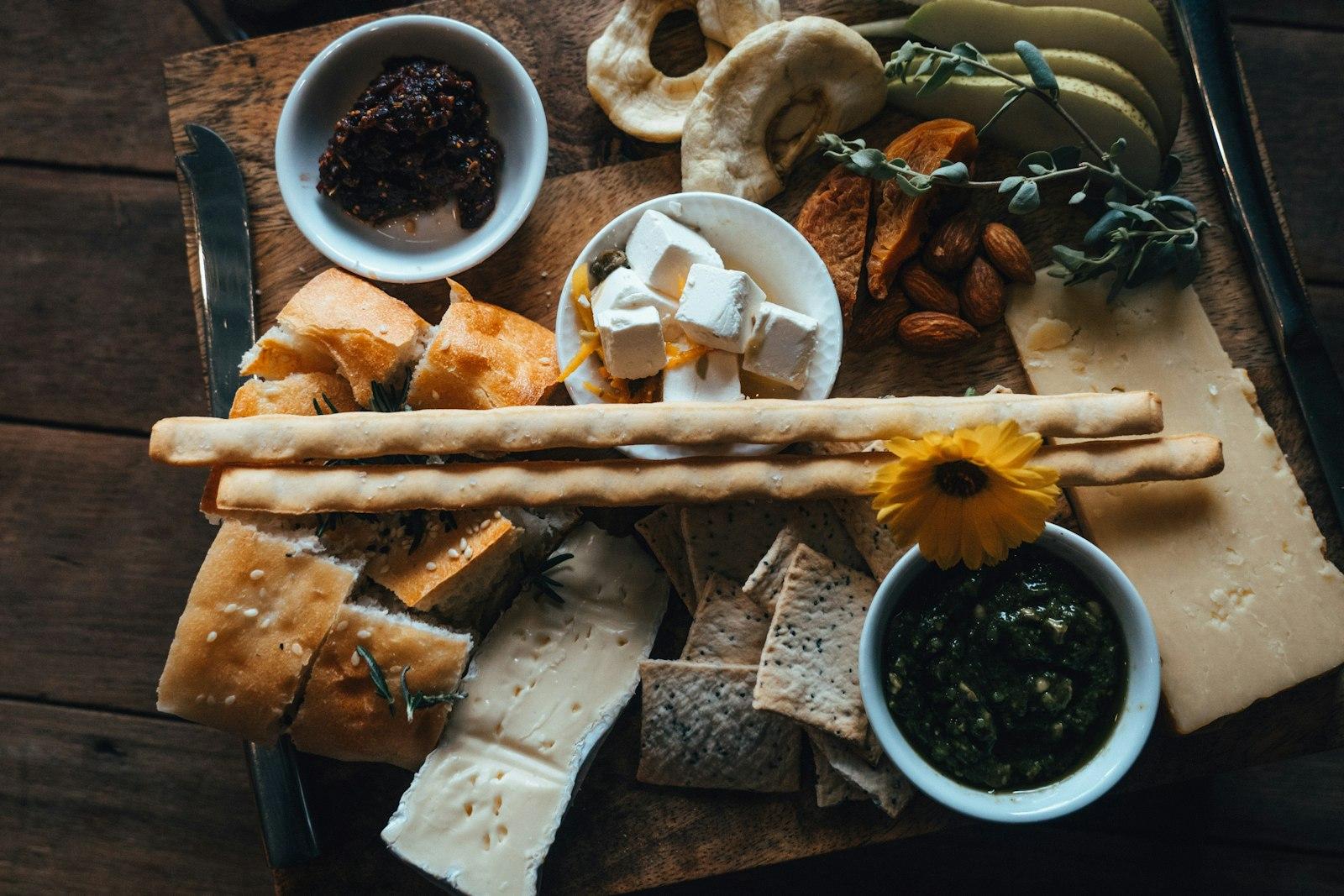
- Cheese and crackers or a cheese board: wheat crackers, dried fruit, apple or pear, wine and a long grazing session.
- Cheeseburger: bun, fatty meat, sauce, often chips.
- Quesadilla or nachos: wheat tortilla or corn chips, beans, onion and sour cream.
This is stacking, the idea that several servings, each fine on its own, can add up past a threshold. Our guide to FODMAP stacking examples explains how that works and where it is still extrapolated from small studies. In the cheese case, you can stack more than FODMAPs: fat, volume and alcohol all contribute to the colon response described above. The point is not that every meal needs to be bland. It is that you need a baseline where cheese is the only variable, which is exactly what the test plan below builds.
Two other plate partners deserve a mention. Wine and beer came up in the Böhn survey at 31%, close to cheese, and the two are so often paired that it is easy to blame the cheese for something the glass did. And onion and garlic, in cheese sauces, pizza sauce and seasoned chips, are among the best-known FODMAP triggers; our guide to onion and garlic substitutes on a low FODMAP diet is a good place to start if your cheese meals tend to be savory.
If your cheese is fine alone but pizza is a problem, that is useful information about stacking, not about cheese. Read why safe foods sometimes trigger IBS for how thresholds move from day to day.
Do additives and processing in cheese matter?
Possibly, but we cannot say so with confidence. Processed cheese slices, cheese sauces, spreads and many shredded or lactose-free products contain more than milk, salt and cultures: emulsifiers, starches, gums, flavorings and sometimes milk solids. We found no trial that tested these in IBS, so this section is about what to log, not what to fear.
The only directly relevant evidence we found is laboratory work. In a model that kept human gut bacteria alive outside the body, 20 common emulsifiers were tested; carboxymethylcellulose and polysorbate 80 had lasting effects on the bacteria, and carrageenans and various gums had particularly stark effects, while lecithin did not significantly affect them (Naimi 2021). The authors said clinical trials are needed. That is a signal about biology in a dish. It does not show that a particular cheese product triggers IBS, and several of these additives are used in tiny amounts.
What it does support is a reasonable habit: when you test cheese, test plain cheese. A block of cheddar and a "cheese product" in a squeezy tube are not the same experiment. And since a Spanish database found 55% of lactose-free products were classified as ultra-processed (Martínez Rodríguez 2021), the lactose-free version of a cheese may bring an ingredient list the regular version does not. Read the label and note whether the cheese is a plain block, shredded, sliced, spread or sauce. If your reactions track with the processed forms and not the plain ones, that is a lead worth taking to a dietitian.
What about casein and other milk protein?
Cheese is made by concentrating milk protein, and lactose-free dairy still contains it. Some people on forums and some wellness sites attribute IBS reactions to casein or whey. The honest summary is that milk protein allergy, an immune reaction, is a different condition from IBS, and that we found no trial showing casein or whey "sensitivity" explains IBS symptoms. If your reactions include hives, swelling around the mouth, wheeze, vomiting, blood in the stool or reactions after tiny amounts, that points away from IBS and toward an allergy or another disorder. Ask a doctor. Our lactose-free milk guide discusses the A1 and A2 milk protein trials and the limits of what they show.
Why can cheese cause stomach pain for days?
We found no study measuring how long a cheese reaction lasts in IBS, so the honest answer is that nobody knows precisely. Plausible contributors are the long colonic response to fat, a gut that stays sensitive after a trigger, repeated exposure over several days, and other triggers stacking on top. Pain that lasts several days or worsens should be checked.
The community pattern is clear enough to describe. In the first Reddit thread linked above, people talk about pain for days after cheese, a "delicate stomach" for several days after eating too much dairy, and weeks of trouble after dairy in people who believe they have a milk protein problem. These are experiences, and they include a mix of explanations: lactose intolerance, protein allergy, fat, histamine and "something else". The point for a trigger hunt is that the effect window may be much longer than a typical food diary captures.
That is a practical problem. If you only record symptoms for the evening of the cheese meal, you will miss a reaction that arrives the next day or the day after. The way around it is to record in three windows and to space your tests so one reaction does not overlap the next. See how long an IBS flare-up lasts for general timing, and why your food diary shows no pattern for how late reactions and repeated exposure hide a trigger.
Clairop logs meals, symptoms and stool in seconds, then looks for the foods your gut reacts to, including reactions that land days later.
How do I test whether cheese is my trigger?
Test one change at a time, on a plain base, and repeat each version. The goal is to separate three things that usually arrive together: how much fat, how much cheese, and which kind of cheese. Keep everything else about the meal the same, record symptoms in three time windows, and give each version two or three tries.
This is a practical framework, not a validated protocol. No trial defines the right number of repeats or the right washout, so the numbers below are sensible defaults. If you are working with a dietitian, follow their plan. The British Dietetic Association guidance frames first-line IBS diet advice as healthy eating delivered by any healthcare professional and low FODMAP as second-line advice delivered by a dietitian (McKenzie 2016), so for anything restrictive, get support.
Step 0: Pick a baseline meal and a good week
Choose a plain meal you already tolerate, for example rice or boiled potato with plain chicken or egg and a simple low FODMAP vegetable. It must be something you have eaten many times without trouble. Keep the same meal for every test. Skip tests during a flare, an illness, a hectic week or when you have had alcohol the day before.
Step 1: Test the portion
Use one cheese you suspect, and test small, medium and large amounts on separate days. Weigh it. A reasonable ladder is about 20 g, 40 g and 80 g, though you should adjust to your normal eating.
| Test | Cheese | Amount | Everything else |
|---|---|---|---|
| P1 | Your suspect cheese | 20 g | Same plain base |
| P2 | Same cheese | 40 g | Same plain base |
| P3 | Same cheese | 80 g | Same plain base |
If you react only at the larger amount, portion is a main driver and the cheese itself may be fine in a smaller serving. If you react at all three, move on.
Step 2: Test the fat
Compare a lower-fat and a higher-fat version of the same style of cheese at the same weight, for example part-skim versus whole-milk mozzarella. Then add a control with no cheese: the same base with olive oil that matches the fat grams in the higher-fat cheese. Check the label's fat per 100 g to work out the match.
| Test | What you eat | What it separates |
|---|---|---|
| F1 | Lower-fat cheese, 40 g | Cheese with less fat |
| F2 | Higher-fat cheese, 40 g | Cheese with more fat |
| F3 | No cheese, oil matched to F2's fat grams | Fat without cheese |
If F3 bothers you as much as F2, fat is the likely driver and the cheese is incidental. If F3 is fine and F2 is not, the cheese is doing something beyond its fat. If only F2 bothers you and F1 does not, the fat dose matters. For background on fat thresholds, see why fatty foods trigger IBS.
Step 3: Test the cheese type
Now match for portion and fat grams and change only the style. Compare a fresh, mild cheese such as mozzarella with an aged cheese such as mature cheddar or parmesan. Because aged hard cheeses are denser, you may need a smaller weight to match the fat grams, so read the label.
| Test | Cheese | Match |
|---|---|---|
| T1 | Fresh cheese | Fat grams matched to T2 |
| T2 | Aged cheese | Fat grams matched to T1 |
If T2 bothers you and T1 does not at matched fat and portion, aged-cheese properties are a candidate, including amines, which is the weak-evidence idea above. If T1 bothers you and T2 does not, think lactose or other fermentable carbohydrate. If both bother you, go back to fat or protein.
Step 4: Add the plate back
Only after the plain tests, add one item at a time back to the cheese: the wheat (crackers or a pizza base), then onion or garlic, then a drink, then the sauce or processed form. This is where stacking shows up. If plain cheese is fine and cheese plus pizza dough is not, you have learned something precise.
What should I record, and when?
For every test, record:
- The cheese, the weight in grams, and the fat per 100 g from the label.
- The rest of the meal, any drink, and the time you ate.
- Symptoms and their severity in three windows: the first 6 hours, 6 to 24 hours, and 1 to 3 days.
- Stool form (the Bristol scale is fine; our Bristol stool chart checker can help) and any non-gut symptoms such as flushing, headache or hives.
- Anything unusual that day: poor sleep, stress, illness, alcohol, a period.
Leave at least two to three days between tests and wait until you are back at your baseline before starting the next. Repeat each version two or three times, spread out. That is slow, but one good or bad day is easy to misread in a condition that changes on its own.
How many exposures before I can conclude anything?
No guideline gives a number. A fair rule of thumb is that a food looks like a trigger for you when it causes symptoms on most tries and a comparison version does not, and that two or three tries of each version is the minimum worth acting on. A quick test plan gives you hints, not verdicts, so treat the first result as a reason to repeat, not a ruling.
A worked example
Maya, 41, has IBS-M diagnosed years ago. She has been told that cheese is "usually fine", but a lactose-free cheddar on a cheese toastie leaves her with cramps and loose stools the next morning. She suspects the cheese.
She starts with a plain base: rice, boiled egg and spinach. Over three weeks she works through the plan, two tries each.
- Portion. 20 g and 40 g of mature cheddar on the base are fine. 80 g gives cramping that afternoon and a loose stool the next morning on both tries. So portion matters.
- Fat. Whole-milk mozzarella at 40 g is fine. A matched amount of olive oil with no cheese is fine. A lower-fat cheese is fine. So fat alone is not it at this dose, but she notices the 80 g result lined up with the largest fat load.
- Type. At matched fat and portion, cheddar and mozzarella both cause no symptoms. So type is not the issue.
- Plate. Her toastie used wheat bread, a large portion of cheese and a pickle with onion. She adds the bread to 40 g of cheddar: mild bloating but no morning diarrhea. She adds the onion pickle: bloating again, plus urgency.
Her conclusion, which she takes to a dietitian, is that the cheese itself is fine up to about 40 g, that cheese at 80 g or more seems to be over her threshold, and that wheat plus onion adds to it. She did not cut cheese out, and she did not need to blame lactose. This is an invented example to illustrate how the pieces separate; your result will differ.
How can I bring this to a dietitian or GI?
Bring a short table, not a diary dump. A dietitian or gastroenterologist can do more with "20 g and 40 g are fine, 80 g gives next-morning loose stool, tested twice" than with "cheese gives me trouble sometimes". List the cheeses, grams, plate contents and the three symptom windows, and note what remained unclear.
A good summary includes:
- Which tests you finished and how many times each was repeated.
- The portion at which symptoms began, if any.
- Whether matched oil without cheese caused symptoms.
- Whether fresh and aged cheese differed at the same fat and portion.
- Non-gut symptoms, especially flushing, hives, swelling or headaches.
- Anything you changed during the testing, such as medication, travel or illness.
If you track in Clairop, it compares symptom severity after meals with a food against meals without it across three delay windows (under 6 hours, 6 to 24 hours, 1 to 3 days), shows nothing until there are at least five meals with the food and five without, and turns the log into a one-page GI visit report. The GI appointment summary tool is an alternative if you prefer to fill in a form. For a deeper look at what to bring to a nutrition appointment, see the IBS dietitian follow-up diary. If you want to work out whether a change actually helped over weeks, how to measure IBS symptom improvement lays out how. For the wider method behind trigger hunting, see how to find out what triggers your IBS. Clairop's own approach to testing foods is described on how it works and in the method, and our best apps for IBS page compares trackers that do this.
The low FODMAP reintroduction phase is where cheese testing often belongs. Our reintroduction planner can help you organize it, though it is no substitute for a dietitian.
What are the common myths about cheese and IBS?
A few ideas travel widely and deserve a gentle correction.
"Lactose free means safe." It means lactose is reduced. The fat, the protein, the portion and the plate are unchanged.
"Aged cheese is always safe because it has no lactose." Aged cheese is low in lactose, but it can be higher in amines, and the fat per gram is often high. Safe for lactose is not the same as safe for you.
"Aged cheese always means histamine." Amine levels vary widely between cheeses of the same name, and the evidence linking dietary histamine to IBS is weak. Do not adopt a low-histamine diet because of one forum post.
"If cheese hurts, you must be lactose intolerant." That is one possibility. A fat threshold, portion size and stacking can all mimic it, and a lactose-free trial that does not help is evidence against it.
"If it were the fat, I would react to every fatty food." Fat is a dose and a context. You may react to a creamy sauce at a restaurant and not to a salmon fillet, because the amount, the rest of the meal and the state of your gut all differ. Thresholds move.
"I should cut out all cheese forever." Unnecessary restriction carries its own costs. Cheese is a source of protein and calcium, and a more precise answer, such as "40 g of aged cheese on a plain plate, not a pizza", usually serves you better than avoidance.
When should I see a doctor about cheese reactions?
See a doctor promptly if cheese, or any food, comes with blood in your stool, unexplained weight loss, fever, symptoms that wake you at night, anemia, or new symptoms after age 50, or if you have a family history of bowel cancer or inflammatory bowel disease. These are not features of IBS and need a proper evaluation.
Also ask for advice if:
- You get hives, swelling of the lips or face, wheeze, vomiting or faintness soon after dairy. That points to an allergy and needs medical advice, not self-testing.
- Reactions are triggered by tiny amounts of dairy or last for weeks.
- Loose stools follow fatty meals consistently the next morning, which can be a clue to bile acid malabsorption; see bile acid malabsorption vs IBS.
- You pass pale, bulky, greasy stools or are losing weight, which suggests problems with fat absorption.
- You have not had celiac testing. It needs to be done while you are still eating gluten, so ask before you cut wheat out of your cheese meals.
- You have Crohn's disease or ulcerative colitis and cheese symptoms are new or worsening; dairy symptoms can overlap with other causes, including a flare. Our guide to IBS-like symptoms in Crohn's remission explains why that distinction matters.
The short version
Cheese can trigger IBS when it is lactose free because lactose was never the only thing in it. Cheese is a dense dose of fat in a small volume, and in lab studies the IBS gut responds to fat at lower doses than healthy guts do, and with a longer tail. Portion shifts that threshold, aged cheese may add amines with weak evidence behind them, and the rest of the plate often brings wheat, onion, alcohol and additives.
The way to find out is not to guess but to test on a plain base: portion first, then fat (with a no-cheese oil control), then fresh versus aged at matched fat, then add the plate back one item at a time. Record three windows, repeat each version two or three times, and take the table to a dietitian. Red flags, signs of allergy and symptoms that will not settle are for a doctor, not a food diary.