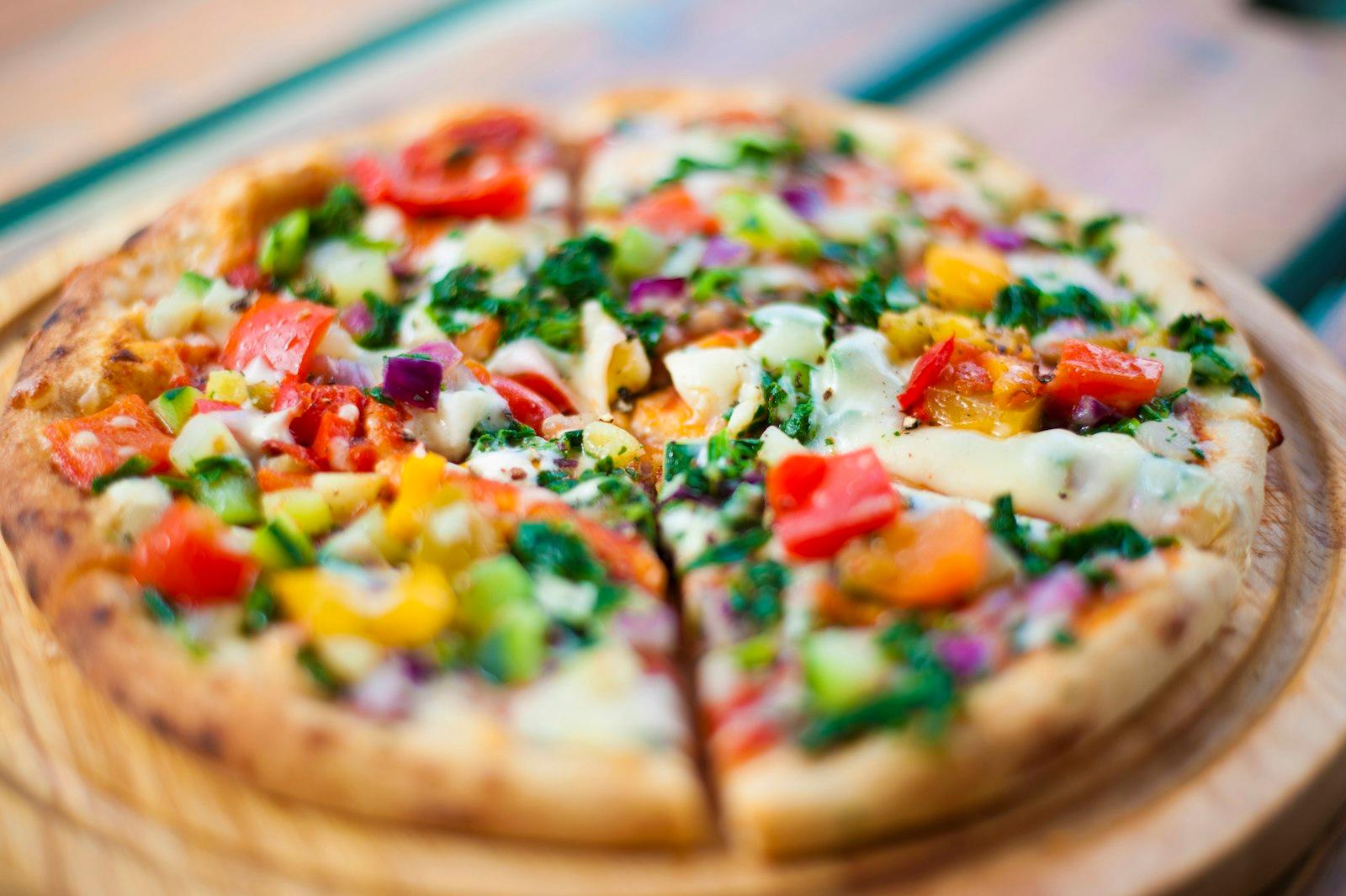
Pizza is not automatically bad for IBS, but it is one of the few meals that stacks nearly every common trigger at once: wheat dough, a sauce that often contains garlic or onion, cheese and meat that add fat, and a portion much bigger than most people would eat of any single food. That is why pizza can feel like a gamble, and why the answer to "is pizza bad for IBS" is usually "some part of it, for you, at a certain size."
This article breaks a pizza into its parts, shows what the research says about each, gives a takeout and restaurant ordering guide, and explains how to test your own tolerance with a log that records timing, because a fat reaction within the hour and a fermentation reaction hours later look different once you write the times down. Where we say "we could not find," that reflects our searches of PubMed, Europe PMC and the Monash FODMAP blog, not proof that nothing exists.
Is pizza bad for IBS? The short answer
Pizza is bad for IBS in the sense that it can cause symptoms in many people, and not bad in the sense that nothing about it is off limits. Whether it affects you depends on which ingredient does the work and how much of it you eat. We found no controlled trial of pizza itself in people with IBS, so everything below applies evidence on its parts.
What the large surveys show is that people with IBS often blame the parts of a pizza. In a Swedish questionnaire study of 197 people with IBS, 52% reported symptoms after fried and fatty foods, 49% after dairy and 24% after flour (Böhn 2013). Those categories describe the main ingredients of a pizza, though the study did not ask about pizza specifically.
On Reddit, pizza is a familiar running joke in r/ibs. One popular thread about ordering takeaway pizza and cheesy garlic bread draws replies describing a cycle of regretting it and then eating it again a week later (r/ibs thread). That is lived experience, not evidence, but it matches something real: pizza is rarely one problem, and the same pizza can be fine one week and rough the next.
Two guidelines frame the bigger picture. The American College of Gastroenterology recommends a limited trial of a low FODMAP diet for people with IBS (Lacy 2021), and the UK's NICE guideline advises regular meals and taking time to eat, and suggests it may help to limit high-fiber foods such as wholemeal flour and breads (NICE CG61). Neither names pizza.
Why does pizza upset my stomach or give me diarrhea?
Pizza upsets the stomach in two different ways on two different clocks. Fat and the act of eating a large meal tend to cause cramps and urgency soon after, often within the first hour. Fermentable carbohydrates such as fructans from wheat and onion cause gas, bloating and looser stools more slowly, over several hours.
The fast clock: fat and the gastrocolic response. Eating switches on movement in the colon, and fat strengthens that response. In a manometry study of 18 healthy volunteers, meals with 60% of calories from fat or carbohydrate both increased colon activity in the first hour after eating, with the fat-meal response starting more slowly but lasting longer (Rao 2000). In people with IBS, the sensory side of this response is exaggerated. In a lab study of 16 people with IBS and 13 healthy volunteers, fat infused into the small intestine lowered the thresholds at which balloon distension in the colon was felt as discomfort and pain in the IBS group, and the effect was stronger in IBS-D than IBS-C (Simrén 2001). Our post on why fatty foods trigger IBS explains this in depth.
The slow clock: fermentation. Poorly absorbed carbohydrates reach the large intestine, where bacteria ferment them. In a crossover study of 15 healthy people and 15 with IBS who ate provided diets low (9 g a day) or high (50 g a day) in FODMAPs for two days, breath hydrogen measured hourly over 14 hours was higher on the high FODMAP diet in both groups, and the high FODMAP diet induced gastrointestinal symptoms in the people with IBS (Ong 2010). An MRI study found the symptom picture is not only about gas: people with IBS were more sensitive to the same colon distension than healthy people (Major 2017). That is why the same pizza can bring bloating to one person and nothing to another.
So "pizza gives me diarrhea" can come from the fat arriving on the fast clock, the fructans and garlic on the slow clock, or both. The practical value of knowing this is the log described later in this article.
Which parts of a pizza can trigger IBS?
A pizza has five parts that can each matter: crust, sauce, cheese, meat and other toppings, and the portion itself. The table below summarizes what each contributes and how much evidence applies.
| Part | Likely trigger | Clock | How strong is the evidence? |
|---|---|---|---|
| Wheat crust | Fructans (FODMAP) | Slow, hours | Good for fructans in IBS; none for pizza dough |
| Tomato sauce | Garlic or onion if added | Slow, hours | Good that garlic and onion are high in fructans; sauce recipes vary |
| Cheese | Fat; lactose in a large amount | Fast (fat) and slow (lactose) | Moderate; mozzarella and hard cheeses carry little lactose per portion |
| Meat toppings | Fat, plus garlic in some salami | Fast | Fat evidence is mechanistic; seasoning varies |
| Portion | Stacking of all of the above | Both | Dose effects are shown for FODMAPs and fat |
Is the pizza crust the trigger (wheat, fructans and gluten)?
The crust is high in fructans because wheat is. Fructans are chains of fructose that humans cannot digest in the small intestine, so they reach the colon and are fermented. A food composition study of 55 grains, cereals and breads found fructans were the most common short-chain carbohydrate in cereal products, ranging, per portion as eaten, from 0.07 g in spelt bread to 0.6 g in dark rye bread, with couscous at 1.12 g (Biesiekierski 2011). We did not find a published fructan measurement for pizza dough itself, so we cannot say how much a given slice contains.
What we can say is that the fructans, not the gluten, are the more likely culprit. In a double-blind crossover trial of 59 people who had put themselves on a gluten-free diet and did not have celiac disease, 2.1 g of fructan raised overall symptom scores and bloating more than 5.7 g of gluten or placebo, and gluten scores did not differ from placebo (Skodje 2018). An earlier trial of 37 people with IBS and self-reported gluten sensitivity found that symptoms improved on a low FODMAP diet and worsened to a similar degree with gluten or whey protein, with gluten-specific effects in only 8% (Biesiekierski 2013).
This is a major reason a gluten-free label is a poor shortcut. It tells you gluten is absent, which matters a great deal for celiac disease, but it does not tell you about the sauce, the toppings or whether the flour blend and added fibers are low in FODMAPs. The ACG guideline suggests celiac serology in people with IBS and diarrhea (Lacy 2021), so if you have never been tested, mention it to your doctor before cutting gluten out.
Crust thickness and type matter in a simple way: a thick, deep-dish or stuffed crust is more dough, and more fat, on the same plate. NICE also suggests limiting wholemeal and high-fiber breads for some people with IBS (NICE CG61), so a whole wheat crust is not a safe swap by default.
Is garlic and onion in the pizza sauce the trigger?
If you can only test one thing about a pizza, test the sauce. Garlic and onion are among the highest-fructan foods measured. When Monash researchers measured fructans in 60 vegetables and 43 fruits, garlic, artichoke, shallots, leek bulb and onions had the highest quantities, ranging from 1.2 to 17.4 g per 100 g of fresh weight (Muir 2007). Our explainer on why garlic and onion affect IBS covers the mechanism.
Pizza sauces vary. Monash notes that many traditional restaurants make their sauce from only tomatoes and salt, and advises asking whether the tomato passata on pizzas contains garlic or onion (Monash, eating out Italian). Its Italy guide says to make sure no garlic has been added to the tomato sauce (Monash, Italy tips). Some pizzas also start with a bianco base of olive oil and garlic, and Monash says that if they are made to order the chef may be able to leave off the garlic.
A r/ibs thread about a pizza labeled gluten free shows how this plays out. Commenters pointed out that gluten-free does not mean the sauce is safe, with several naming garlic and onion in the sauce as their main problem and one describing making their own crust with garlic-infused oil and lactose-free cheese (r/ibs thread). That is anecdote, but it matches the science: the crust label and the sauce are separate questions.
Is the cheese the trigger (lactose is usually the smaller part)?
Cheese contributes fat on every pizza, and lactose on some. Hard and matured cheeses contain little lactose because most of it drains away with the whey, and Monash states that many dairy products such as hard cheeses and butter are very low in lactose (Monash, dairy and lactose). On mozzarella, Monash says it is suitable, that a lactose-free version is usually available if you want larger serves, and that the quantity of mozzarella on a pizza is generally small, so not a problem to eat (Monash, Italy tips). We could not find a published lactose figure for mozzarella, and the exact low FODMAP serve sizes are in the Monash app, which we did not use.
It also helps to know how much lactose most people can handle. A systematic review of 36 randomized studies concluded, on moderate-quality evidence, that most adults with lactose intolerance or malabsorption tolerate 12 to 15 g of lactose at once, roughly a cup of milk, with the caveat that most studies enrolled people with malabsorption rather than IBS (Shaukat 2010). Monash gives the same 12 to 15 g figure and adds that intake may be better tolerated when spread over the day. A slice of pizza is unlikely to deliver a cup of milk's worth of lactose, so if cheese bothers you on pizza, the fat and the portion are also suspects. Our post on lactose intolerance versus IBS helps separate them.
Does fat from cheese and meat trigger IBS symptoms after pizza?
Fat is the most consistent explanation for pizza symptoms that arrive quickly. US government food data for chain pizza (14 inch, regular crust) lists about 9.7 g of fat per 100 g for a cheese pizza, 11.9 g for pepperoni and 12.4 g for sausage (USDA cheese; USDA pepperoni; USDA sausage). The cheese pizza entry lists a slice as 107 g and the whole pizza as 853 g. Applying that slice weight to all three entries (an approximation, since topping weights differ), a slice contains roughly 10 g of fat for cheese, 13 g for pepperoni and 13 g for sausage, and three slices of pepperoni add up to roughly 38 g.
| Chain pizza, regular crust (USDA) | Fat per 100 g | Fat per slice (about 107 g) | Fat for 3 slices |
|---|---|---|---|
| Cheese | 9.7 g | about 10 g | about 31 g |
| Pepperoni | 11.9 g | about 13 g | about 38 g |
| Sausage | 12.4 g | about 13 g | about 40 g |
These are averages for a type of product, not for your local restaurant. A pizza with extra cheese, a stuffed crust or a pool of oil on top will sit higher. The point is not that these numbers are dangerous, but that a few slices add up to a large fat load for a single meal. We could not find a study that tested a fat dose of this size from a real meal in IBS: the lab studies infused fat directly into the small intestine, so their doses do not translate one-to-one to pizza (Simrén 2001).
If your pattern is urgency within an hour of fatty pizza, fat is the first thing to test: a thin-crust pizza with a lighter cheese portion and a vegetable topping carries less of it. If fat is not the problem, you will know within a couple of tries.
Do portion size and stacking make pizza worse for IBS?
Portion size is the least glamorous suspect and often the strongest. FODMAP effects are dose dependent: in the MRI study, 40 g of inulin pushed 13 of 29 people with IBS past a predefined symptom threshold within 300 minutes, compared with 6 of 29 after glucose (Major 2017). In the trial that established the low FODMAP diet's benefit, the goal was less than 0.5 g of FODMAPs per meal, and symptom scores were 22.8 mm on the low FODMAP diet against 44.9 mm on a typical Australian diet (Halmos 2014).
What that means for pizza is stacking. One slice of a plain crust may be fine. Three slices plus garlic bread, a sauce with onion, and a milkshake or ice cream can combine several small loads into one large one. Our post on FODMAP stacking examples shows how modest portions of several foods add up.
Clairop logs meals, symptoms and stool in seconds, then looks for the foods your gut reacts to, including reactions that land days later.
Is gluten-free pizza low FODMAP?
Gluten-free pizza is not automatically low FODMAP, but a gluten-free base can be a good option because it removes wheat, the main source of fructans in a pizza crust. Monash notes that gluten-free bread tests low in FODMAPs because of the low FODMAP content of the flours, not because gluten-free is a magic label (Monash, spelt products). On the Italian eating-out page, it says many restaurants offer gluten-free bases and that, because they contain no wheat, they suit a low FODMAP diet (Monash, eating out Italian).
Three cautions apply:
- The rest of the pizza still counts. The sauce, any garlic or onion, the cheese and the toppings are unchanged by the base.
- Check the ingredients. Added fibers such as inulin are a fructan, and inulin triggered symptoms in 13 of 29 people with IBS at 40 g in the MRI study (Major 2017). Read the ingredient list of ready-made gluten-free bases and mixes rather than trusting the front of the box.
- Celiac disease is a separate matter. Monash says people with celiac disease should double-check for gluten contamination from ovens and benches (Monash, eating out Italian).
For reference, Monash's own pizza dough recipe is built on gluten-free flour, baking powder, salt, water and olive oil (Monash pizza recipe). That tells you what a gluten-free base can be made from, though not whether a particular product you buy is suitable. For store-bought bases, look for a product listed or certified in the app you use.
Is sourdough pizza crust better for IBS?
Sourdough pizza crust may be lower in fructans, but it is not a guaranteed improvement. The long fermentation used in traditional sourdough lets bacteria and yeasts consume some of the fructans before you do. Monash says spelt sourdough made with traditional methods has a reduced FODMAP content, that sourdough proving typically runs more than 12 hours, and that spelt is lower in fructans than modern wheat to start with (Monash, sourdough processing). It also cautions that this does not apply to every product made with spelt (Monash, spelt products).
Laboratory work supports the idea. A bakery study found that sourdough made with selected starter cultures cut bread's fructans by more than 92% compared with fermentation using baker's yeast only (Menezes 2021), and another found that yeast strains differ widely in how well they degrade fructans (Fraberger 2018). That is why "sourdough" on a menu tells you little: the starter, the time and the flour all change the result.
The symptom evidence is more cautious. In a randomized, double-blind 7-day pilot of 26 people with IBS who had poor subjective tolerance of wheat, long-fermented sourdough wheat bread was lower in FODMAPs than yeast-fermented wheat bread, yet there were no significant differences in gastrointestinal symptoms between the two (Laatikainen 2017). The authors disclosed commercial ties to a bakery and a dietetic company, and it was a small pilot. A different trial found that low FODMAP rye bread caused milder flatulence, pain and cramps than regular rye bread in 87 people with IBS, and lowered breath hydrogen, though it did not change overall IBS severity scores or quality of life (Laatikainen 2016).
The takeaway is to treat sourdough as a reasonable item to test, not a fix. A pizzeria whose dough is proved for a day or more is plausible, a "sourdough-style" crust made with yeast and a flavoring may not be. If you do try it, test the crust alone, with a garlic-free sauce, so the result means something.
What are low FODMAP pizza toppings?
The safest toppings are simple ones, and Monash's own ideas give a good map. Its pizza recipe page suggests greens (silverbeet or kale, broccoli, lemon, parmesan and mozzarella), ham and pineapple (check the app for a low serve of pineapple), eggplant with olives and basil, mushroom with spinach and pecorino, potato and rosemary, prawns with rocket and tomato, pumpkin with spinach, pine nuts and feta, and shredded chicken with capsicum and tomato (Monash pizza recipe). Its eating-out advice lists capsicum, zucchini, tomatoes and olives as easy build-your-own choices (Monash, eating out Italian).
Things to watch:
- Cured and seasoned meats. Monash advises avoiding salami unless you can check the label, since it may contain garlic (Monash, Italy tips). Pepperoni is also fat-dense: USDA lists plain sliced pepperoni at 46.3 g of fat per 100 g (USDA pepperoni slices), although the amount on a pizza is small.
- Garlic-oil or garlic-herb finishes. Garlic-infused oil is a low FODMAP technique because fructans do not dissolve into oil, but actual garlic, garlic powder and garlic bread are not the same thing. The pizza recipe page uses garlic-infused oil, not garlic.
- Serve sizes. Monash's recipe page says to check its app for serving sizes. We did not use app data, and values change as foods are retested, so check the app you rely on for current numbers.
- Dairy-free cheese. If you swap to vegan cheese, read the label for added fibers.
Can I eat pizza on a low FODMAP diet?
Often yes, once you adapt it, and pizza makes a good test food during reintroduction. The low FODMAP diet is meant to be a short, structured process: a few weeks of restriction, systematic reintroduction of each FODMAP group, and then a personalized diet that is as varied as your tolerance allows. It works best with a dietitian trained in it. In the main trial, 30 people with IBS were studied for 21 days per diet, with almost all food provided, which is not how most people do it at home (Halmos 2014). The ACG recommends a limited trial of the diet, not an indefinite one (Lacy 2021).
During the strict phase, a pizza built from a low FODMAP base, a garlic-free tomato sauce, a modest portion of mozzarella or hard cheese and low FODMAP toppings fits the plan. During reintroduction, you can add back wheat (fructans), then garlic or onion, then lactose, one at a time, which is a cleaner way to learn what part of pizza is yours than guessing. Our guides on the reintroduction order and how to reintroduce foods after the diet walk through the steps, and the low FODMAP food list is a quick reference.
If you are not on the diet at all, you do not need to treat pizza as forbidden. Eating a normal-size portion of a pizza you tolerate, on a day when you are not already symptomatic, is what most people are trying to get back to.
How should you order restaurant and takeout pizza with IBS?
Restaurant and takeout pizza is harder than homemade because you cannot see the sauce, the oil or the dough. The best approach is to ask a few specific questions and keep the order simple enough that you can tell what caused a reaction. Our broader guide to eating out on a low FODMAP diet covers other cuisines.
| What to decide | A gentler choice to try | Why |
|---|---|---|
| Crust | Thin crust, or a gluten-free or sourdough base you have already tested | Less dough per slice; fewer fructans if the base is suitable |
| Sauce | Ask if it contains garlic or onion; plain tomato and salt if possible | Garlic and onion are among the highest-fructan foods |
| Base oil | Skip bianco (garlic and oil) bases, or ask for no garlic | Monash says chefs may be able to leave the garlic off |
| Cheese | A regular amount of mozzarella, parmesan, or ask for lighter cheese | Lactose per portion is small; fat adds up with extra cheese |
| Toppings | Vegetables, plain chicken, ham, olives, tomato, rocket | Monash's own topping ideas |
| Meats | Skip salami or sausage unless you can check the label; go easy on pepperoni | Possible garlic; high fat density |
| Sides | Skip garlic bread and creamy dips | Extra fructans and fat |
| Portion | Share, or box half before you start | Stacking is the issue for most people |
A few extra tips that come from the research rather than from lists online. First, repeat the same order. If you change the pizzeria, the crust and the sauce at once, you learn nothing from the result. Second, eat it as a meal, not after a long gap, since NICE advises regular meals and not leaving long gaps between eating (NICE CG61). Third, if you have celiac disease, a gluten-free pizza from a shared oven may not be safe, and that is a question for the restaurant and your own care team.
How do you test pizza tolerance with a symptom log that records timing?
The most useful thing you can add to a pizza test is the time. Because fat tends to act within the first hour and fermentation unfolds over many hours, noting when symptoms start often points to the cause better than the ingredient list does.
Here is a practical protocol:
- Pick a baseline pizza. Choose one specific pizza (say, a thin-crust cheese pizza with a plain tomato sauce) and a fixed portion, such as two slices.
- Log the meal time and what else you ate. Record any drink, side or dessert, since stacking is the usual confounder.
- Log every symptom with a clock time. Write down urgency, cramps, bloating, gas and stool form (the Bristol scale works), with the time each started. Note blood, mucus or night-time symptoms separately, because those are red flags covered below.
- Watch two windows. Within about the first hour, urgency and cramping point toward fat and the gastrocolic response (Rao 2000; Simrén 2001). From a few hours on, gas, distension and looser stools point toward fermentation. In the MRI study, symptoms were tracked over 300 minutes, and fructose symptoms peaked sooner than inulin symptoms (Major 2017); in another study, breath hydrogen was measured hourly over 14 hours (Ong 2010). Some reactions show up later still, so keep logging through the next day before you decide a pizza was fine.
- Change one thing at a time. Next time, keep the crust and swap the sauce for a garlic-free one. Then try a smaller cheese portion. Then try a different crust. A single change is the only way a result tells you anything.
- Repeat it. One pizza is an anecdote. Two or three similar meals show a pattern. Symptoms vary from day to day for reasons unrelated to food, so do not read too much into one bad night.
This is a lot of bookkeeping by hand, and delayed reactions are the ones memory gets wrong. Clairop logs meals by tap, voice, a typed sentence or a photo, records Bristol entries with urgency and night-time detail, and tests each food against three delay windows (under 6 hours, 6 to 24 hours and 1 to 3 days) with correction for false discoveries; it shows nothing until you have at least 5 meals with and 5 without a food, and it is iPhone only and needs a Pro subscription to use (how it works, method). It is not a medical device and does not diagnose. For a longer guide to the manual version, see how to keep a food diary for IBS.
What about garlic bread, soda and ice cream with pizza?
The side dishes often do more damage than the pizza. Garlic bread combines wheat fructans, garlic fructans and butter or oil. In the r/ibs thread about takeaway pizza, it was the garlic bread alongside it that gave the post its title. Fizzy drinks are on the list of things NICE suggests people with IBS may want to reduce (NICE CG61).
Ice cream is a dairy food, and Monash lists it with milk, yogurt and cheese (Monash, dairy and lactose). If lactose is a problem for you, the 12 to 15 g figure is the scale to keep in mind (Shaukat 2010), and ice cream's fat adds to the fast-clock effect described above. For Italian meals, Monash suggests fruit-based iced desserts such as sorbetto or granita instead (Monash, Italy tips). We could not find a trial of ice cream in IBS.
Myths about pizza and IBS
"Gluten-free pizza is safe for IBS." Gluten-free is only about gluten. The trial evidence points at fructans, not gluten, in people who believed they were gluten sensitive (Skodje 2018; Biesiekierski 2013), and the sauce and toppings are unchanged.
"The cheese is what is wrecking me." Possibly, but lactose is usually smaller than people think. Hard cheeses are very low in lactose and the mozzarella on a pizza is a small quantity (Monash, dairy and lactose; Monash, Italy tips). The fat in the cheese is a stronger candidate.
"Sourdough solves it." It lowers fructans, but the one symptom trial we found did not show better tolerance, and "sourdough" is not a standard (Laatikainen 2017).
"If I react once, pizza is banned forever." One reaction is one data point, and many people find a version they tolerate. Cutting foods out unnecessarily has its own costs, so a structured test is better than a permanent ban.
"It is all in my head because the lab tests are normal." The British Society of Gastroenterology classifies IBS as a disorder of gut-brain interaction (Vasant 2021), and symptoms after meals are real even when routine tests are normal. Fat sensitizes the colon in IBS in laboratory studies (Simrén 2001).
When should you see a doctor about pizza symptoms?
Pizza symptoms are only IBS symptoms if the rest of the picture fits. See a doctor promptly if you have blood in your stool, black or tarry stools, unexplained weight loss, fever, persistent vomiting, symptoms that wake you at night, anemia, or symptoms that began after age 50. The same applies if you have a family history of bowel cancer or inflammatory bowel disease. NICE says everyone with possible IBS symptoms should be assessed for red flag indicators and referred for further investigation if any are present (NICE CG61).
Also talk to your doctor before cutting out wheat or gluten entirely if you have not been tested for celiac disease, because ACG suggests celiac serology in people with IBS and diarrhea (Lacy 2021). If you have Crohn's disease or ulcerative colitis, a flare can look like a "bad pizza night," so unusual blood, fever or a change from your usual pattern is a reason to contact your care team rather than to adjust your diet.
What we could not find
Being clear about the gaps matters on a health topic. We did not find:
- A controlled trial in which people with IBS ate pizza, or a trial comparing pizza types.
- A published fructan or FODMAP measurement for pizza dough, which would let us put a number on a slice.
- A published lactose figure for mozzarella as used on pizza. The Monash app holds tested serving sizes, which we did not use, and Clairop is not affiliated with Monash University.
- A study showing whether thin versus thick crust changes IBS symptoms.
- A symptom trial showing sourdough pizza is better tolerated than yeast pizza.
The bottom line
Pizza is a reasonable food to test, not a food to fear. Break it into crust, sauce, cheese, meat and portion; suspect the sauce first, then the fat, then the crust; and write down when your symptoms start as well as what you ate. If you are on the low FODMAP diet, use pizza as a reintroduction test with a dietitian's help. And if blood, weight loss, fever or night-time symptoms are part of your picture, see a doctor promptly rather than adjusting your pizza order.