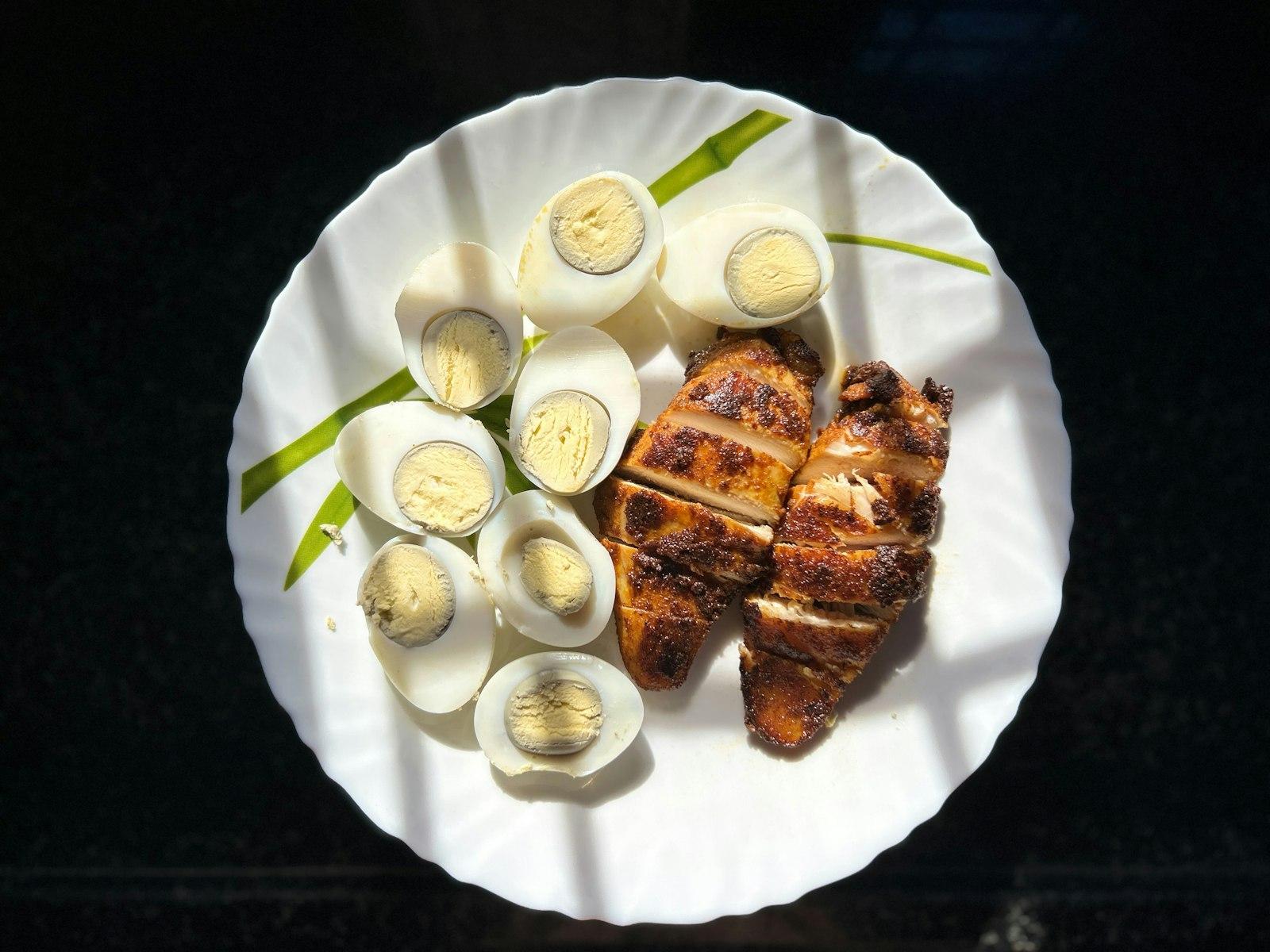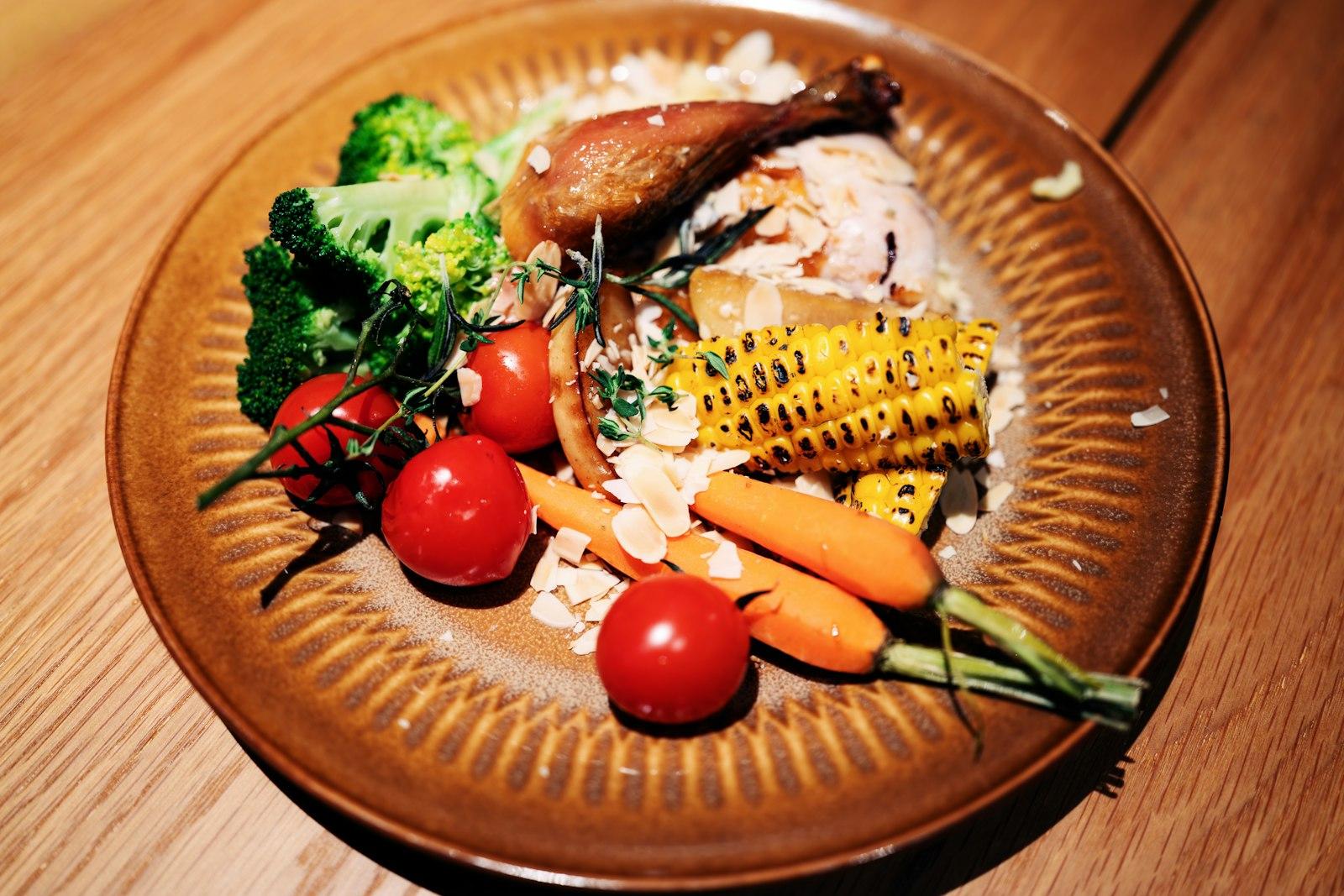
Restaurant chicken triggers IBS mostly because of what is done to the chicken, not the chicken. Plain grilled chicken breast has no carbohydrate in it, so it cannot supply FODMAPs. A restaurant version often comes brined or marinated, seasoned with blends that can include garlic and onion, coated in breading, cooked in fat, finished with a sauce and served in a large portion. Any one of those layers can be the trigger.
That is why so many people write some version of the same post: the rotisserie chicken from one store is fine, a drive-through chicken sandwich wrecks the evening, and the chicken they grill at home never does anything. A recent popular thread in r/ibs is a typical example, and the replies split between an ingredient theory (brines and marinades), a fat theory, a "check your gallbladder" theory and a "nothing on a fast food menu is safe" shrug. This article sorts those theories into what the evidence supports, what it cannot tell us, and how to find out which one is yours.
We keep one boundary clear throughout. This is a dietary and tracking guide, not a diagnosis. Where we say "we could not find a study", that reflects our searches of PubMed and the regulatory sources we cite, not proof that none exists.
Why does restaurant chicken trigger IBS when plain chicken doesn't?
Plain chicken is protein and fat with essentially no carbohydrate, so it has nothing for gut bacteria to ferment. USDA data list grilled skinless breast at 0 g carbohydrate and about 3.2 g fat per 100 g. Restaurant chicken differs because of additions: brine, seasoning, breading, cooking fat, sauce and portion size.
FODMAPs are fermentable carbohydrates, which is why the low FODMAP diet's cutoffs are defined by the amount of each sugar or fiber in a serving (Varney 2017). Meat has none to speak of. The USDA's FoodData Central lists skinless, boneless grilled chicken breast at 0 g of carbohydrate and 3.17 g of fat per 100 g (USDA FoodData Central). That is the reason plain poultry is a standard "safe" protein in low FODMAP guidance, and it is also the reason that the first move with restaurant chicken is to ask what else is on the plate.
The same paper that set out the cutoff values makes a second point that matters here: FODMAP content of a food is affected by processing techniques and ingredient selection, and the authors noted that US processed foods can carry extra fermentable sugar because of ingredients such as high-fructose corn syrup (Varney 2017). A separate analysis of US foods found that several processed products had FODMAP content that was not apparent from the label (Chumpitazi 2018). Neither paper tested restaurant chicken. They simply establish that "it is just chicken" and "it is just chicken plus whatever was added" are different foods for a fermentation-sensitive gut.
What is actually in restaurant chicken? The six layers
A restaurant chicken dish is built in layers, and each layer has a different possible trigger. The table below lists them with what to ask. It is a map for investigation rather than a verdict, because the same dish at two restaurants can differ at every layer.
| Layer | What it can contain | Why it might trigger IBS | What to ask or check |
|---|---|---|---|
| Brine or injected solution | Water, salt, phosphates, broth, flavorings | Broth and flavorings can carry onion or garlic; evidence for additives themselves is thin | "Is the chicken brined or injected before cooking?" |
| Marinade or rub | Garlic or onion powder, soy, herbs, sugar, citrus | Fructans (garlic, onion), possible soy components, sweeteners | "What is it marinated in?" |
| Breading or batter | Wheat flour, starch, spices, sometimes milk or egg | Wheat fructans, gluten, onion or garlic in the seasoned flour | "Is there a grilled option with no coating?" |
| Cooking fat | Frying oil, butter, pan fat, skin | Fat sensitizes the gut in IBS; larger doses when fried | "How is it cooked, and in what?" |
| Sauce, glaze or gravy | Garlic, onion, sugar, cream, honey | Highest-risk layer for hidden fructans and large fat doses | "Can the sauce come on the side or be left off?" |
| Portion and sides | Large piece, fries, bread, soda, salad dressing | Meal size drives the after-meal gut response | "Is there a smaller portion?" |
Notice how many of the answers are not chicken at all. That is the central reason people with IBS report that one restaurant's chicken is fine and another's is not, even when both are "grilled chicken": the layers differ.
Is it the garlic and onion powder in the marinade?
Garlic and onion are the leading suspects because they are the richest everyday sources of fructans, a FODMAP that people with IBS commonly react to. In one analysis of 60 vegetables, garlic, shallots, leek bulb and onions were among the highest in fructans, at 1.2 to 17.4 g per 100 g fresh weight (Muir 2007).
The commonest explanation in the community is that restaurant chicken is soaked in a marinade or brine that includes onion, garlic, wheat and soy, and it is a reasonable hypothesis. Savory marinades, rubs and seasoning blends very often include garlic or onion in powdered form. Dried powders concentrate the fructans in a small, invisible amount of seasoning, which is why you can react to chicken that has no visible onion on it. The reason fructans cause symptoms, and why dose matters, is covered in why garlic and onion affect IBS.
Two limits are worth stating. First, we could not find a study that measured fructans in restaurant chicken, so "it contains garlic and onion" is a plausible inference, not a measured fact for any particular restaurant. Second, many restaurants will not know the full composition of a pre-made marinade or seasoning blend either, because it arrives from a supplier. The practical consequence is that "no visible garlic or onion" tells you very little, and the cleanest test is plain, unseasoned chicken, which we come to below.
What do restaurants inject into chicken, and does it matter for IBS?
Many raw chickens sold in the United States contain added solutions, usually water, salt, phosphates, broth or flavorings, to improve juiciness. Whether that matters for IBS is unproven. We found no trial linking phosphates or similar additives to IBS symptoms, so the realistic risk from an injection is flavoring or broth that carries onion or garlic.
The thread that inspired this article was titled around what restaurants "inject" into chicken, and it is a fair question. For raw retail chicken, a US Department of Agriculture rule proposal described the practice directly. It estimated that about 30% of the 49.2 billion pounds of poultry consumed by US households contained added solutions, and it listed example label wordings such as "Contains up to 15% water, salt, and sodium phosphates" and "Contains up to 15% chicken broth" (FSIS 2011). That is a 2011 proposal about retail raw products, and it says nothing about what a given restaurant's supplier uses. It is still the best public description of the practice, and it shows two things: the practice is common, and the ingredient can be broth.
US regulation also lists the substances allowed in poultry. Phosphates such as sodium tripolyphosphate are permitted in poultry products up to 0.5% of the total product, and carrageenan is permitted as a binder or stabilizer in various poultry products (9 CFR 424.21). "Permitted" is a statement about legal safety limits, not about IBS.
What about the gut? A 2024 review in Nature Reviews Gastroenterology & Hepatology concluded that the evidence on food additives and gut disease comes largely from preclinical work in cells and animals, with fewer human intervention studies (Whelan 2024). A review focused on IBS reached a similar place: few data exist on additives and the gut microbiota in people with IBS, and most studies were in animals (Rinninella 2020). On carrageenan specifically, which one Reddit commenter blamed, the only human trial we found was a pilot of 7 people with quiescent ulcerative colitis. Over one week, carrageenan did not worsen disease activity, and symptoms were actually lower in the carrageenan period than in the placebo period, though the authors called for larger studies (Laatikainen 2023). That is a tiny trial in a different condition. It does not clear carrageenan for everyone, but it does mean we cannot honestly tell you it causes IBS symptoms either.
So treat the injection theory as a prompt for a question, not as an established mechanism. If you suspect a brined product, the useful experiment is to compare a chicken product whose label you can read, with a short ingredient list, against the restaurant version.
Could the breading, wheat or soy be the problem?
Yes. Breading adds wheat, and wheat is a major fructan source. In trials of people who believed gluten was their problem, fructans often explained the symptoms better than gluten did. Soy is a possible trigger for some people too, but we could not verify how often restaurant chicken contains soy.
Fried chicken adds a coating that plain chicken lacks. USDA lists fast-food fried chicken breast with skin and breading at 12.4 g fat and 6.03 g carbohydrate per 100 g, compared with 3.17 g fat and none for the grilled breast (USDA FoodData Central). Some of that carbohydrate is the coating, and the coating is where wheat enters.
Whether the culprit is wheat's gluten or its fructans has been tested. In a double-blind crossover of 59 people on a self-chosen gluten-free diet, in whom celiac disease had been excluded, overall symptom scores differed significantly between gluten, fructan and placebo challenges, and fructans produced the highest scores, which led the authors to conclude that fructan rather than gluten induced the symptoms (Skodje 2018). An earlier trial in 37 people found gluten-specific effects in only 8% of participants once FODMAPs were reduced (Biesiekierski 2013). For a person reacting to fried chicken, that means the coating can matter even if gluten is not the active ingredient.
One caution belongs here. Do not drop gluten to test breading without talking to a doctor first: a clinicians' guide to celiac serology advises that a gluten-free diet should not be started before the diagnosis is confirmed (Rashid 2016). The American College of Gastroenterology suggests serologic testing for celiac disease in people with IBS and diarrhea (Lacy 2021). A meta-analysis found biopsy-proven celiac disease was significantly more common in people with IBS symptoms across the studies pooled, although there was no increase in the North American studies (Irvine 2017). Our celiac versus IBS guide covers how the two overlap and what the test involves.
As for soy, a few people in the threads describe a soy intolerance and point to soy-based fillers and binders in meat products. That is a legitimate individual issue, and a soy allergy or intolerance is a different problem from IBS. We could not verify how often restaurant chicken contains soy, so the honest advice is to ask, and to see an allergist or doctor if you suspect a true intolerance.
Is it the fat and the frying?
Fat is a strong, well-studied gut trigger in IBS, and a fried or skin-on restaurant portion carries far more of it than plain chicken. In lab studies, fat made the colon more sensitive in people with IBS at doses healthy volunteers tolerated. Chicken skin and frying can multiply the fat in a serving several times over.
The numbers are visible in USDA data. Grilled skinless breast is listed at 3.17 g fat per 100 g, rotisserie breast without skin at 3.57 g, rotisserie breast with skin at 7.67 g, and fast-food fried breast with skin and breading at 12.4 g (USDA FoodData Central). Those are per 100 g, and a restaurant piece is often more than that.
Food-related symptoms after fried and fatty foods are common in IBS: in a questionnaire study of 197 people, 52% reported gut symptoms after fried and fatty foods (Böhn 2013). The mechanism research is consistent, though small. In 61 people with IBS and 20 controls, an hour of fat delivered into the duodenum lowered the colon's discomfort and pain thresholds more in the IBS group, and the response was similar across bowel habits (Simrén 2007). In a gas-handling study, people with IBS retained gas at a fat dose that healthy volunteers handled without retention (Serra 2002). An earlier study of 16 people with IBS and 13 healthy volunteers concluded that after-meal symptoms may be explained in part by an exaggerated sensory component of the gastrocolonic response (Simrén 2001). Separately, in healthy volunteers a fat-rich meal prolonged colonic motor activity compared with a carbohydrate-rich meal (Rao 2000).
Those are small studies, mostly using fat delivered through a tube, and they cannot say how much chicken skin or fryer oil is too much for you. Our full explainer, why fatty foods trigger IBS, goes through the evidence and the look-alike conditions. For this topic the practical point is simple: if fat is your layer, grilled-no-skin should be noticeably easier than fried, and a sauce can erase the difference.
Reddit threads about fast-food chicken often name the oil as the suspect, for example in a thread about one fried chicken chain bothering someone while other fried chicken did not (r/ibs). People also suggest sides, sauces and cross-contact with dairy. Those are all reasonable things to test, and none of them is established for any specific chain.
Does portion size matter more than the chicken?
It can. Restaurant meals are large: a sampling of frequently ordered meals from non-chain restaurants in three US cities averaged 1,205 kcal, and 92% exceeded typical energy needs for a single eating occasion. A big meal is a bigger signal to the gut, whatever the food.
That figure comes from a measured study using bomb calorimetry on real restaurant meals, which found non-chain meals averaged 1,205 kcal and were not significantly different from chain equivalents (Urban 2016). It does not isolate chicken, but chicken dishes with sides, bread and a drink sit comfortably in that range.
Meal-related symptoms are common in gut-brain disorders. In a survey of 54,127 adults across 26 countries, 11.0% reported abdominal pain that was meal-related at least half the time, and those people were more likely to have a disorder of gut-brain interaction (Colomier 2022). The after-meal gut response also scales in the lab with the amount of fat in the meal, as the studies in the previous section show.
So when a restaurant chicken meal bothers you, three things travel together and are hard to separate: the added ingredients, the fat, and simply the size. This is why the plain-versus-restaurant experiment later in this article keeps portion constant.
Why is the same kind of chicken fine sometimes and not others?
Because tolerance in IBS is a threshold, not a yes or no, and the threshold moves. The same dish can be fine when you are rested and the rest of your day was low in triggers, and not fine after a poor night or a big lunch. It also varies by restaurant, since the layers differ.
People in the community describe exactly this pattern. In one r/ibs thread, several commenters said a plain store rotisserie chicken was fine for them while another store's product, or a fast-food chicken sandwich, was not. In a different thread, people with IBS describe eating from a fast-food taco chain without trouble (r/tacobell), and in another, a poster found fast food easier than home-cooked "healthy" food, with replies guessing at onions in a home recipe, habituation, or simply that complex food is harder for them (r/ibs).
So why can some people tolerate Taco Bell with IBS? Nobody has studied it, and we do not want to pretend otherwise. These are hypotheses, not findings:
- Different ingredients per item. A taco and a chicken sandwich are different foods with different seasoning, coatings and sauces, so tolerating one says little about the other.
- Smaller dose per dish. If your threshold is dose-dependent, a small item can sit under it while a large entree goes over.
- Fat and the IBS-D gut. In IBS-D some people say greasy food is oddly fine or even settling. We could not find a study of that, and our fatty food guide discusses why it might go either way.
- Everything else that day. Stress, sleep, alcohol and the rest of your meals shift the threshold. That is the subject of why safe foods sometimes trigger IBS.
The consistent lesson is that a single meal is weak evidence and a pattern over several meals is strong evidence, which is exactly what a diary is for.
Could it be food poisoning instead of an IBS trigger?
Sometimes, yes. Poultry is a major reservoir of Campylobacter, which is among the most widespread infectious causes of gut illness, and the UK's NHS says food poisoning symptoms usually start within a few hours or days of eating. If a restaurant chicken meal was followed by vomiting, fever or watery diarrhea, consider infection before blaming IBS.
A global review describes poultry as a major reservoir and source of transmission of campylobacteriosis to humans (Kaakoush 2015). The NHS advises that symptoms usually begin within hours or days of eating the contaminated food, that most cases improve within a week, and that you should call NHS 111 (a nurse line in the UK; in the US, call your doctor or an urgent care line) if you have bloody diarrhea, diarrhea lasting more than 7 days, vomiting for more than 2 days, or signs of dehydration (NHS). People outside the UK should follow their local urgent-care advice.
There is a second reason to take this seriously. A meta-analysis of 45 studies found that about 10% of people were diagnosed with IBS 12 months after infectious enteritis, and the risk was 4.2-fold higher in the first year than in people who had not had enteritis (Klem 2017). If your restaurant-chicken reactions began after a single awful episode, our guide to IBS after food poisoning is worth reading, and a doctor can help work out whether the cause was infection.
A practical rule of thumb: a trigger reaction is usually repeatable, reasonably predictable and mild to moderate. A one-off severe illness with fever or vomiting that hit several people at the same meal is not a trigger story.
When could it be the gallbladder, celiac disease or something else?
If fat reliably causes trouble, the culprit may be a gallbladder or bile problem rather than IBS, and breading reactions can be celiac disease. Neither can be settled from the plate. Several Reddit commenters raised the gallbladder, and it is a fair question to put to a doctor.
For the gallbladder, a study of gut transit found that removal of the gallbladder sped up colonic transit from about 51 to 38 hours at one month, and the faster transit persisted four years later (Fort 1996). That is relevant if you have had your gallbladder out and now react to foods you used to tolerate. On the other side, a systematic review found that apart from classic biliary colic, single abdominal symptoms did not reliably predict gallstones, and 80% of referred patients with gallstones presented with other abdominal symptoms (Berger 2000). In plain terms, you cannot self-diagnose the gallbladder from how fatty food feels. Our guide to bile acid malabsorption versus IBS covers a related cause of fat-triggered diarrhea that is testable.
The same logic applies to wheat, as above: if breading consistently hurts, ask about celiac testing before removing gluten.
The plain chicken versus restaurant chicken experiment
The cleanest way to find your layer is to hold everything else still and change one thing at a time. Cook plain chicken at home as the baseline, then add back one restaurant layer per test. Keep portion, timing and the rest of the day's food as similar as you can.
British dietetic guidance describes first-line dietary advice for IBS as healthy eating and lifestyle measures, and reserves the low FODMAP diet as second-line advice for dietitian delivery (McKenzie 2016). Nothing here asks you to follow a restrictive diet. It is a short, targeted comparison.
Step 1: baseline. For several days, eat chicken cooked at home with only salt, pepper and a plain oil, in a normal portion with plain sides. Note symptoms. If plain chicken at home bothers you, the problem is not the restaurant layers, and it is worth mentioning to a doctor or dietitian.
Step 2: restaurant grilled, nothing added. Order the plainest preparation available, with sauce on the side and left off. Same portion as at home if possible.
Step 3: add one layer. Next time, add only the sauce, or choose the breaded version, or the marinated one. Change one thing per visit.
Step 4: repeat at least twice. One meal proves little. If the same layer produces the same reaction on two or three occasions, that is a pattern.
Step 5: read the delay. Some reactions arrive within an hour and some the next morning. Our guide on how long after eating an IBS flare-up starts explains why you should check both windows before blaming or clearing a meal.
| What changed | If symptoms return | Likely reading |
|---|---|---|
| Plain home chicken | Yes | Not the restaurant layers; discuss with a clinician |
| Restaurant grilled, no sauce | Yes, repeatedly | Brine, marinade, seasoning, fat or portion |
| Plus sauce only | Yes | Sauce (garlic, onion, fat, sugar) |
| Breaded or fried version | Yes | Coating (wheat) or fat load |
| Large portion of the version that was fine small | Yes | Dose or total meal size |
This is a reasoning aid, not a diagnostic table, and a single result can have more than one explanation.
If you keep a log, record the restaurant, dish, how it was cooked, sauce, sides, portion size and symptoms with times. Our guide to keeping an IBS food diary that works covers what to write down. A manual diary is enough for this experiment. If you would like the comparison done for you, Clairop tests each logged food against symptoms in three delay windows and only shows a pattern after at least five meals with and five without the food (how it works). It is iPhone only, and it is a tracker, not a diagnostic tool.
Clairop logs meals, symptoms and stool in seconds, then looks for the foods your gut reacts to, including reactions that land days later.
How do I order chicken at a restaurant with IBS?
Ask for plainly cooked chicken, grilled or roasted, with no marinade, glaze or sauce, and sauces on the side. Ask whether it is brined or seasoned before cooking and what it is cooked in. Choose a normal portion. A short, specific, polite request works better than a long list of restrictions.
A script that tends to work:
- "Is the chicken marinated or brined before it is cooked?"
- "Could I have it grilled or roasted with just salt and pepper, no glaze or sauce?"
- "Can the sauce or dressing come on the side?"
- "Is there a smaller portion, or can I take half home?"
- "What is it cooked in?" (Useful for fried or pan-cooked dishes.)
Kitchens differ in how much they can accommodate, and a server may not know a supplier's seasoning blend, so treat "it is just seasoned with salt" as a good sign, not a guarantee. For allium-specific advice, such as what to say about stocks, dressings and spice mixes, we have a dedicated guide on how to avoid garlic and onion when eating out. For the broader picture of restaurants and a low FODMAP approach, see eating out low FODMAP.
If a packaged rotisserie chicken is your safe option, check the ingredient label, because the same species can come plain or seasoned. USDA lists plain rotisserie breast without skin at 0 g carbohydrate per 100 g, but a seasoned, pre-sliced deli rotisserie breast at 2.92 g carbohydrate per 100 g (USDA FoodData Central), a hint that the second product contains more than chicken. These are database entries for specific products, not statements about any store you shop at.
Myths about restaurant chicken and IBS
"Chicken is a trigger food." For most people the chicken itself is not the issue. Plain chicken has no carbohydrate. Some people do report symptoms from chicken, and a small number may have an individual intolerance, but the more common explanation is the layers around it.
"If it is grilled it is safe." Grilled can still be marinated, brined, glazed or served in a large portion. Grilled is a good start, not a guarantee.
"No visible onion means no onion." Powders and broths carry fructans invisibly, and suppliers' seasoning blends are often unknown even to the kitchen.
"It must be an additive." Additive theories are popular, but the human evidence for IBS is thin, as covered above. Treat them as hypotheses to test.
"Fast food is never safe." A common refrain on Reddit, but people clearly differ, and some report tolerating certain items. A blanket rule is less useful than a record of what you personally tolerate.
"Cutting out chicken will fix it." We avoid promises of that kind. Cutting a food out of your diet entirely has costs, and dietetic guidance positions the low FODMAP diet as a structured, dietitian-delivered second step rather than a first move. The aim is to learn which layer matters so you can keep eating the foods you like.
When should you see a doctor about reactions to restaurant food?
See a doctor promptly if reactions come with blood, fever, weight loss, night-time symptoms or persistent vomiting, or if a single meal made you seriously unwell. Also raise it if reactions are frequent enough to be shrinking what you eat or where you go.
Specifically worth discussing: reactions that started after an infection, reactions that happen with plain home-cooked chicken too, fat-triggered diarrhea, symptoms after gallbladder surgery, and any reaction to wheat. A clinician can consider celiac testing, bile acid problems, infection and other causes. A diary with dates, dishes, preparation and symptoms makes that visit far more productive, and our guide to symptom trackers for doctor appointments shows what clinicians find useful.
If you are looking for a tool to do the logging, our food and symptom tracker comparison lists the options and what each does well.
What this means in practice
Restaurant chicken is not one food. It is a stack of choices made by a kitchen and a supplier, and your gut can be reacting to any layer. The evidence supports three modest conclusions: plain chicken is carbohydrate-free, garlic and onion are the best-documented hidden fructan sources, and fat and portion size matter for people with IBS in measurable, if small-study, ways. The evidence does not support blaming injected phosphates or carrageenan for IBS, though it does not clear them either.
So the useful stance is curiosity rather than fear. Test plain chicken at home, order the plainest restaurant version, change one layer at a time, and write down what happens. Within a few meals you will usually know whether your problem is the sauce, the coating, the fat or the size of the plate, and that is a far better position than a blanket rule that nothing on a menu is safe.